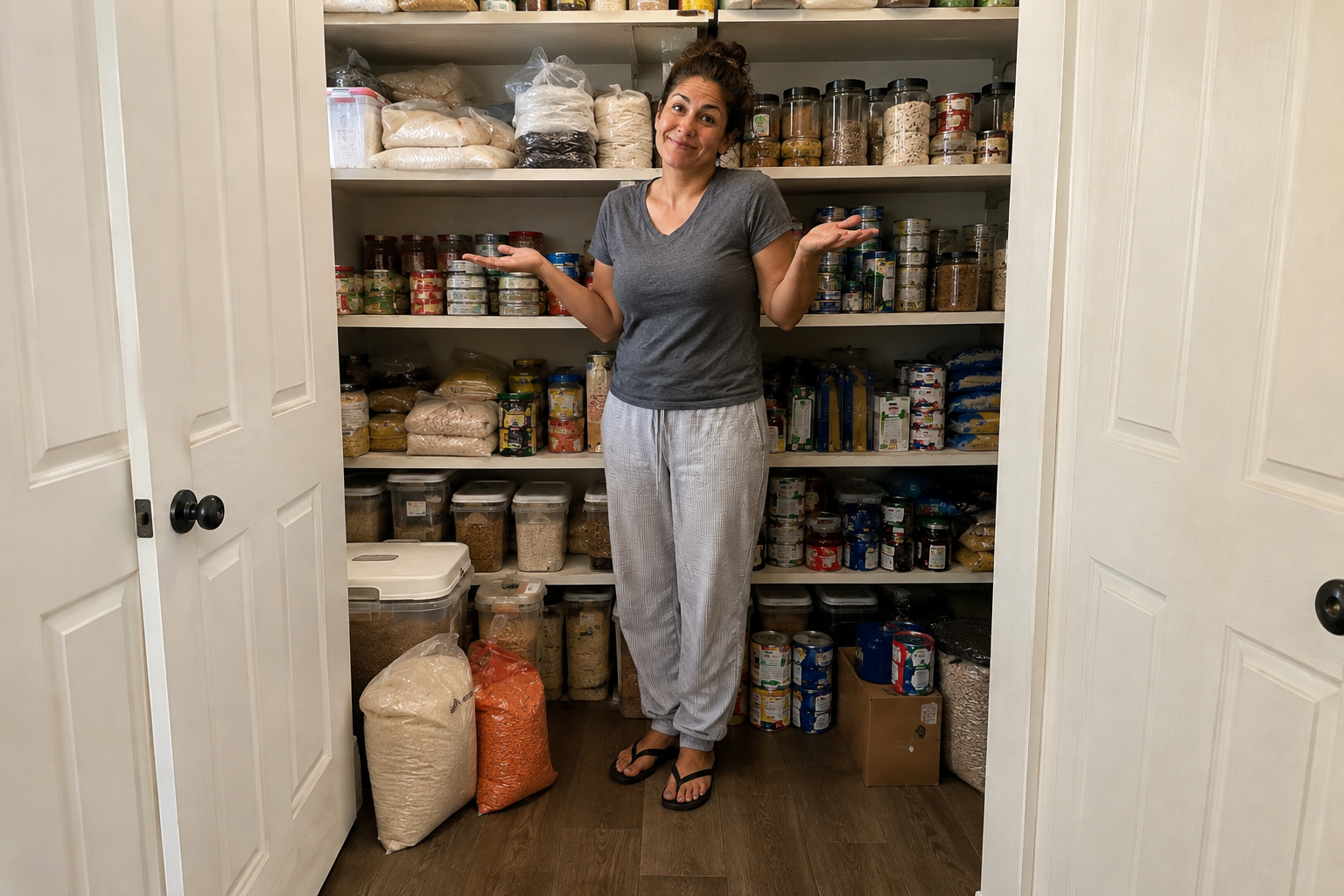
Bulk shopping solves one problem and creates another. Knowing how to store bulk groceries is the difference between a pantry that works and one that quietly turns into a warehouse.
You leave Costco, Sam’s Club, or BJ’s with more food for fewer shopping trips—and sometimes a lower unit price. Then you get home and discover that the package was designed for warehouse economics, not for the shelf you actually use every morning.
A 25-pound bag of rice does not behave like a normal grocery package. A two-bag flour pack does not need the same storage strategy as a single oversized sack. A cereal multipack is different again.
That pattern has become common enough that home builders have given it a name: the “Costco closet.” The National Association of Home Builders has tracked the trend directly, noting the rise of “oversized ‘Costco closets’” as a feature buyers now expect in new homes. Worth being upfront about what that evidence actually shows: when surveys report that a large share of homebuyers — some put it around 85% — say they want a walk-in pantry, that’s a stated preference among people shopping for a new home, not a measurement of how many pantries in America are actually deep enough to handle bulk groceries today. Most households aren’t renovating their kitchen to fit a 25-lb bag of rice. They’re trying to make the pantry they already have work.
The goal is not to make every package disappear into matching containers. The goal is to build a pantry that lets you use bulk quantities without turning the room into a warehouse.
The system in this guide is simple:
Daily Use → Backstock → Refill
Before we get there, though, there is one question that matters even more: should you have bought the bulk package in the first place?
The First Gate: Should You Buy Bulk Groceries at All?
Bulk buying is not automatically cheaper.
In our August 2026 price checks, the pattern depended on the product.
At Walmart, Mahatma white rice showed the classic bulk pattern:
| Package Size | Price per Ounce |
| 2 lb | ~8.3¢ |
| 5 lb | ~6.2¢ |
| 20 lb | ~3.7¢ |
Bigger was clearly cheaper per ounce in that comparison.
Flour told a different story.
| Retailer | Product | Package Size | Price | Price per Pound |
| Costco | Kirkland Organic All-Purpose Flour | Two 10 lb bags (20 lb) | $15.89–$19.89 | ~$0.79–$0.99 |
| Walmart | Gold Medal All-Purpose Flour | 5 lb | $3.97 | ~$0.79 |
That is not a perfect apples-to-apples comparison—Kirkland is organic and Gold Medal is not—but that is exactly the point: do not assume the warehouse package wins. Check the unit price.
Prices vary by location, channel, and promotion, and these are dated observations from August 2026—not permanent retailer rankings. Before buying, compare the current unit price where you shop.
Then ask the second question: can your household realistically use the quantity before quality declines? A lower unit price is not a savings if part of the package ends up stale, rancid, infested, or discarded.
Why Bulk Storage Fails
Most pantry organization advice starts with the container. Bulk storage works better when you start with consumption.
A warehouse package and a daily-use package are not the same thing. Treating them as if they were creates several predictable problems:
- Containers that are too large for comfortable daily use
- Half-empty original bags with nowhere to go
- Duplicate purchases because backstock is invisible
- Food stored in places that are convenient but poorly suited to long-term storage
- Products that stay open longer than their quality window
Warehouse club membership itself is mainstream — an estimated 80% of adults living in U.S. households earning more than $50,000 a year belong to at least one club, according to a Bernstein Research estimate reported in the financial press — so this isn’t a niche problem, and it isn’t really about willpower. It’s about treating a month or two of inventory as if it were this week’s groceries. For context: the EPA
estimated in 2025 that uneaten food costs the average U.S. consumer about $728 annually, or approximately $2,913 when its per-capita estimate is scaled to a household of four. That figure blends food wasted at home and away from home, so it’s a data point about national food waste broadly — not a claim that a disorganized pantry costs any specific family that much, or that bulk buying itself causes it. The more useful, closer-to-home explanation is what the rest of this guide covers: bulk staples fail not because you bought too much, but because nothing in the system decides what happens to the extra once it’s inside the door.
The solution is not a larger collection of matching containers. It is separating inventory from daily use.
The System: Daily Use → Backstock → Refill
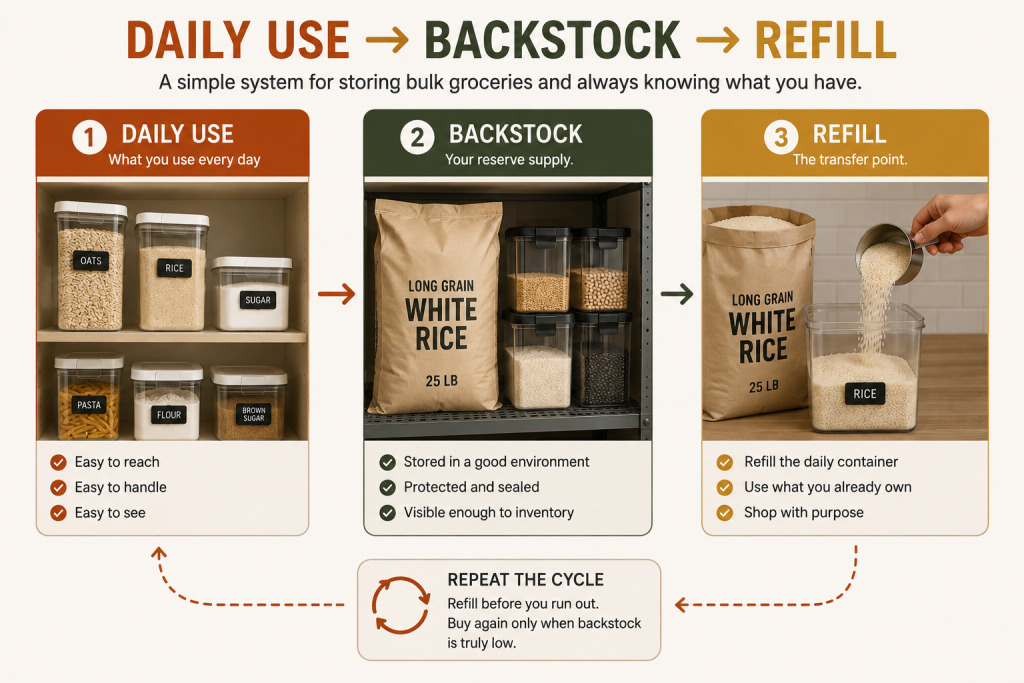
Think of bulk storage as a small inventory system with three zones.
Daily Use. This is the amount your household needs readily accessible for normal cooking, breakfast, snacks, or baking. It should be easy to reach, easy to handle, and easy to see.
Backstock. This is the reserve quantity you purchased but do not need open or in your prime-access space yet. Backstock should stay protected, visible enough to inventory, and stored under appropriate conditions.
Refill. This is the transfer point between the two. When the active quantity gets low, you refill it from backstock instead of automatically adding the item to the shopping list.
That last step matters more than it sounds. If backstock is invisible, the household can own twelve pounds of rice and still buy another bag because the person making the shopping list only sees the nearly empty daily container.
The system therefore has to answer four questions: What is open? What is in reserve? When should the active supply be refilled? When should the product actually be purchased again? This is inventory management scaled down for a normal household.
Start With Consumption, Not Container Size
One of the easiest mistakes in bulk storage is choosing a container based on the size of the package you bought. Reverse the logic.
Your daily-use container should be sized around how much your household actually consumes between refills—not around how much came home from the warehouse club.
Think of it this way: household consumption × desired refill interval = active container capacity. The important word is desired. Your shopping frequency and your refill frequency are not necessarily the same.
U.S. grocery-shopping data illustrates the difference. Flipp’s 2025 State of Grocery Report, based on a survey of roughly 3,000 U.S. households, found that 36% shopped for groceries once a week and 26% twice a week, with 82% shopping at least once a week. A separate survey (GOBankingRates) found that roughly 29% of Costco members shopped there once a month or less.
Those numbers should not be turned into a universal refill schedule. They simply demonstrate why buying frequency and container-refill frequency need to be treated as two different variables. A household might make a warehouse-club trip once a month while refilling its rice container several times during that same period. That is why the active container should solve the daily-use problem, while the remaining quantity belongs to backstock.
Not All Bulk Packages Need the Same Strategy
Before deciding whether to keep, decant, or split a bulk purchase, identify what kind of package you actually bought. There are two useful categories.
Type A — Monolithic Bulk. This is one large quantity in a single package: a 25-pound bag of rice, for example. The package itself may be economical, but it creates an immediate storage problem. Opening the entire bag exposes the full quantity, while trying to fit all of it into a daily-use container can create a container that is unnecessarily large and difficult to handle.
Type B — Factory-Split Bulk. This is a large purchase already divided by the manufacturer into smaller sealed units. A two-bag flour pack, or Costco’s 40.7-oz Cheerios multipack (divided by the manufacturer into two 20.35-oz units), behaves differently from a single 25-pound sack. You may be able to open one unit for daily use while leaving the others factory-sealed as backstock.
That distinction matters because bulk does not automatically mean decant everything. Sometimes the manufacturer has already done the splitting for you. Identifying Type A or Type B is the first step before choosing between KEEP, DECANT, and SPLIT.
Choose Your Strategy: KEEP, DECANT, or SPLIT
KEEP. Keep the product in its original packaging when the package is already practical for daily use, protects the food adequately, and fits comfortably in the space where you use it. KEEP is especially useful with Type B packages — if the manufacturer has already divided the purchase into smaller sealed units, there may be little reason to open everything at once. The question is simple: does opening or transferring this product actually solve a problem? If the answer is no, keep it.
DECANT. Decant when transferring the product into another container makes daily use easier or provides more appropriate protection after the original package has been opened. The container should be sized for the amount you actually use between refills — not automatically for the entire warehouse package. This is where the Daily Use → Backstock → Refill system matters: the active container serves daily use, and the remaining quantity stays protected as backstock.
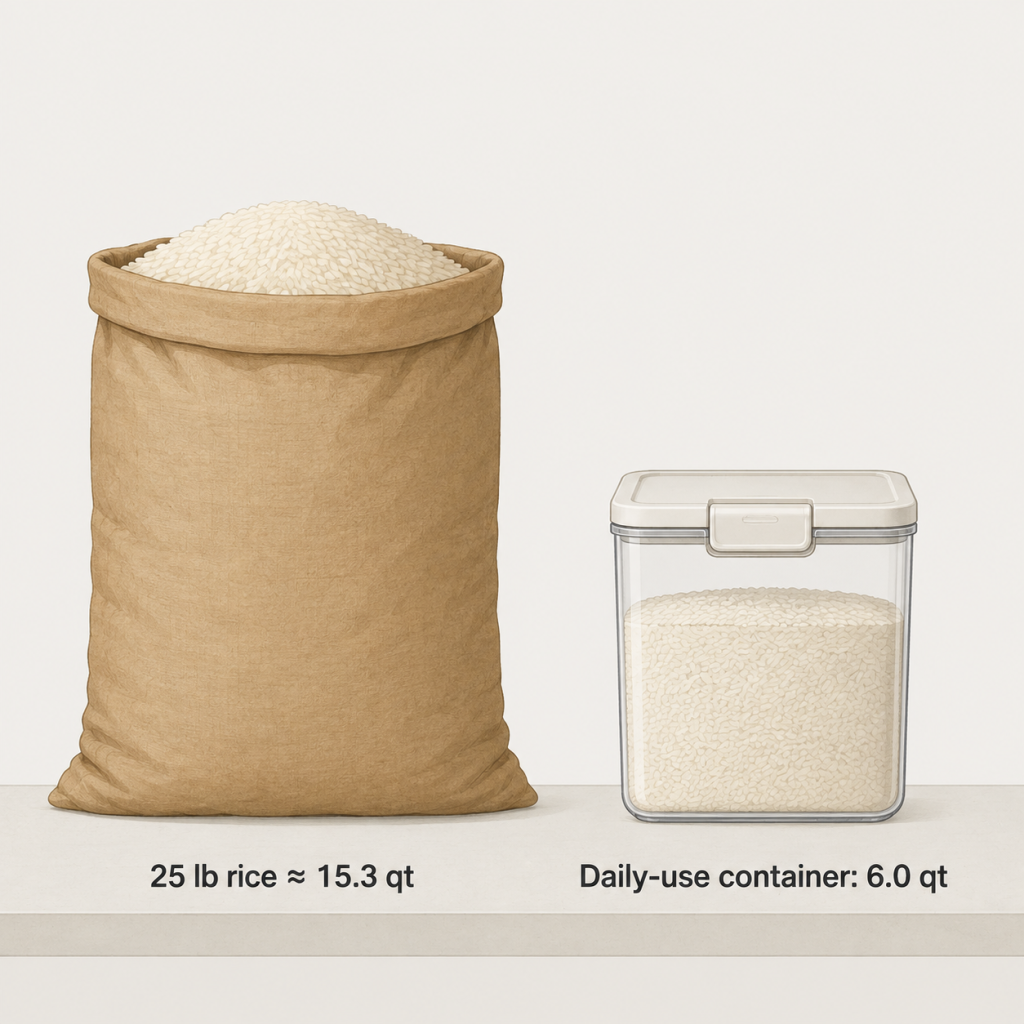
SPLIT. Split when one large package creates two different storage jobs. A 25-pound bag of rice is a good example. Based on the weight-to-volume conversion used in our research, 25 pounds of uncooked rice is approximately 15.3 quarts. For comparison, the largest verified size in the OXO POP line, the Big Square Tall, holds 6.0 quarts — which OXO itself markets for everyday household staples, not bulk storage. That means the rice purchase represents roughly 2.5 times that container’s capacity. That’s not a flaw in the container, and it doesn’t mean the answer is to buy three giant containers — it means the warehouse package and the daily-use quantity are solving different problems. Put a manageable amount into the active container, protect the remaining rice as backstock, and refill the active container as needed. That is SPLIT.
The rule. Do not choose KEEP, DECANT, or SPLIT because of how organized the pantry will look. Choose based on how the product arrives, how much your household uses, how often you want to refill, what protection the food needs, and where the reserve quantity can be stored safely. The best storage system is the one that makes the food easy to use, easy to inventory, and difficult to waste.
Choose the Right Container for the Job
Not every dry food needs the same kind of container. Once you have decided what belongs in daily use and what belongs in backstock, the next step is choosing storage based on the job the container actually needs to perform.
For daily-use storage, prioritize four things:
Airtight protection. Rice, flour, oats, cereal, pasta, and baking ingredients benefit from a container that limits exposure to moisture and pests after the original package has been opened. University of Maryland Extension recommends tightly closed glass, rigid plastic, or metal containers for these dry staples — pressure-sealed glass jars with rubber gaskets offer particularly strong protection — and advises against relying on plastic bags or cardboard boxes, since some pantry pests can chew through them.
Easy handling. A container can technically hold the right amount and still be a poor choice if it is awkward to lift, pour from, scoop from, or return to the shelf. This matters especially with frequently used staples. The best daily-use container is not necessarily the largest one that fits your pantry — it is the one you can comfortably use every day.
Visibility. Clear containers make it easier to see how much product remains. That visibility has a practical purpose: it helps you distinguish between a container that needs to be refilled from backstock and a household supply that actually needs to be purchased again.
Efficient use of space. Container shape matters. Square and rectangular containers can often use shelf depth and width more efficiently than round containers, particularly when several are stored side by side. But maximizing shelf density should not come at the expense of usability — a perfectly packed shelf that makes everyday ingredients difficult to reach is not an efficient system.
Backstock has a different job. It does not need to be displayed like the food you use every day. It needs to remain protected, identifiable, and easy to inventory until it is time to refill the active container. Depending on the product, that may mean keeping unopened packages in their original packaging, placing opened reserve quantities in appropriately sealed food-storage containers, or dividing a very large purchase into smaller protected quantities. Daily-use storage is optimized for access; backstock storage is optimized for protection and inventory. Trying to make one container perform both jobs is one of the reasons bulk-storage systems become unnecessarily large.
Storage Conditions Matter More Than the Container
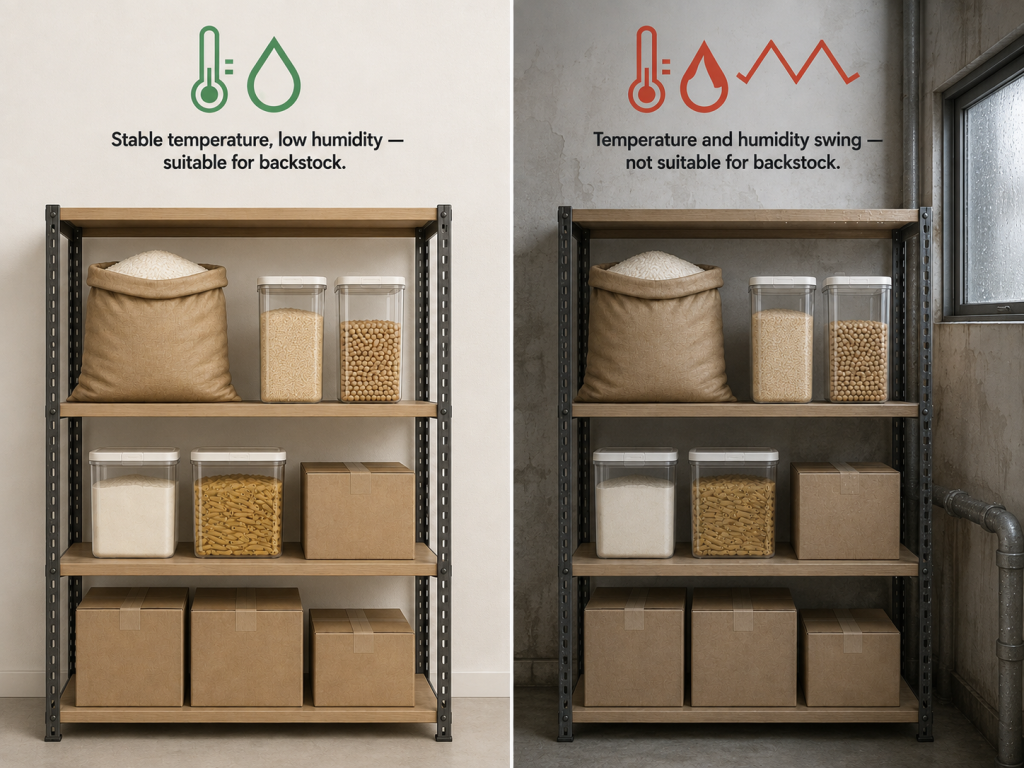
An airtight container cannot fix a bad storage environment. Where you keep bulk food matters just as much as what you keep it in. University of Minnesota Extension frames the underlying rule well: choose backstock space based on storage conditions, not just empty square footage.
Keep food cool. University Extension shelf-life guidance for these staples generally assumes a stable, moderate-temperature environment — avoid storing long-term backstock next to ovens, heating equipment, or other consistently warm areas.
Keep food dry. Moisture is one of the biggest enemies of dry storage. A basement, garage, or utility area may offer plenty of space, but that does not automatically make it suitable for food. If the environment is damp or subject to condensation, choose another location.
Protect it from pests. Large bags and thin packaging can be vulnerable once brought into the home. If the original package does not provide adequate protection, move the food into one of the sealed container types described above.
Keep it off questionable surfaces. Backstock should be stored in a clean, dry location where packages are protected from spills, moisture, household chemicals, and contamination.
Watch temperature swings. A garage or basement may be unsuitable when humidity or temperature fluctuates substantially — the issue isn’t the name of the room, it’s whether the conditions are appropriate for the food. A climate-stable garage shelf can work fine; an attic that swings 40 degrees between seasons usually won’t. That makes non-climate-controlled spaces convenient for paper goods and household supplies, but not automatically ideal for long-term food storage.
Bulk food also has a clock, and it doesn’t move at the same speed for every product. There’s no single honest number for “how long will this last,” because shelf life depends on the product, whether it’s opened, packaging, temperature, and humidity. University Extension sources illustrate exactly how much that range can move:
| Staple | Virginia Tech Extension | Texas A&M AgriLife | Utah State University |
|---|---|---|---|
| White rice | Up to 2 years unopened / 1 year opened | — | 2 years (at ~70°F, unopened/opened not distinguished) |
| All-purpose flour | 6–12 months unopened / 6–8 months opened | 3 months (cool, dry pantry; up to 6 months if frozen — opened/unopened not distinguished) | 1 year (same 70°F assumption) |
| Ready-to-eat cereal | 6–12 months unopened / 2–3 months opened | — | Cold cereal: 1 year / Hot cereal: 6 months |
| Cooking oils | 6–12 months / 3–5 months refrigerated after opening | — | — |
| Nuts | 2–4 weeks at room temp / 9–12 months refrigerated / 24 months frozen | — | — |
Three university sources give three different numbers for flour alone. Each comes from a different measurement condition — TAMU assumes cool, dry pantry storage without distinguishing opened vs. unopened; VT and USU do distinguish opened/unopened and temperature — so treat them as three separate, non-interchangeable data points rather than competing answers to the same question. Use the range for the specific food, note the condition it assumes, and let that — not the package size — guide how much you buy at once.
The lesson across all of this is simple: don’t choose a backstock location because it has empty space. Choose it because it provides suitable storage conditions. A smaller amount of properly stored inventory is more useful than a huge reserve slowly deteriorating in the wrong environment.
Make Backstock Visible
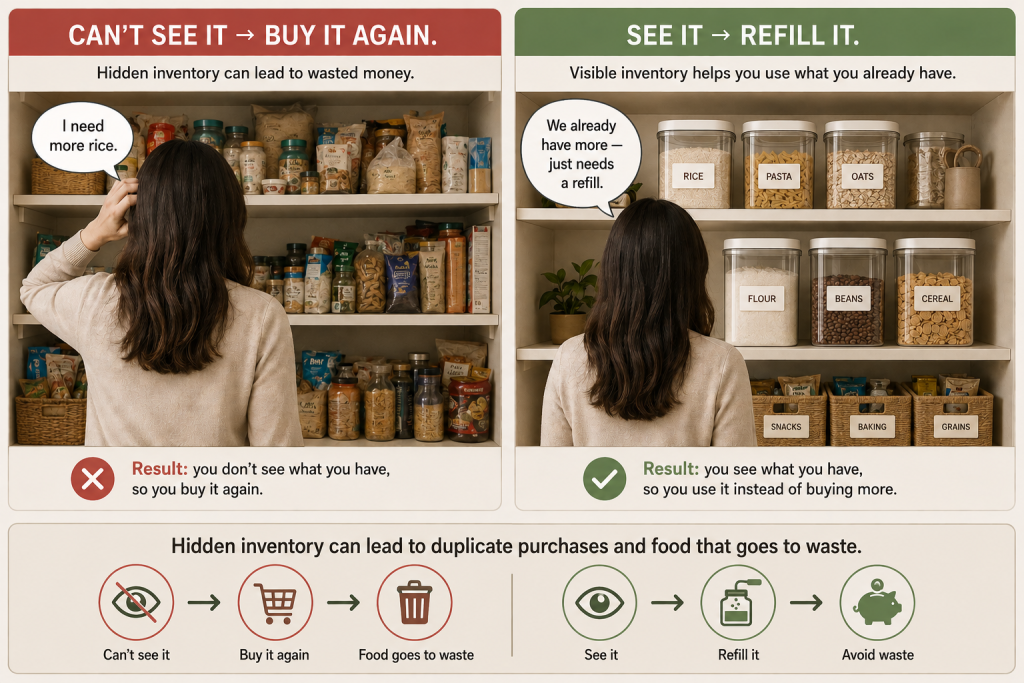
Bulk storage only works if you know what you already have. A reserve supply hidden behind other packages, buried in a garage shelf, or forgotten in a storage bin can easily become invisible inventory — and invisible inventory creates two problems: you may buy something you already have, or you may discover a product only after it has sat in storage far longer than intended.
The solution isn’t necessarily to put every package on display. It’s to make the backstock easy to inventory.
Create one home for each category. Keep similar reserve items together. Rice should have a predictable backstock location, and the same applies to pasta, flour, cereal, and other products your household regularly buys in bulk. When the location is consistent, checking inventory becomes much easier — you don’t have to search the pantry, garage, basement, and kitchen cabinets to determine whether you already have another package.
Make the oldest product the easiest to use next. When new inventory arrives, avoid automatically placing it in front of what’s already there. Move the older product forward and place the newer purchase behind it. This simple rotation helps prevent an older package from remaining forgotten while newer purchases are repeatedly opened first. For products with printed dates, keep those dates visible whenever practical.
The objective is simple: know what you have, know where it is, and know what should be used next.
Know When to Refill—and When to Buy Again
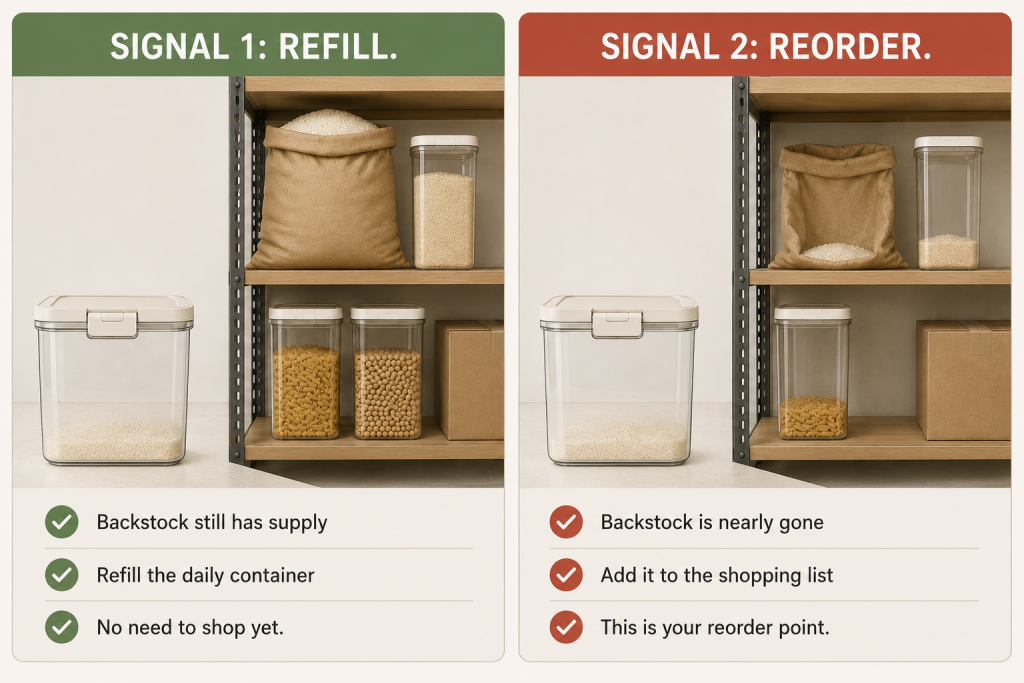
A nearly empty container does not necessarily mean you’re running out of food. It may simply mean it’s time to refill — and that distinction is one of the most important parts of a working bulk-storage system.
When the daily-use container begins to run low, check the backstock first. If reserve inventory is available, refill the active container. Don’t add the product to the shopping list yet — the purchasing decision comes later.
Set a reorder point. Instead of waiting until every package is gone, or buying more whenever the active container looks empty, choose a simple point at which it makes sense to purchase again. For a product your household uses regularly, ask: how quickly do we use it, how often do we normally shop for it, how long would the remaining supply reasonably last, and how much reserve do we actually need before the next shopping trip? The objective isn’t the largest possible stockpile — it’s enough inventory to comfortably bridge the time between purchases.
Refill and reorder are two different signals. If your daily-use rice container is almost empty but you still have two unopened bags in backstock, the correct action is to refill. If the container runs low again several weeks later and only part of the final reserve bag remains, that may be your reorder point. The container in the kitchen didn’t determine when you purchased more — your total household inventory did.
Avoid the “just in case” loop. Bulk buying makes overbuying surprisingly easy: you see a good price, you can’t remember exactly how much you have at home, so you buy another package “just in case.” Repeated often enough, those decisions create more inventory than the household can comfortably store or use. A visible backstock system changes the question from “should I grab another one?” to “have we reached our reorder point?” — turning purchasing into a deliberate decision instead of a reaction.
Putting It All Together
The Costco Pantry Decision Box
- BUY? — Is the current unit price actually better for a comparable product, and can your household realistically use and store this much?
- USE — How fast do you consume it?
- DAILY USE — How much do you want immediately accessible?
- KEEP / DECANT / SPLIT — Does the original package work as-is, or does it need to be transferred or divided?
- BACKSTOCK — Can the remainder live somewhere cool, dry, stable, and easy to inventory?
- REFILL — What tells you it’s time to move reserve inventory forward?
- CHECK BEFORE BUYING AGAIN — Have you reached your reorder point, or is there already another package hiding in backstock?
If the system fails at step 5, the answer at step 1 may need to be no — regardless of the unit price.
THE BOTTOM LINE
Don’t size your daily pantry around what Costco sells you. Size it around what your household actually uses between refills.
The package size was decided by a factory. How much of it deserves a spot on your counter is a decision only your kitchen can make. Once Daily Use, Backstock, and Refill are separated, bulk shopping stops being something you’re constantly fighting to fit into your kitchen — it becomes inventory you’re actually managing. Because the best Costco pantry isn’t the one that holds the most food. It’s the one that lets your household use what it buys.
A note on prices in this article: specific prices and unit-price examples above reflect prices observed in August 2026 and are provided as illustrations of a method, not as current facts. Prices vary by retailer, location, promotion, and date — always check the current unit price before deciding whether a larger package is actually the better deal.
Public Sources
- Costco.com, CostcoBusinessDelivery.com, Walmart.com — package sizes and current listings.
- USDA FoodData Central; King Arthur Baking (Ingredient Weight Chart) — weight-to-volume conversions.
- OXO.com — container capacities.
- Virginia Tech Cooperative Extension (publication 348-960), Texas A&M AgriLife Extension, Utah State University Extension — storage and shelf-life guidance.
- University of Maryland Extension, University of Minnesota Extension — pest-prevention guidance.
- Flipp State of Grocery Report (2025), GOBankingRates — shopping and refill-frequency data.
- Bernstein Research (as reported in financial press coverage) — household warehouse-club membership estimate.
- National Association of Home Builders (NAHB) — cultural/market trend context.
- U.S. Environmental Protection Agency — “Estimating the Cost of Food Waste to American Consumers” (2025), food-waste cost context.

Comments
One response to “The Costco Pantry Problem: How to Store Bulk Groceries Without Turning Your Pantry Into a Warehouse”
[…] matters especially if you buy groceries in bulk. As covered in The Costco Pantry Problem, daily-use inventory and backstock do different jobs: daily-use should prioritize access; backstock […]