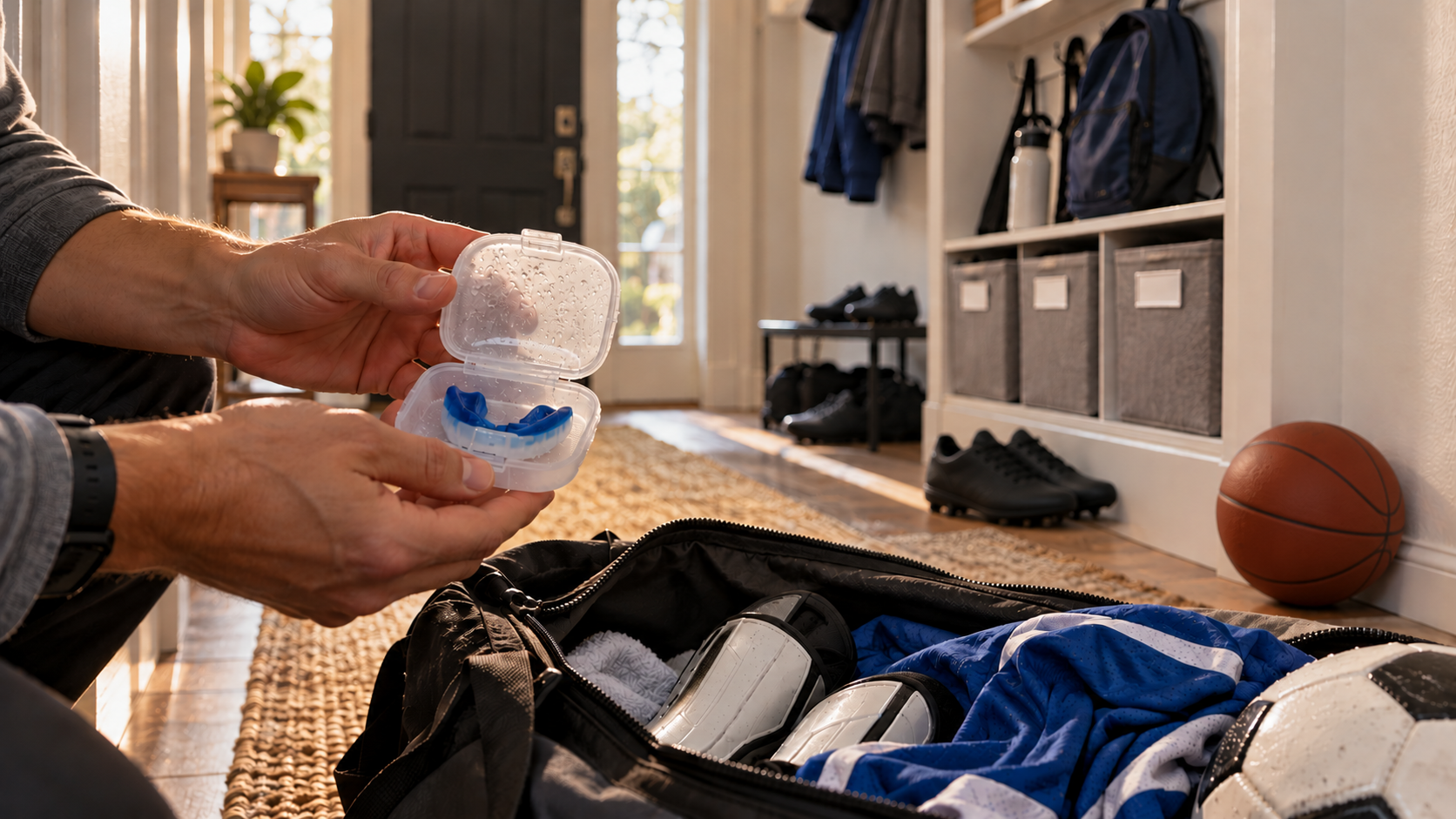
The soccer cleats are by the front door. A basketball has found its way into the hallway. Somewhere in the garage, a hockey bag that should have been emptied two days ago is still zipped shut.
Then it’s 7:40 on Saturday morning, the game starts at 8:30, and someone asks the question that turns an ordinary morning into a search party: Where’s the mouthguard?
It turns up at the bottom of the soccer bag, still damp from Thursday’s practice, zipped inside a closed case, in a bag that spent two days in the trunk.
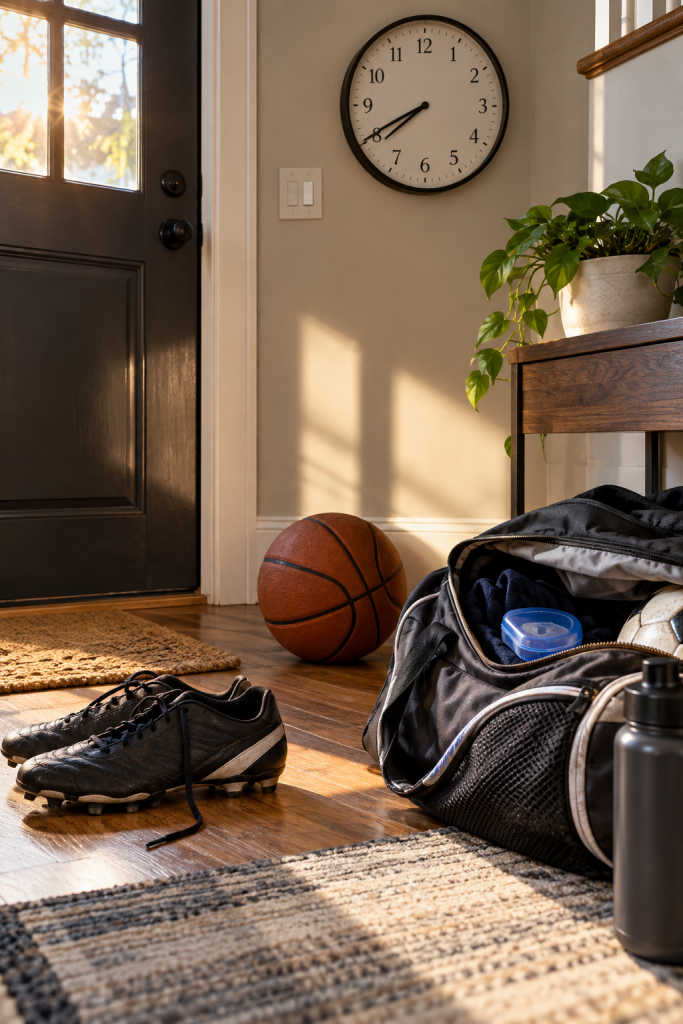
This family is hypothetical, but the problem is familiar. They have hooks, bins, and plenty of labels. What they don’t have is a routine that starts in the right place.
Most storage advice starts with where will everything fit? The better first question is this: what does each piece of equipment need to reach the next practice in good condition?
A uniform, a hockey pad, a basketball, and a bike helmet can come home in the same car and need four different things before the next game. Buying another rack won’t solve a drying problem, and a bigger bin won’t make a hot trunk suitable for a helmet.
So start with the gear. Then design the space around it.
Four Jobs Before Anything Goes on a Shelf
Instead of sorting gear by sport, sort it by what needs to happen next. Most of the manufacturer and health-agency guidance we reviewed falls into four jobs:
- Dry what gets wet, using the right method for each item.
- Keep heat-sensitive gear away from heat.
- Know what’s shared and what belongs to one person.
- Review gear before it goes back into use or on to someone else.
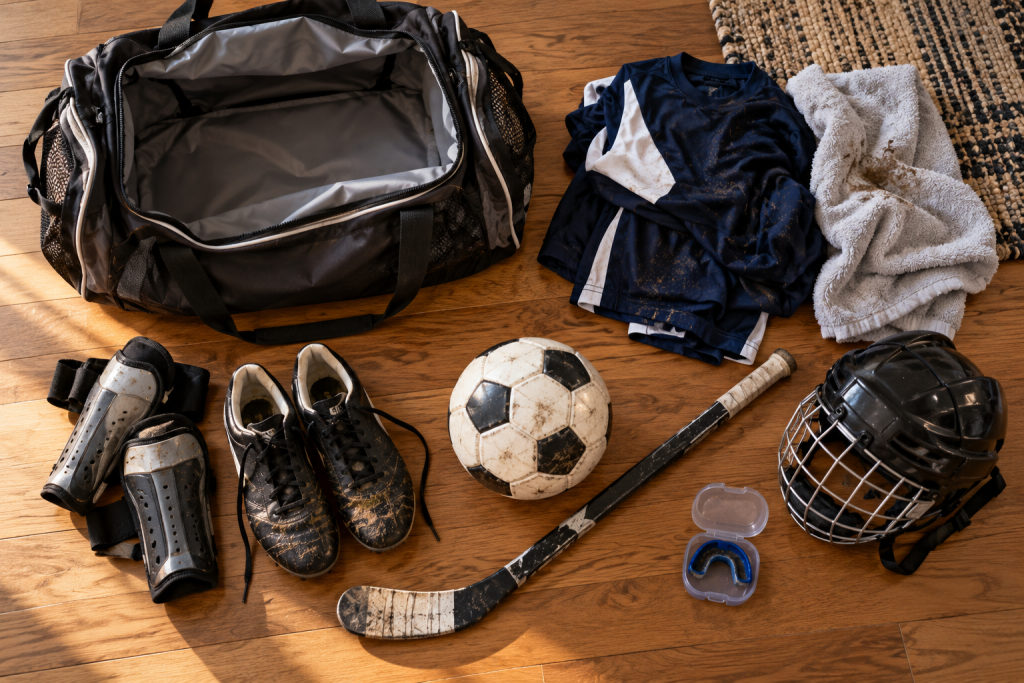
Hooks, bins, and shelves are how you do those jobs. They aren’t the jobs themselves.
Job 1: One bag, two drying destinations
Empty the bag when you get home. A sports bag is great for getting gear to practice, but it shouldn’t become the gear’s home for the rest of the week.
Here’s the part that surprises most families: items coming out of the same bag can need opposite drying methods.
For clothing, the CDC’s MRSA-prevention guidance for athletes is specific. It recommends that athletes “wash and completely dry (in a dryer, not through air/hang drying)” their uniform, towels, and clothing after each use, and follow the clothing label’s instructions.
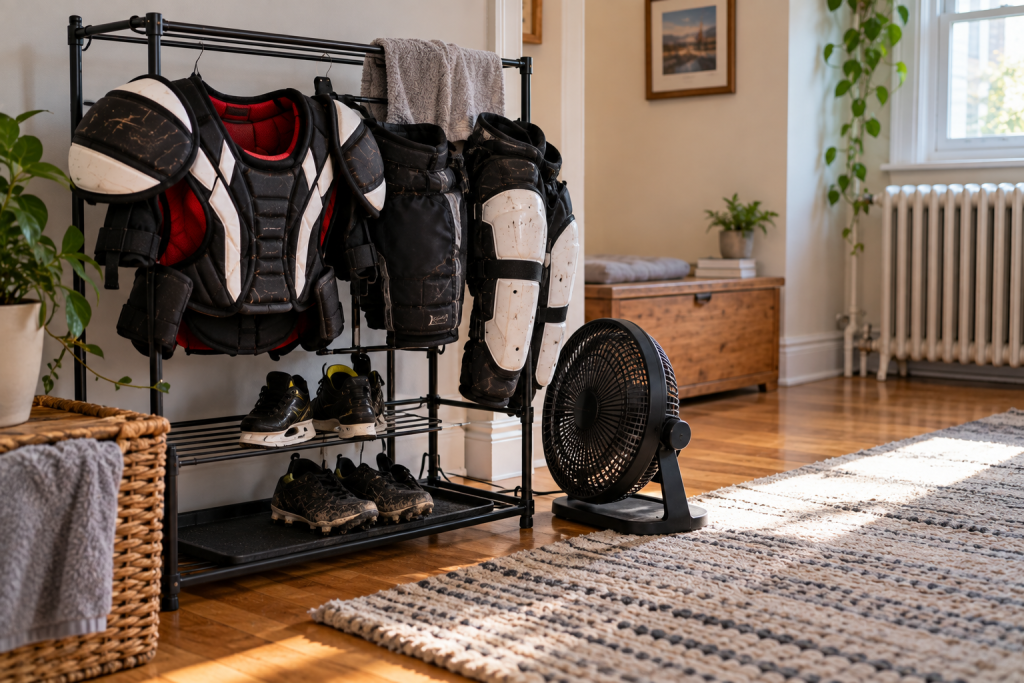
Protective gear is a different story. Brown Hockey, which makes goalie equipment, tells players to hang gear to dry and says airflow is the best tool for the job; a simple oscillating fan is enough. It also rules out a clothes dryer or a heater, warning that “heat will compromise the protective components.” Vaughn, another goalie-gear maker, likewise calls for air-drying at room temperature, with no heat.
Cleats follow the same logic. adidas advises air-drying football boots indoors and warns against a hair dryer, a tumble dryer, or direct sunlight. Only once they’re completely dry do they go into a breathable bag.
In other words, the uniform may belong in the dryer while the pads and cleats next to it require air-drying.
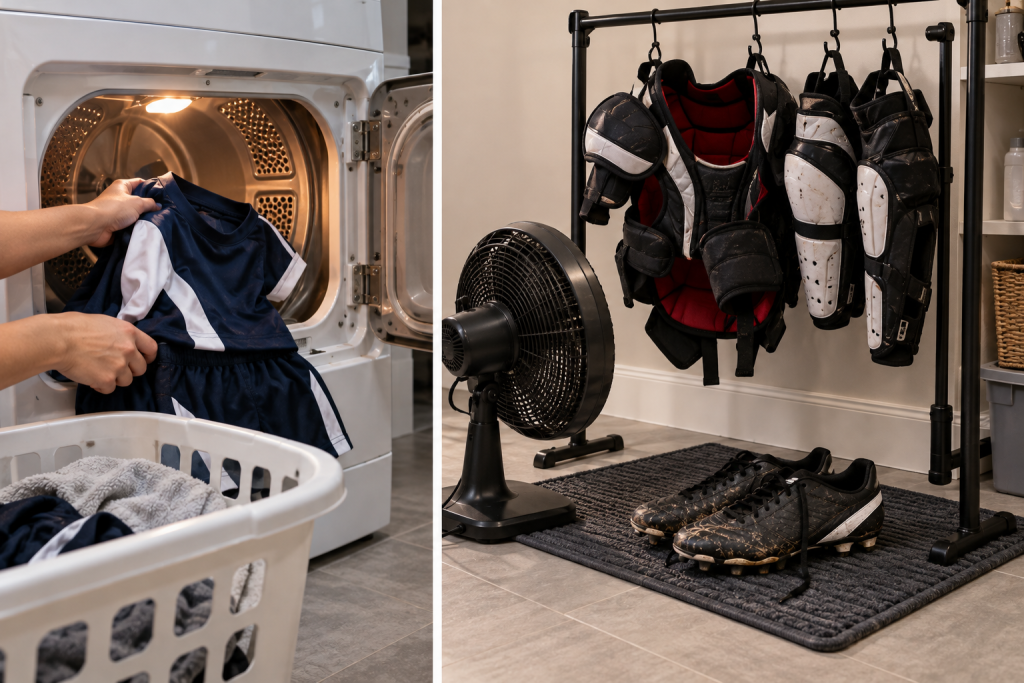
One wrinkle stays open. The CDC’s MRSA-prevention guidance recommends machine-drying clothing and following its care label. If the label specifies hang-drying, those instructions point in different directions; the CDC guidance reviewed here does not explain how to resolve that conflict.
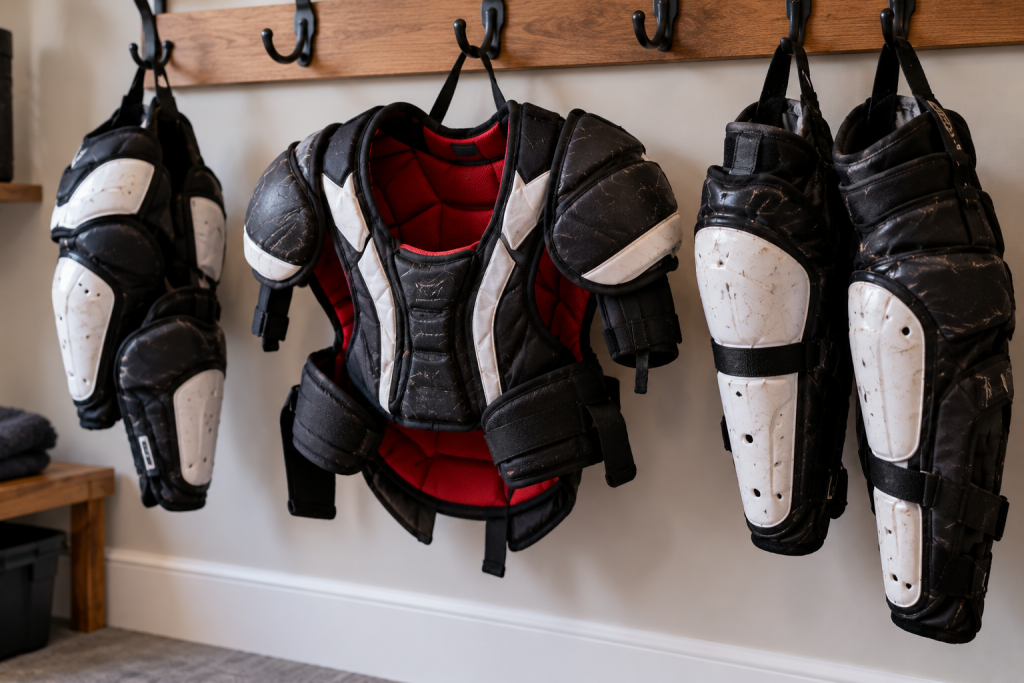
Clean, dry gear needs a home, but wet protective gear needs somewhere to dry first. A hook can be useful for that, but only if the gear hangs open, with room for air to circulate and away from heat. Otherwise, a closed cabinet full of damp pads may look organized while leaving the real job unfinished.
The mouthguard needs its own routine
A mouthguard takes up almost no space. Yet its care is more complicated than that of much bigger gear.
In a 2025 study in BMC Oral Health, researchers examined mouthguards and storage cases used by ten 11- and 12-year-old Australian football players. They identified 38 bacterial isolates from 13 genera. The used mouthguards had much rougher surfaces than new ones, and some bacteria recovered from the cases were strong biofilm formers.
A separate part of the study tested pieces of mouthguard material in the lab. Artificially roughened surfaces picked up more than eight times as much of one test bacterium as new surfaces within the first hour. That does not mean used mouthguards carry eight times more bacteria in real life, and the study didn’t measure infections in children.
The researchers also compared cleaning methods in the lab. Brushing with toothpaste removed about 98% of the test bacteria, while rinsing with water removed about 60–70%, depending on water temperature. However, they didn’t test whether repeated brushing wears down the surface, and they flagged that as an open question. It matters, because rougher surfaces were where bacteria built up.
At a Glance: What the Mouthguard Study Showed, and What It Didn’t
| Part of the study | What it found | What it doesn’t establish |
|---|---|---|
| Used mouthguards and cases from ten 11- and 12-year-old players | 38 bacterial isolates from 13 genera; used mouthguards had much rougher surfaces than new ones | The study didn’t measure infections in children |
| Lab test on mouthguard material | Artificially roughened surfaces picked up more than eight times as much of one test bacterium as new surfaces within the first hour | It does not mean used mouthguards carry eight times more bacteria in real life |
| Lab cleaning comparison | Brushing with toothpaste removed about 98% of the test bacteria; rinsing with water removed about 60–70%, depending on water temperature | Whether repeated brushing wears down the surface wasn’t tested; the researchers flagged it as an open question |
Storage guidance is clearer. Shock Doctor, a mouthguard maker, says to let the mouthguard air-dry completely in a cool, shaded place and only then put it in a ventilated case, never storing it wet or in a sealed container. The American Dental Association recommends “a sturdy container that has vents so it can dry and keep bacteria from growing,” and warns against leaving a mouthguard in the sun or in hot water. For cleaning, the ADA lists rinsing or brushing with a toothbrush and toothpaste as options, while Shock Doctor recommends cold water and mild soap.
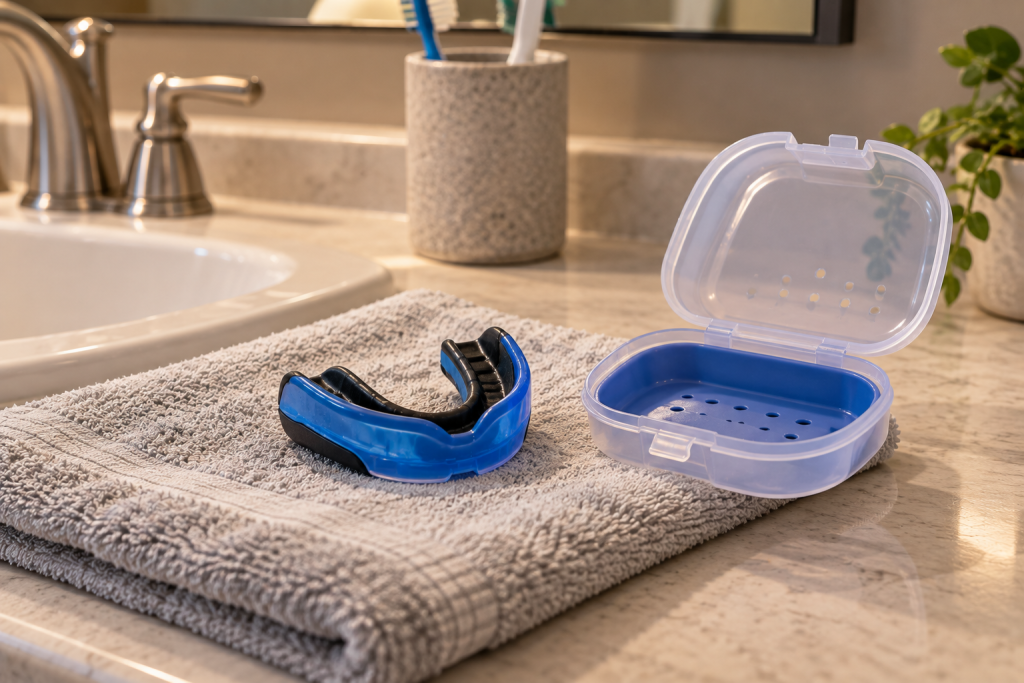
So follow the instructions for your child’s specific mouthguard. We didn’t find a universal cleaning procedure for the case itself, so check any instructions that came with it, too. A case is there to protect a mouthguard that’s been cared for, not to hide a wet one at the bottom of a bag.
Job 2: The car isn’t an equipment closet
Leaving everything packed in the car can feel efficient. There’s no morning scramble, and nobody has to haul bags upstairs.
The catch is how quickly a parked car heats up. In a study published in Pediatrics, researchers measured the air inside a parked dark sedan on sunny days with outside temperatures between 72°F and 96°F. On average, the interior rose about 40°F within an hour, and about 80% of that rise came in the first 30 minutes. Even on the coolest day in the study, the inside reached 117°F. Cracking the windows made no meaningful difference.
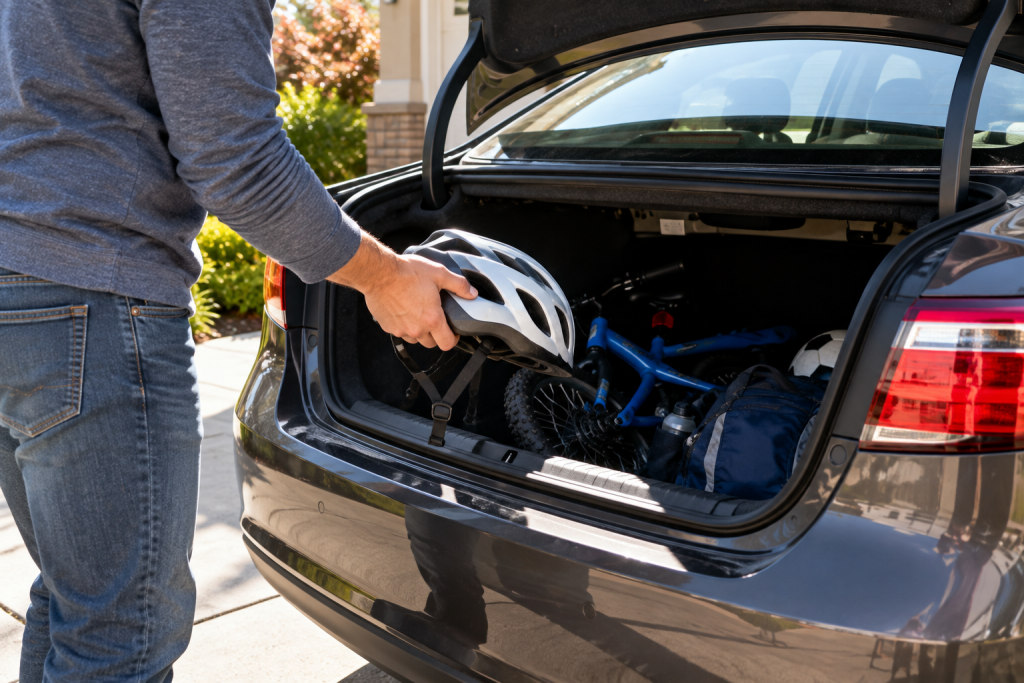
That study measured air, not equipment. Even so, helmet makers and safety experts point the same way.
Bell’s bike-helmet owner’s manual is direct: “Never leave your helmet in your car or anywhere near direct or indirect heat.” Bell also says heat damage isn’t covered by its warranty. That’s one manufacturer’s guidance for its own helmets, so check the manual for your child’s specific model.
Bell isn’t alone, though. A U.S. Consumer Product Safety Commission engineer, quoted by Consumer Reports, warned that the temperature inside a trunk “can prevent a helmet from adequately absorbing impact.” Children’s Hospital of The King’s Daughters is just as plain, advising families not to store a bike helmet in a car.
Other gear has its own limits. Spalding advises against storing basketballs outdoors or in a vehicle, warning it can lead to deflation and a shorter life. Likewise, Rawlings and Easton recommend storing bats, batting helmets, gloves, and uniforms in a cool, dry area, away from direct sunlight. Their warranty also excludes bats used in temperatures under 60°F, which is a limit on use, not a storage temperature.
There’s no single temperature limit for all sports equipment. Put simply, though, the trunk is for getting gear to practice, not for keeping it between practices.
What about football helmets?
This is the one case we couldn’t close. We checked three specific documents for heat or storage guidance: NOCSAE’s recertification requirements and recommendations, NAERA’s 2025 helmet reconditioning guidance, and the fitting guide for Riddell’s Victor youth helmet. In none of them did we find heat or storage conditions addressed.
That’s a narrow finding. Other manuals, from Riddell or other makers, may cover it, so check the documents that came with your child’s helmet. It also doesn’t mean a hot trunk is fine, or that bike-helmet guidance automatically applies. We simply won’t fill that gap with a guess.
Job 3: Know what’s shared
Some things belong to one person. The CDC’s guidance for athletes says not to share items that touch the skin, including towels, washcloths, razors, and clothing, uniforms included. A mouthguard, fitted to one child’s mouth, clearly belongs in that personal category too.
Other gear really is shared. For athletic facilities, the CDC recommends cleaning shared equipment after each use and letting it dry before the next use. It also says to follow manufacturers’ cleaning instructions, so the cleaner doesn’t harm the item.
That guidance was written for gyms and teams, not homes. Still, applying the same habit at home is a reasonable step, and it’s our suggestion: gear that passes between siblings, or between your child and teammates, gets cleaned and dried the way its manufacturer recommends before the next person uses it.
There’s a reason to think beyond visible dirt. Researchers at the University of California, Irvine, simulated play with basketballs and volleyballs and found that Staphylococcus aureus could move between hands, balls, and the floor. They reported that the bacteria could still survive on a sports ball after 72 hours in storeroom conditions.
That was a gym storeroom, not a family closet, and the research doesn’t show that balls stored at home cause infections. What it does show is that a shared ball isn’t automatically clean just because it’s been sitting on a shelf since the last game.
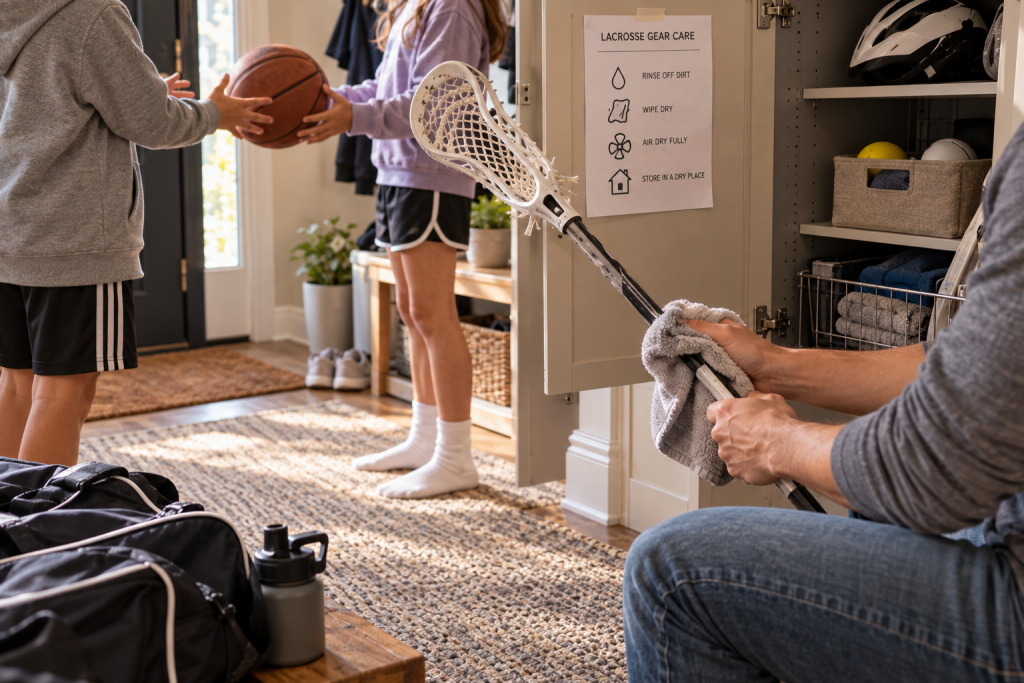
One practical habit helps here: keep each manufacturer’s cleaning directions where the family can find them. That’s more useful than buying a single cleaner and assuming it suits leather gloves, helmet components, balls, and mouthguards alike.
Job 4: Review before storing or passing it on
Most storage guides tell you to donate what your kids have outgrown. That’s good advice for jerseys. Protective gear, however, deserves its own checkpoint.
Take bike helmets. According to the CPSC engineer quoted by Consumer Reports, a helmet liner compresses on impact and loses the ability to absorb additional energy, and that damage can be hard to see. Bell recommends replacing its helmets after a severe blow, even if they look undamaged. Age matters too: Bell also advises replacing them every three to five years from the date of purchase. Other makers may set different rules and timelines, so check the manual for your child’s helmet.
Football helmets have their own maintenance timeline. NOCSAE strongly recommends recertification, although its standards don’t require it, and the interval depends on the manufacturer. Riddell’s youth-helmet guide calls for reconditioning at least every two years by a NOCSAE-licensed reconditioner. NAERA, for its part, recommends that helmets be reconditioned and recertified annually unless the manufacturer says otherwise. NOCSAE also notes that NAERA sets a 10-year “useful life” rule: a helmet more than 10 years past its initial certification isn’t eligible for recertification. That applies to helmets parents buy, not just the ones a league hands out.
At a Glance: Football Helmet Reconditioning, Source by Source
| Source | What it says |
|---|---|
| NOCSAE | Strongly recommends recertification, although its standards don’t require it; the interval depends on the manufacturer |
| Riddell (Victor youth-helmet guide) | Reconditioning at least every two years by a NOCSAE-licensed reconditioner |
| NAERA | Reconditioning and recertification annually unless the manufacturer says otherwise |
| NAERA’s 10-year “useful life” rule (as noted by NOCSAE) | A helmet more than 10 years past its initial certification isn’t eligible for recertification |
| USA Football | Applies to helmets parents buy, not just the ones a league hands out |
Mouthguards age out too. The ADA advises replacing one right away if it’s worn, damaged, or no longer fits, and notes that children may need replacements more often because their mouths are still changing.
Surface wear matters for cleaning as well. For athletic facilities, the CDC advises repairing or discarding equipment whose damaged surfaces can’t be cleaned adequately. That’s facility guidance, not a household rule, but it’s a useful reason to look closely at worn gear before it goes back into circulation.
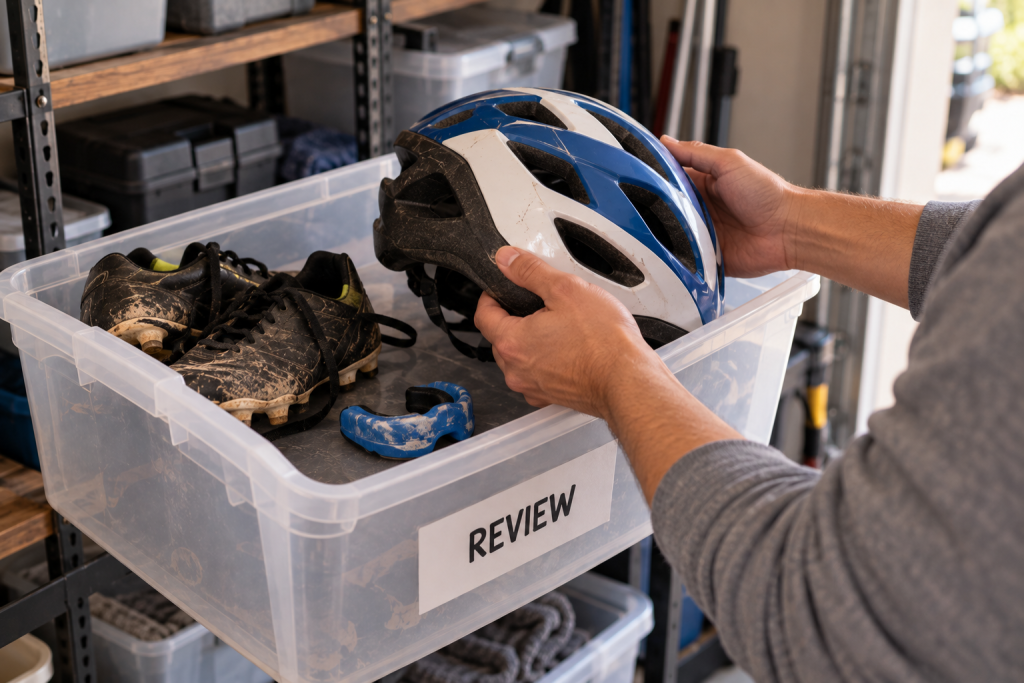
None of this means a helmet can never be passed along. It means a helmet shouldn’t move to a younger sibling, or into a donation bag, until you’ve checked its crash history, age, fit, condition, and any reconditioning or certification requirements. A clearly marked review bin keeps questionable gear from slipping back into the game-day bag in the meantime.
At a Glance: What Each Piece of Gear Needs
| Equipment | Before storing | Storage condition | Source |
|---|---|---|---|
| Uniforms, towels, clothing | Wash and dry completely after each use; follow the label | Keep clean and dirty items apart | CDC (athletes) |
| Hockey protective gear | Hang to dry with airflow; no clothes dryer or heater | Room to separate items so air can move | Brown Hockey, Vaughn |
| Cleats | Air-dry indoors; no hair dryer, tumble dryer, or direct sunlight | Breathable bag once completely dry | adidas |
| Mouthguard | Clean per the manufacturer; let dry completely before casing it (Shock Doctor) | Sturdy, vented case that allows drying (ADA, Shock Doctor); no sun or hot water (ADA) | ADA, Shock Doctor |
| Bike helmet | Mild soap and water; replace after a severe blow (Bell) | Not in the car; away from heat | Bell, CPSC (via Consumer Reports), CHKD |
| Bats, gloves, batting helmets | Follow the care instructions | Cool, dry area, away from direct sunlight; glove with a ball in the pocket | Rawlings/Easton |
| Basketball | Check inflation (7–9 psi) | Temperature-regulated room; not outdoors or in a vehicle | Spalding |
| Football helmet | Check labels and reconditioning status | Follow the model’s instructions (no heat-storage guidance found in the three documents reviewed) | Riddell, NAERA, NOCSAE |
| Shared equipment | Clean after each use per the manufacturer; let dry | — | CDC guidance for athletic facilities; applying it at home is our editorial suggestion |
At a Glance: What We Could Document, Sport by Sport
Not every sport has the same depth of guidance behind it, and we’d rather show you that than hide it. In the table below, the middle column is what published sources say. Anything in this article that isn’t tied to a named source, like the drying and storage zones, is our own organizing suggestion.
| Sport | Gear covered here | What’s documented | What we couldn’t document |
|---|---|---|---|
| Soccer | Cleats, mouthguard, balls | Boot drying and storage (adidas); mouthguard drying and vented case (ADA, Shock Doctor); ball sizes by age and official dimensions | Shin-guard care: no manufacturer guidance reviewed |
| Basketball | Balls | Storage away from vehicles and inflation range (Spalding); official ball sizes | — |
| Baseball & softball | Bats, gloves, batting helmets, uniforms | Cool, dry storage away from direct sunlight; glove with a ball in the pocket (Rawlings/Easton); bat lengths by division (Little League) | Catcher’s gear |
| Hockey | Protective gear | Air-drying without heat (Brown Hockey, Vaughn, both goalie-gear makers) | Other brands’ instructions, helmets, sticks |
| Tennis | Rackets, balls | Official racket lengths and ball sizes only | We found no manufacturer care or storage instructions for rackets or strings, so we cover tennis gear only for space and organization |
| Cycling | Helmets | No storage in the car (Bell, CPSC engineer via Consumer Reports, CHKD); how impact damages a liner (CPSC engineer); Bell’s own guidance on replacing its helmets after a severe blow and every 3 to 5 years | Storing the bike itself |
| Football | Helmets | Reconditioning schedules (Riddell, NAERA, NOCSAE) | Heat storage (not addressed in the three documents reviewed); shoulder pads |
| Lacrosse | Helmets, sticks, balls | Cleaners that can damage helmets and when to replace them (Cascade); boys’ high-school stick lengths; official ball size | Manufacturer care guidance for sticks, gloves, or pads |
The Small-Apartment Storage Plan
Most sports-storage advice quietly assumes a garage. A family in a small apartment may have no garage, basement, mudroom, or balcony. The front door might open straight into the living room, and the only closet may already be full of coats.
Even so, the four jobs apply here too. They just have less room to work with, so a few decisions matter more.
Keep drying and storing apart. It’s tempting to make one closed cabinet do everything. However, wet protective gear and cleats need to dry in the open before they’re put away, so the drying spot and the storage spot will often be different places, even if they’re only a few feet apart.
Keep drying gear away from radiators and heaters. Apartments often put heat sources right where gear lands. That’s exactly what the manufacturers warn against: Brown Hockey says not to put equipment on a heater, and Vaughn says not to use heat to dry its gear at all.
Think about humidity. The EPA recommends keeping indoor humidity below 60 percent, and ideally between 30 and 50 percent. That guidance is for homes in general, not sports gear specifically. Still, it’s a reasonable reason to avoid choosing a small, steamy bathroom as the permanent drying spot.
Give laundry its own route. Because the CDC recommends machine-drying uniforms and towels, the laundry routine is part of the storage plan. In a building with shared machines, a dedicated bag for dirty uniforms can go straight to the laundry room, kept apart from the gear that needs to hang open at home.
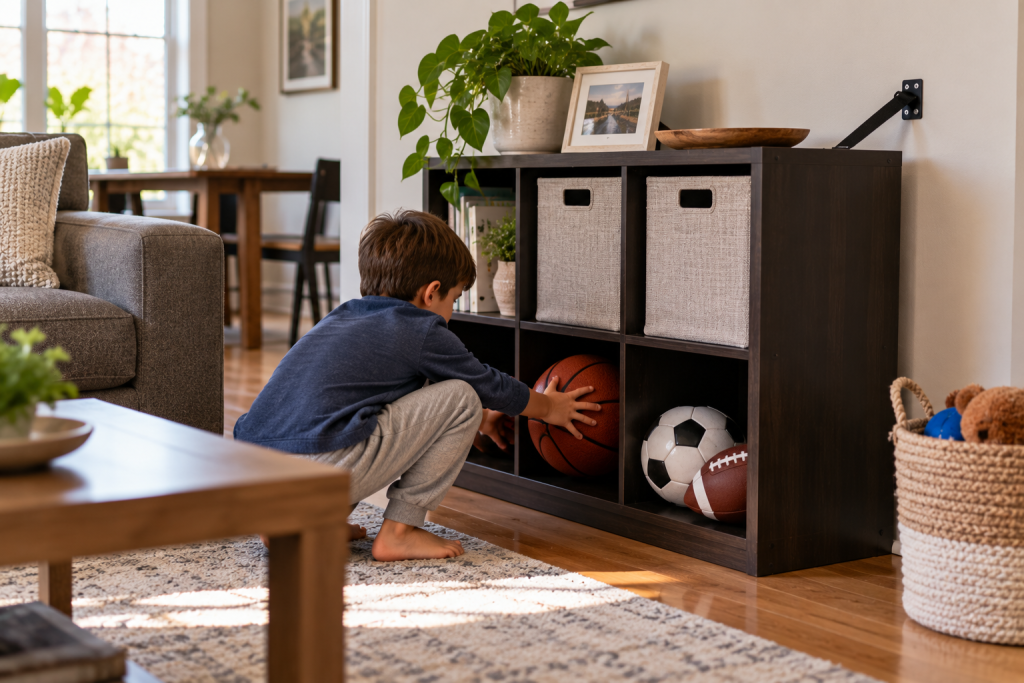
Remember that renting doesn’t make stability optional. If you can’t drill into the walls, freestanding shelves become tempting, but tip-over risk doesn’t disappear because you rent. The CPSC advises anchoring furniture such as bookcases to the wall, storing heavier items on lower shelves, and avoiding placing appealing items where children may be tempted to climb for them. Balls are exactly that kind of item, so keep them low and easy to grab.
Bikes need their own space check, too: one that fits along a wall on paper can still block the entrance once you account for handlebars, pedals, and room to maneuver. Electric scooters and e-bikes add battery-charging and fire-safety questions, so we’re covering them in a separate article.
A hypothetical family: two kids, three sports, no garage
This is an illustrative scenario, used to show how the decisions fit together. It isn’t a home we measured or a setup we tested.
Picture a two-bedroom apartment with one busy coat closet. One child plays soccer and basketball; the other plays hockey.
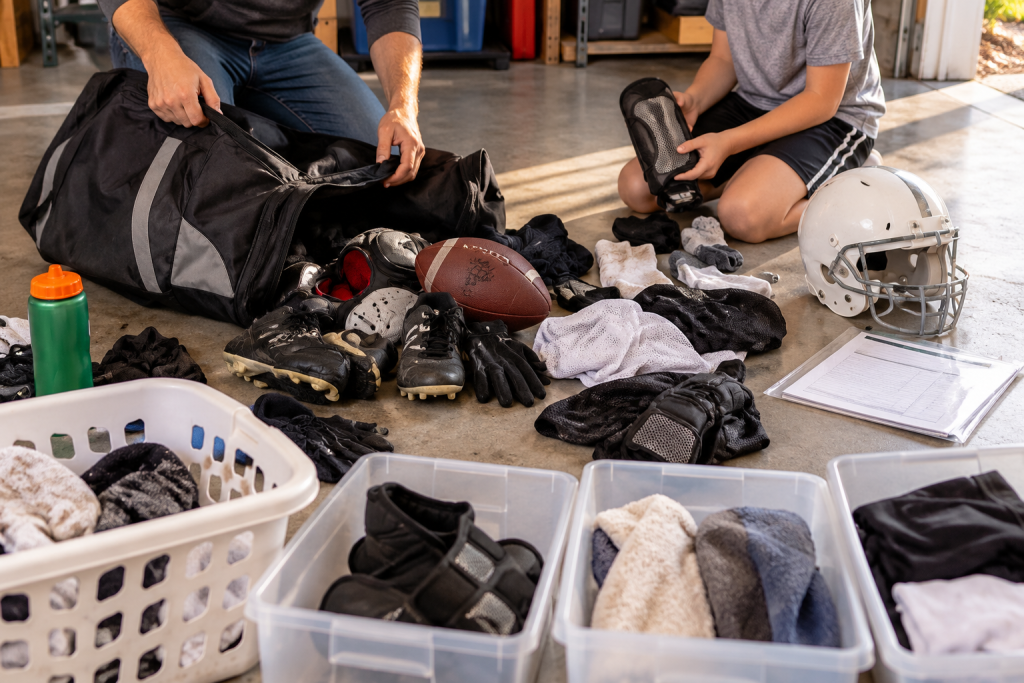
Step 1: Unload and sort by job. Uniforms and towels go into a laundry bag, pads and cleats go to the drying spot, and the mouthguard gets the routine described above.
Step 2: Dry before storing. The family picks an open corner away from the radiator and out of the bathroom, with room to hang the pads open and point a fan at them. That’s a proposed setup, not a tested drying system.
Step 3: Compare storage units only after the gear is dry. As one example, an IKEA KALLAX 2×2 shelf unit is listed at 30⅛ inches wide, 15⅜ inches deep, and 30⅛ inches tall, rated for 29 pounds per shelf. Its openings match IKEA’s 13-by-13-inch inserts, so by our calculation each opening fits one regulation size 5 soccer ball or one high-school basketball, but not two side by side. That’s a dimensional proposal, not a tested capacity.
An IKEA JONAXEL shelving unit offers a different configuration: 31½ inches wide, 15 inches deep, and 63 inches tall, with a maximum load of 55 pounds per shelf. Its open frame, however, doesn’t make it a drying rack.
Step 4: Settle anchoring before buying. IKEA states that the KALLAX “must be securely anchored,” and that includes its low two-compartment version. For JONAXEL, IKEA says anchoring to the wall is “the best way to reduce the risk of tip-over accidents.” So the family checks the lease first. If the landlord doesn’t allow anchoring, they choose a different arrangement rather than skipping the instructions.
At a Glance: The Two Apartment Examples (Listed Specs, Not Tested Capacity)
| Unit (example only) | Listed size (W × D × H) | Listed load | IKEA’s anchoring instruction |
|---|---|---|---|
| IKEA KALLAX 2×2 shelf unit | 30⅛ × 15⅜ × 30⅛ in | 29 lb per shelf | “Must be securely anchored” |
| IKEA JONAXEL shelving unit | 31½ × 15 × 63 in | 55 lb per shelf | Anchoring is “the best way to reduce the risk of tip-over accidents” |
Step 5: Measure the space people actually use. They check that a 15⅜-inch-deep unit won’t narrow the path to the door, that nearby doors and drawers still open, and that each child can reach, lift down, and put back their own gear safely. A shelf that fits the wall but blocks movement doesn’t fit the apartment.
Step 6: Keep a review bin. Outgrown cleats, a worn mouthguard, and anything waiting for a fit check go into one labeled bin, away from game-ready gear.
The six steps matter more than either furniture example. If the family can’t anchor a particular unit, the storage plan changes, but the drying, cleaning, and inspection needs don’t.
Narrow Entryways: Coming In Versus Going Out
An entryway handles two directions of traffic: what just came home, and what needs to leave tomorrow. Mixing the two is why a small space can look tidy at night and still produce a morning search.
One way to organize it is four zones: DRY (still needs attention), READY (clean and used often), STORE (clean, but not needed until another season), and REVIEW (needs an inspection, repair, fit check, or a decision). These are organizing labels, not a tested system, and you don’t need four pieces of furniture. In a small space, they might be a washable tray, a hook rail for clean bags, a closet shelf for off-season gear, and one labeled bin.
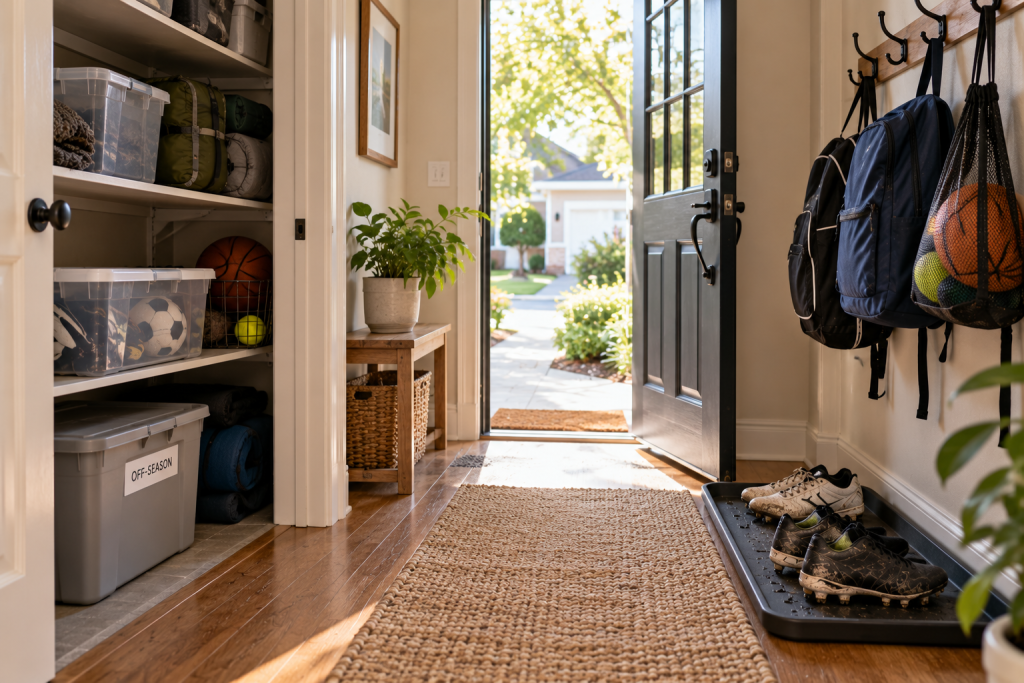
Before buying anything, measure the usable width and depth with the front door fully open. Leave room for a child carrying a bag, someone putting on shoes, and another person passing through. The goal is a clear doorway, not just a tidy floor.
As an example of a slim option, IKEA’s narrow JONAXEL unit measures 9⅞ inches wide, 20⅛ inches deep, and 27½ inches tall, with four wire baskets. Those baskets are only 5⅞ inches tall, so a regulation size 5 soccer ball won’t fit inside one. They could hold smaller items, like shin guards, gloves, or tennis balls and baseballs, but that’s a suggestion, not a tested packing plan. IKEA doesn’t publish a load limit for it, and it recommends anchoring it to the wall. Damp gear still belongs in the drying spot; an open wire basket isn’t a substitute for one.
The One-Car Garage: Park First. Measure Second. Install Last.
Garage organizers are usually photographed against empty walls. Your family, however, has to use that wall with a car parked beside it.
It’s also worth questioning the garage as a storage environment. Garages can run much hotter, colder, or more humid than the inside of a home, and we haven’t found a reliable standard profile for residential garages. For gear whose maker asks for a cool, dry place, decide whether your garage can actually provide that.
An illustrative wall setup
This is a hypothetical procedure meant to show the steps. We didn’t install it or measure a real garage.
Picture a family that parks one minivan in a single-car garage and is considering Gladiator’s Sports GearTrack Pack: a 48-inch GearTrack channel with a 24-inch mesh basket and three hooks.
Step 1: Find the usable wall with the car parked. They park in the usual spot, open the doors the family actually uses, including the front doors, and walk through the space carrying a sports bag. Then they check whether a bat or lacrosse stick could come off the wall without hitting the car. A vehicle’s published body width can’t answer that on its own, because mirrors and open doors change the picture.
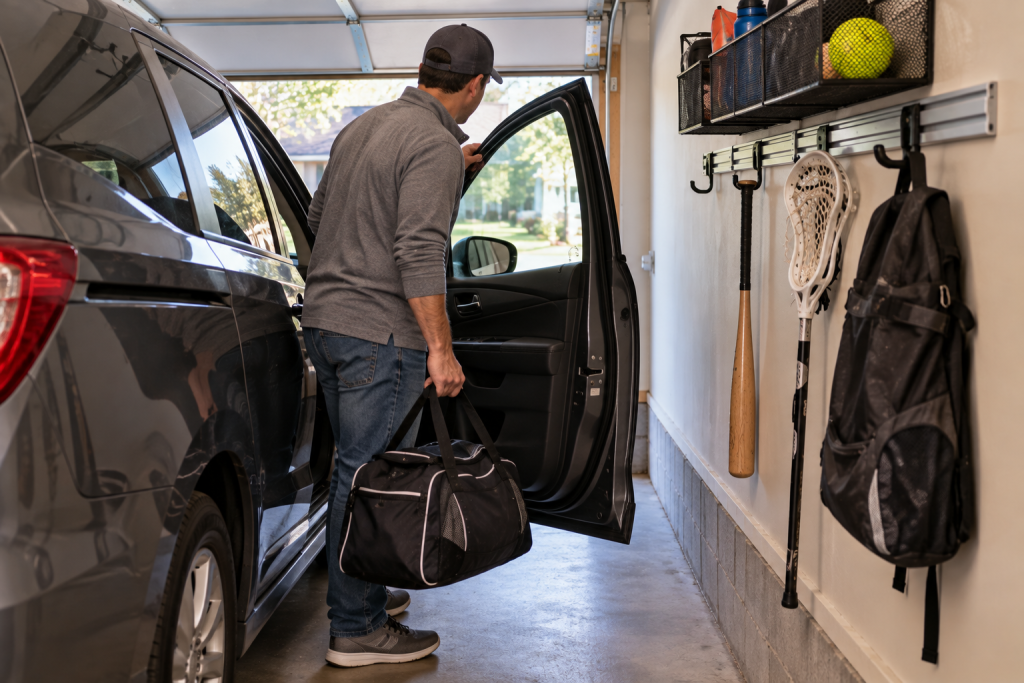
Step 2: Follow the mounting instructions. Gladiator’s installation manual calls for a screw in every slot at every stud location, with no more than 24 inches horizontally between screws. On wood studs, the channel should begin and end at a stud, and pieces cut shorter than 24 inches shouldn’t be used. The manual lists drywall over wood studs, bare wood studs, and masonry as mounting surfaces, and says masonry walls must be waterproofed first. It also warns to make sure screws won’t pierce electrical wiring.
Step 3: Read every load limit separately. The channel is rated at 75 pounds per linear foot. However, each accessory has its own, lower limit: 35 pounds for the 24-inch mesh basket, 30 pounds for the Wide Hook, and 25 pounds each for the Scoop and Tool hooks. Those limits don’t add up into one big number, and the channel’s rating doesn’t raise an accessory’s.
At a Glance: Separate Load Limits That Don’t Add Up
| Component | Listed limit (Gladiator installation manual) |
|---|---|
| GearTrack channel | 75 pounds per linear foot |
| 24-inch mesh basket | 35 pounds |
| Wide Hook | 30 pounds |
| Scoop Hook | 25 pounds |
| Tool Hook | 25 pounds |
Step 4: Test retrieval, not just placement. Balls are candidates for the basket, but we’re not giving a ball count: the weight rating doesn’t tell you how many fit, and we couldn’t confirm the usable interior size of the basket that comes in this pack. Long bats and lacrosse sticks need room to come off their hooks without swinging toward the car.
Step 5: Decide what stays indoors. If this garage gets hot in summer, bike helmets and other gear whose makers ask for cool, dry storage stay inside. Hockey gear is another judgment call: the goalie-gear makers we reviewed call for drying at room temperature, which a garage may not provide.
A properly mounted wall system can organize equipment. It can’t make an unsuitable storage environment suitable, and it can’t replace a clearance check made with the car in place.
Measure Before You Buy
Product listings love to say how many balls or bats a rack holds. Those numbers mean something only when they match what your family actually owns.
Take “holds 10 balls.” Listings rarely say which balls. A regulation high-school boys’ basketball can measure up to 30 inches around, or about 9.55 inches across. By comparison, a regulation size 5 soccer ball tops out at 28 inches around, or about 8.91 inches across. So an organizer sized for soccer balls may not fit basketballs.
At a Glance: Two Regulation Balls, Two Different Fits
| Ball | Maximum circumference | Approximate diameter |
|---|---|---|
| Regulation high-school boys’ basketball | 30 inches | 9.55 inches |
| Regulation size 5 soccer ball | 28 inches | 8.91 inches |
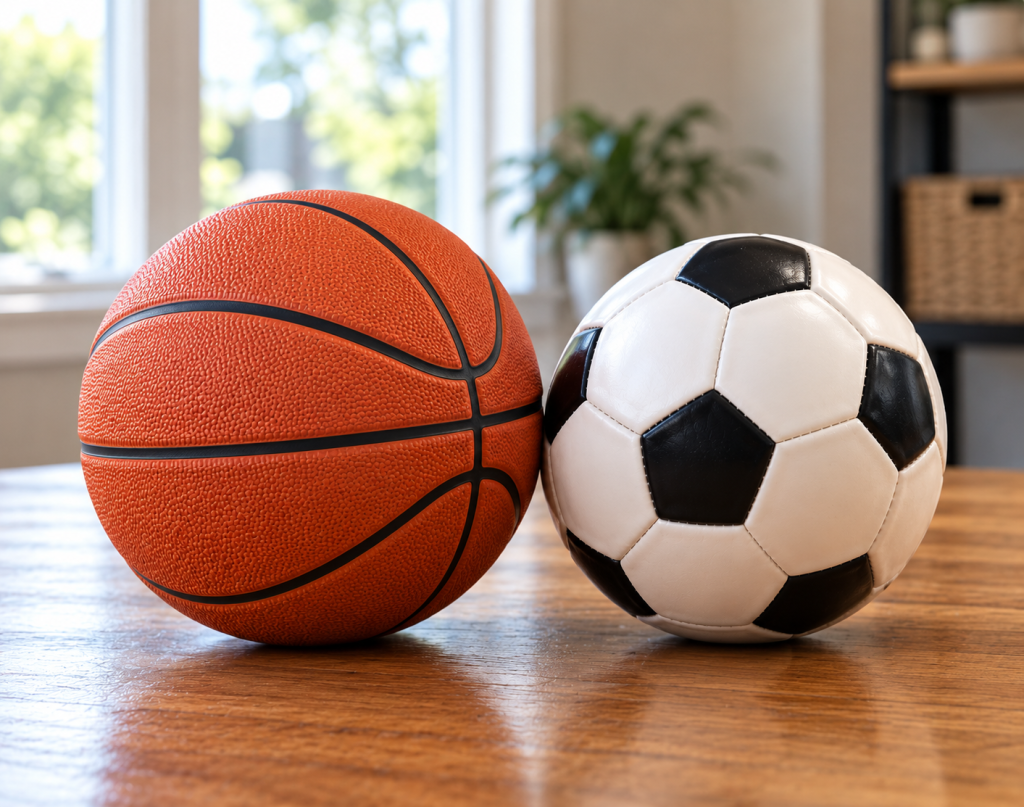
Capacity adds up fast, too. By our own calculation, the 10 soccer balls themselves take up roughly 14 to 16 gallons of volume, depending on where they fall in the official size range. That’s a geometric floor, not a sizing recommendation: it tells you what can’t work, not how big a container needs to be to work in practice. For a sense of scale, lining up 10 of the largest regulation size 5 balls in a simple 5-by-2 grid would need an interior of about 44.6 × 17.8 × 8.9 inches, or roughly 30 gallons. That’s one illustrative layout, not a capacity test, and other arrangements could take up less space.
Keep those numbers in their place. They’re theoretical space, calculated from official ball sizes. An organizer’s real capacity also depends on its shape, openings, dividers, and how easily a child can pull one ball out without the rest rolling away, and no calculation can tell you that.
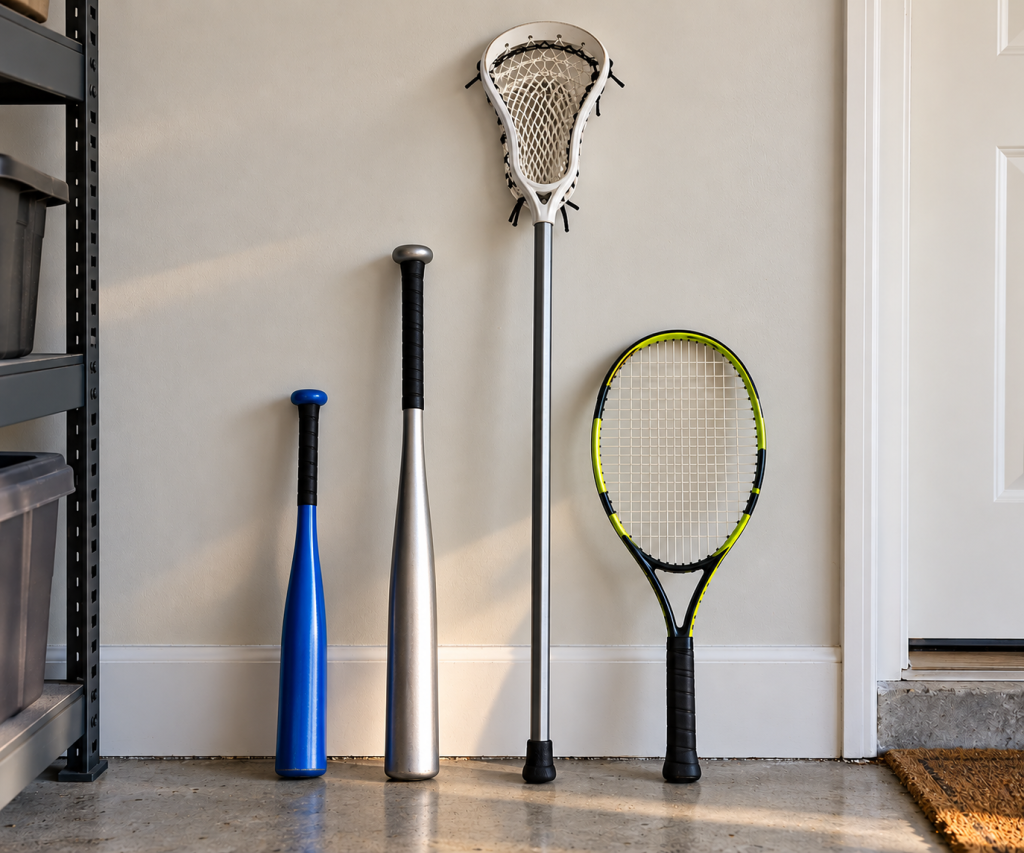
Length matters just as much. Little League’s certified Tee Ball bats are 26 inches and shorter, and its rules allow bats up to 33 inches in the Minor and Major divisions, 34 inches at the Intermediate and Junior levels, and 36 inches in Senior League. A rack that fits a 7-year-old’s bat may not fit the one they’re swinging at 13.
Lacrosse sticks run longer still. Boys’ high-school rules call for short sticks of 40 to 42 inches and long sticks of 52 to 72 inches, so a long pole may not fit anywhere a bat does. Tennis rackets change with age as well: in USTA junior play, rackets top out at 23, 25, or 29 inches depending on the ball stage, and 29 inches is the maximum for adult rackets under ITF rules.
At a Glance: Official Lengths That Change the Fit
| Gear | Length rule | Source |
|---|---|---|
| Tee Ball bats (certified) | 26 inches and shorter | Little League |
| Bats, Minor and Major divisions | Up to 33 inches | Little League |
| Bats, Intermediate and Junior levels | Up to 34 inches | Little League |
| Bats, Senior League | Up to 36 inches | Little League |
| Boys’ high-school lacrosse, short stick | 40 to 42 inches | Boys’ high-school rules |
| Boys’ high-school lacrosse, long stick | 52 to 72 inches | Boys’ high-school rules |
| Junior tennis rackets | Up to 23, 25, or 29 inches, depending on the ball stage | USTA |
| Adult tennis rackets | Up to 29 inches | ITF |
Before you buy, run through a short checklist:
- Have I separated gear that needs drying from clean, dry gear?
- Have I checked the manufacturer’s care instructions for the protective equipment?
- Do I know which items my kids need every day or every week?
- Have I checked our actual equipment against the organizer’s usable dimensions?
- Have I checked the mounting, stability, and load instructions?
- Have I accounted for doors, walkways, and, in a garage, the car?
- Do I have a plan for reviewing gear at the end of each season?
Sometimes the answer turns out to be a basic basket, a properly anchored shelf, or a better unloading routine. Other times, a purpose-built rack really does save space. Either way, you’ll know what you’re buying it for.
Before the Next Season, Reset the System
The end of a season is when a bag is most likely to disappear onto a high shelf without anyone checking what’s inside. Empty it instead.
Run everything through the four jobs one more time: clean and dry it the right way, keep it out of heat, sort out what’s shared, and review what needs a fit check, repair, reconditioning, or replacement. For football helmets, that’s the time to confirm the reconditioning schedule, rather than discovering a missed deadline on the first day of practice.
A family rotating between fall soccer, winter basketball, and spring baseball doesn’t need all three sports occupying the prime space by the door all year. So instead of building storage around one sport, build a system that shifts with the seasons.
If your family is weighing several sports against focusing on one, that decision has costs well beyond the garage. We look at those in Youth Sports Specialization: Your Kid Has a Favorite Sport. But What Would They Have to Give Up?
Back to the Missing Mouthguard
The Saturday-morning scramble wasn’t really a storage failure. After all, the family had hooks, and every bin had a label. What failed was the order of the questions: nobody asked what the mouthguard needed before deciding where it went.
In a better routine, that mouthguard never spends two days damp in a zipped bag. It gets the care its maker specifies, dries, and goes into a vented case. The clean game-day bag has a known place, and anything damaged or outgrown waits in the review bin. That same principle scales from one apartment closet to an entire garage wall.
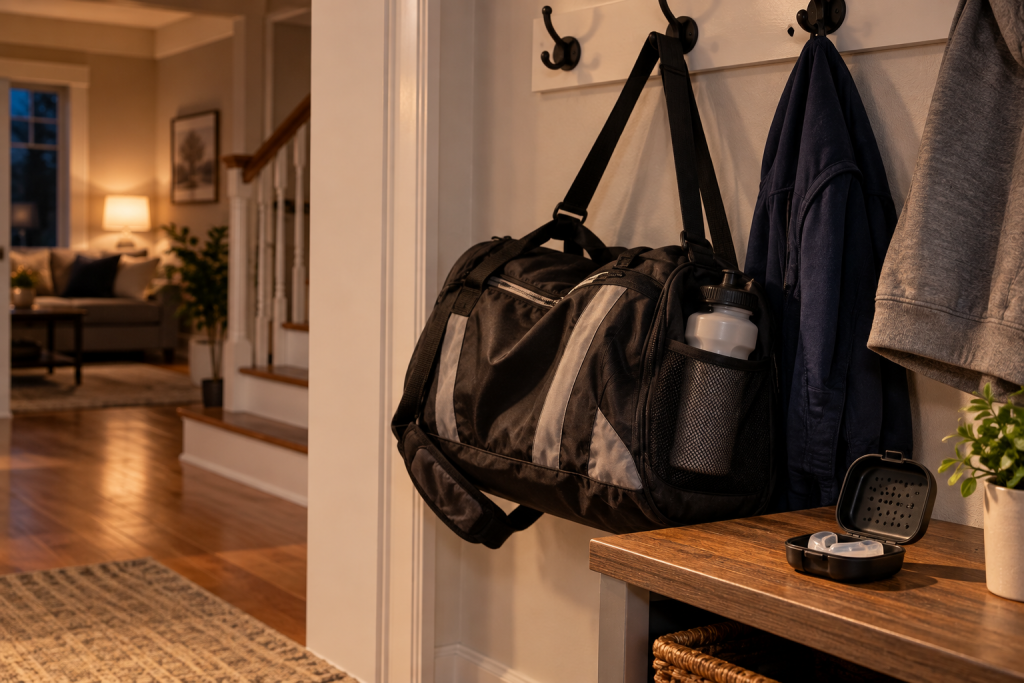
A good storage system isn’t the one that looks finished. It’s the one where every piece of gear ends up in the conditions it needs for the next practice.
Start with what the equipment needs. Then buy the hooks.
Sources
- Centers for Disease Control and Prevention (CDC) (n.d.). Athletes: MRSA prevention and control — wash and completely dry uniforms, towels, and clothing in a dryer after each use; don’t share items that touch the skin. CDC. Link.
- Brown Hockey (n.d.). Care guidelines — hang gear to dry with airflow; no clothes dryer or heater, because heat will compromise protective components. Brown Hockey. Link.
- Vaughn Hockey (n.d.). Maintenance — air-dry equipment at room temperature; do not use heat. Vaughn Hockey. Link.
- adidas (n.d.). How to clean your football boots — air-dry indoors; no hair dryer, tumble dryer, or direct sunlight; store in a breathable bag once completely dry. adidas UK. Link.
- Badari, R. N., Zaferanloo, B., Butardo, V., Jr., & Sumer, H. (2025). Surface deterioration and poor handling of sports mouthguards for young football players promote bacterial attachment and colonisation requiring mechanical cleaning. BMC Oral Health, 25, 1743. Link.
- Shock Doctor (n.d.). How to clean a mouthguard: dos and don’ts — air-dry completely in a cool, shaded place, then store in a ventilated case. Shock Doctor EU. Link.
- American Dental Association (n.d.). Mouthguards — vented storage container, no sun or hot water, cleaning options, and when to replace. MouthHealthy (ADA). Link.
- McLaren, C., Null, J., & Quinn, J. (2005). Heat stress from enclosed vehicles: moderate ambient temperatures cause significant temperature rise in enclosed vehicles. Pediatrics, 116(1), e109–e112. Link.
- Bell Helmets (n.d.). Bike helmet owner’s manual — heat, cleaning, replacement after a severe blow, and replacement every 3 to 5 years. Bell Helmets. Link.
- Consumer Reports (n.d.). The dos and don’ts of bike helmet care — CPSC engineer on trunk temperatures and liner compression after impact. Consumer Reports. Link.
- Children’s Hospital of The King’s Daughters (CHKD) (n.d.). Helmet safety — do not store a bike helmet in a car. CHKD Health Library. Link.
- Spalding (n.d.). How to inflate a basketball — 7–9 psi; store in a temperature-regulated room, not outdoors or in a vehicle. Spalding. Link.
- Rawlings / Easton (n.d.). Support and warranty — cool, dry storage away from direct sunlight; glove stored with a ball in the pocket; warranty exclusion for bats used under 60°F. Rawlings/Easton. Link.
- Centers for Disease Control and Prevention (CDC) (n.d.). Athletic facilities: MRSA prevention and control — clean shared equipment after each use and let it dry; follow manufacturers’ instructions; repair or discard equipment with damaged surfaces. CDC. Link.
- University of California, Irvine (2013). Passing the ball may also pass disease — Staphylococcus aureus transfer between hands, balls, and floor; survival on a sports ball after 72 hours in storeroom conditions (research presented at the American College of Sports Medicine meeting). ScienceDaily. Link.
- NOCSAE (n.d.). General recertification requirements and recommendations. National Operating Committee on Standards for Athletic Equipment. Link.
- Riddell (n.d.). Victor platform helmet fitting guide — reconditioning at least every two years by a NOCSAE-licensed reconditioner. Riddell. Link.
- National Athletic Equipment Reconditioners Association (NAERA) (2025). Helmet reconditioning information, updated October 2025 — annual reconditioning and recertification unless the manufacturer states otherwise. Hosted by NJSIAA. Link.
- NOCSAE (n.d.). About recertification: questions and answers — NAERA’s 10-year “useful life” rule. National Operating Committee on Standards for Athletic Equipment. Link.
- USA Football (n.d.). What youth football parents need to know about helmet reconditioning. USA Football. Link.
- U.S. Environmental Protection Agency (EPA) (n.d.). A brief guide to mold, moisture, and your home — keep indoor humidity below 60 percent, ideally 30–50 percent. EPA. Link.
- U.S. Consumer Product Safety Commission (CPSC) (2025). CPSC Anchor It! campaign marks 10 years — anchoring furniture, heavier items on lower shelves, and avoiding items that tempt children to climb. CPSC. Link.
- IKEA (n.d.). KALLAX shelf unit, 2×2 (206.316.39) — dimensions, load per shelf, and anchoring warning. IKEA US. Link.
- IKEA (n.d.). KALLAX insert with door, 13×13″ — dimensioned to fit KALLAX shelf units. IKEA US. Link.
- IKEA (n.d.). JONAXEL shelf unit (504.199.72) — dimensions, load per shelf, and anchoring guidance. IKEA US. Link.
- IKEA (n.d.). KALLAX shelf unit, two compartments (903.015.55) — anchoring warning. IKEA US. Link.
- IKEA (n.d.). JONAXEL storage combination, narrow, with four wire baskets — dimensions. IKEA US. Link.
- Gladiator GarageWorks (n.d.). Sports GearTrack Pack — channel, mesh basket, and three hooks. Gladiator. Link.
- Gladiator GarageWorks (Whirlpool) (2024). GearTrack / GearWall installation instructions (W11087876) — mounting requirements and load limits, including the 24-inch mesh basket. Whirlpool Corporation. Link.
- National Federation of State High School Associations (NFHS) (2025). Authenticating Mark manual — basketball and soccer ball circumference specifications. NFHS. Link.
- Little League (n.d.). Baseball bat standards — Tee Ball bat certification and maximum bat lengths by division. Little League University. Link.
- NFHS / USA Lacrosse (2024). Boys’ high-school lacrosse rules interpretations — stick lengths (Rule 1-6-2). USA Lacrosse. Link.
- United States Tennis Association (USTA) (2016). Junior red, orange, and green ball regulations — maximum racket lengths. USTA. Link.
- International Tennis Federation (ITF) (2020). Rules of Tennis — racket length and ball specifications. ITF. Link.
- U.S. Soccer (2017). Player Development Initiatives — ball size by age group. Hosted by US Youth Soccer. Link.
- Cascade Lacrosse (2022). Helmet guide (Rev. 22.01) — solvents, cleaners, and hair products can damage helmets; replace a cracked or deformed shell or deteriorated padding. Cascade. Link.
- NOCSAE (2019). Standard performance specification for newly manufactured lacrosse balls (ND049-19) — ball circumference. NOCSAE. Link.

Comments
One response to “Sports Equipment Storage: What Your Gear Needs Before You Put It Away”
[…] the same principle that matters when you match larger storage to sports equipment: capacity numbers become useful only when they correspond to what you actually need to […]