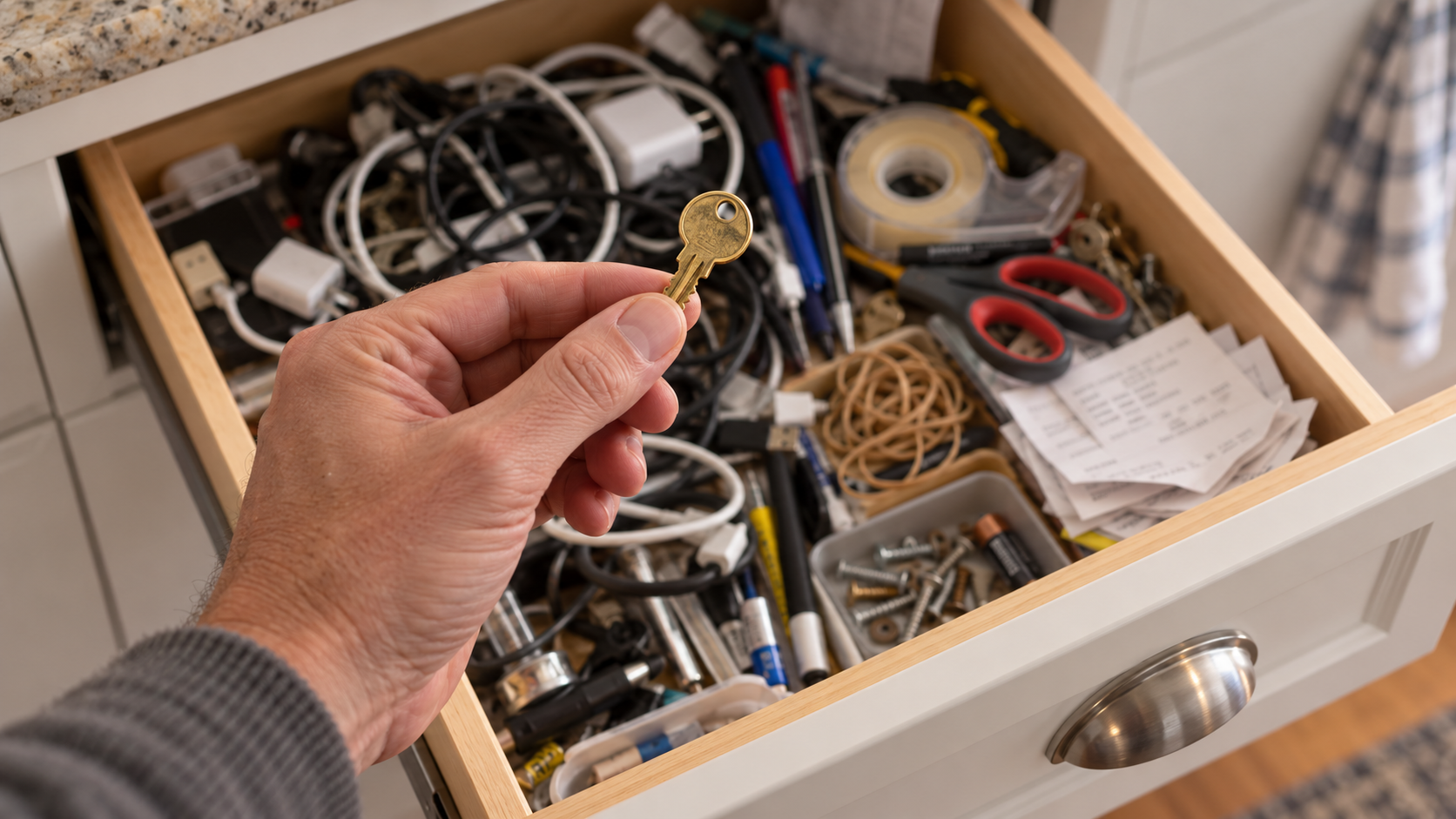
Open your junk drawer and pick up the first thing you can’t explain.
Maybe it’s a small brass key. It could just as easily be a cable with an end you don’t recognize, or a screw that clearly came from something. Or it’s a battery, and you aren’t sure whether it still works.
Now hold it for a second. The obvious question is where it fits in the drawer. Yet the more useful question is simpler: why is this still here?
There’s a second question hiding behind that one. Suppose you sort the whole drawer this weekend. Every pen in its place, every cable coiled, every mystery object resolved. What happens the next time something like that key shows up?
That second question matters just as much as the first, because clearing a junk drawer once and keeping it useful are two different jobs.
Why Organizing It Doesn’t Last
Chances are you’ve done this before. You empty the drawer, toss the dried-out pens, line everything up, and it looks great. A few weeks later, it’s back.
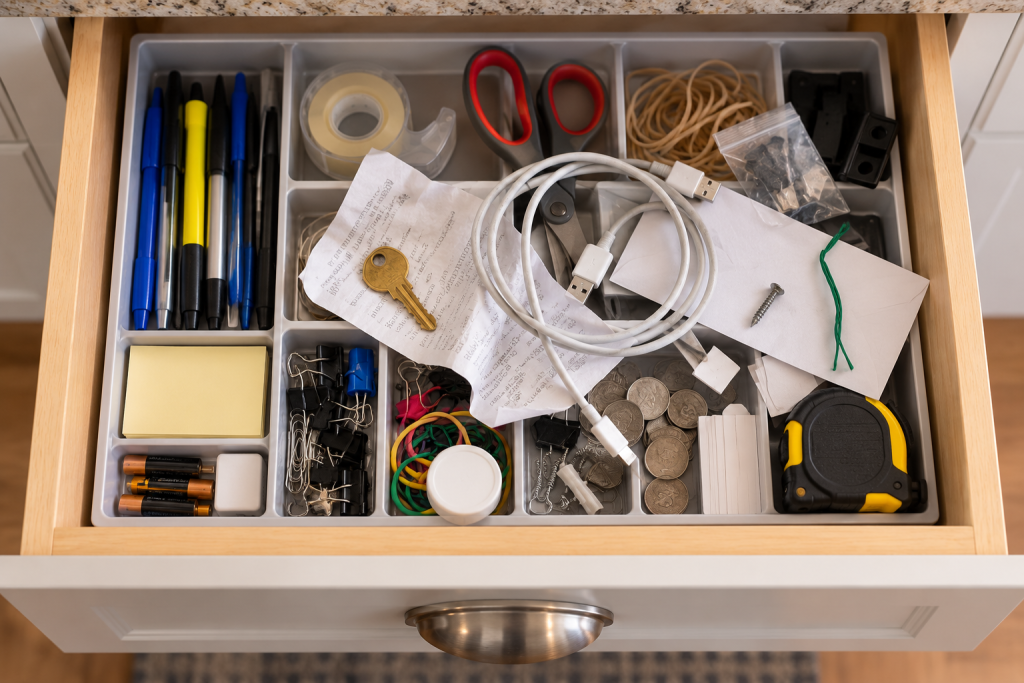
That experience is common. In a 2021 survey commissioned by ClosetMaid, 75% of respondents said they had organized a junk drawer or another messy spot, only to realize they had just moved the mess somewhere else.
So is the drawer itself the problem? Not really.
In fact, a junk drawer can be one of the most useful spots in a house. It’s where the tape lives, and the scissors, and the pen that actually writes. Those things don’t need to be scattered across five rooms to satisfy a rule about tidiness.
Don’t eliminate the junk drawer. Give it a job.
The trouble starts when the drawer takes on a second job it was never given: holding things no one has dealt with yet. And once they’re lying side by side, a useful object and an unresolved one can look almost identical.
There’s a small body of research that points in this direction. In surveys of U.S. adults, people who report putting off tasks and decisions also tend to report more problems with clutter (Ferrari & Roster, 2017). A later study from the same research group found that people who described themselves as hesitant or indecisive reported more negative effects from clutter than people who described themselves as decisive and action-oriented (Patel, Graupmann & Ferrari, 2023).
Those are associations, not proof that indecision causes junk drawers. But they point to a useful distinction when you’re standing over your own drawer: some objects are there because they belong there. Others are there because you haven’t figured out what to do with them yet.
An organizer treats both as inventory. They aren’t.
Here’s the real problem, then. A junk drawer doesn’t fail because unrelated things share a drawer. It fails when the drawer has no rule for what belongs there, what needs a decision, and what should never enter. Organize what’s inside once — but fix what gets allowed in, and you change what happens next.
Put simply: Decide what’s inside. Then decide what gets in.
The Four Decisions
Start by taking everything out.
But don’t make a pen pile, a cable pile, a tool pile and a battery pile. Don’t measure for trays yet, and don’t shop. Grouping by object type feels productive, yet it skips the step that matters most.
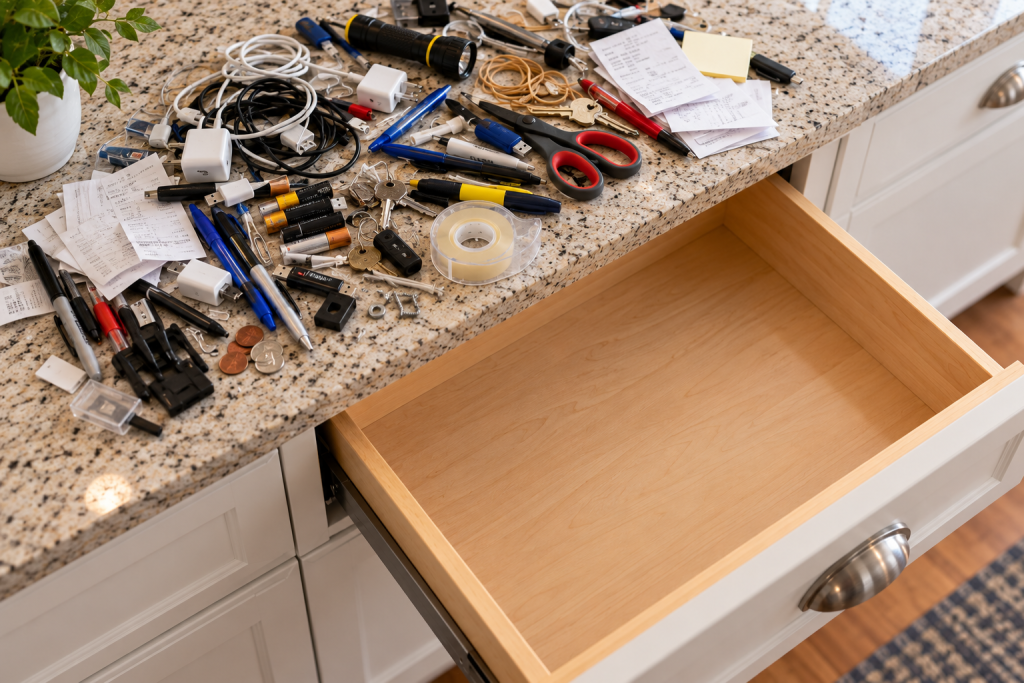
The first useful sort isn’t by what each object is. It’s by what that object needs from you.
These four groups aren’t a scientific classification. They’re a practical way to make that first sort.
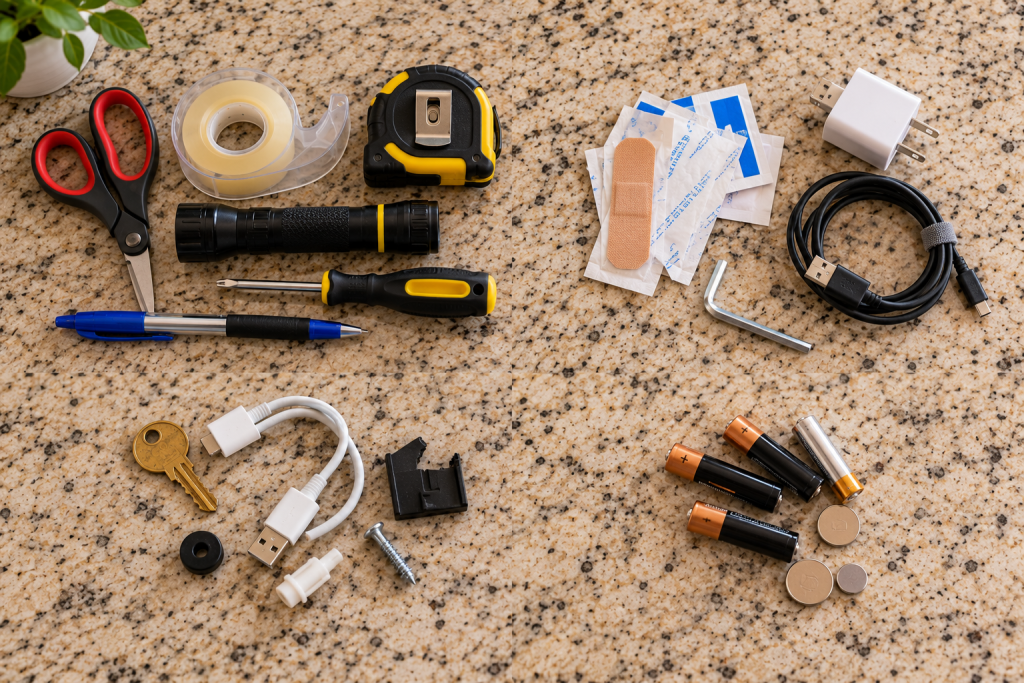
Belongs Here
These are small things you actually use, and this drawer really is their natural spot. Tape, scissors, a working pen, a small screwdriver, a measuring tape, a flashlight.
Here’s a quick test: if you needed the scissors tomorrow, would this be one of the first places you’d look? If so, they already have a home.
There’s nothing wrong with these objects. They’re the reason the drawer is worth having.
Needs a Home
These objects are useful, but their place is somewhere else. The spare bandages belong with the first-aid supplies. Likewise, the hex key that came with a bookshelf belongs with the tools.
This is also where sorting by object type can mislead you. A neat row of three tools can look organized even if two of them belong somewhere else.
Nothing about this group calls for an organizer. What it calls for is a short walk.
Needs a Decision
This is the group that can quietly turn the drawer into a waiting room. Think mystery keys, an unknown cable, a broken item you meant to fix, a part from something you may no longer own.
Each one is waiting for an answer: return it, repair it, recycle it, identify it, sell it or discard it.
The catch is that “someday” is remarkably good at becoming storage. In a 2026 survey of 4,000 U.S. consumers, only 23% of people said they planned to store their current device once they were done with it. Yet among people describing what they had actually done with a previous device, 39% had stored it (Saeedi et al., 2026).
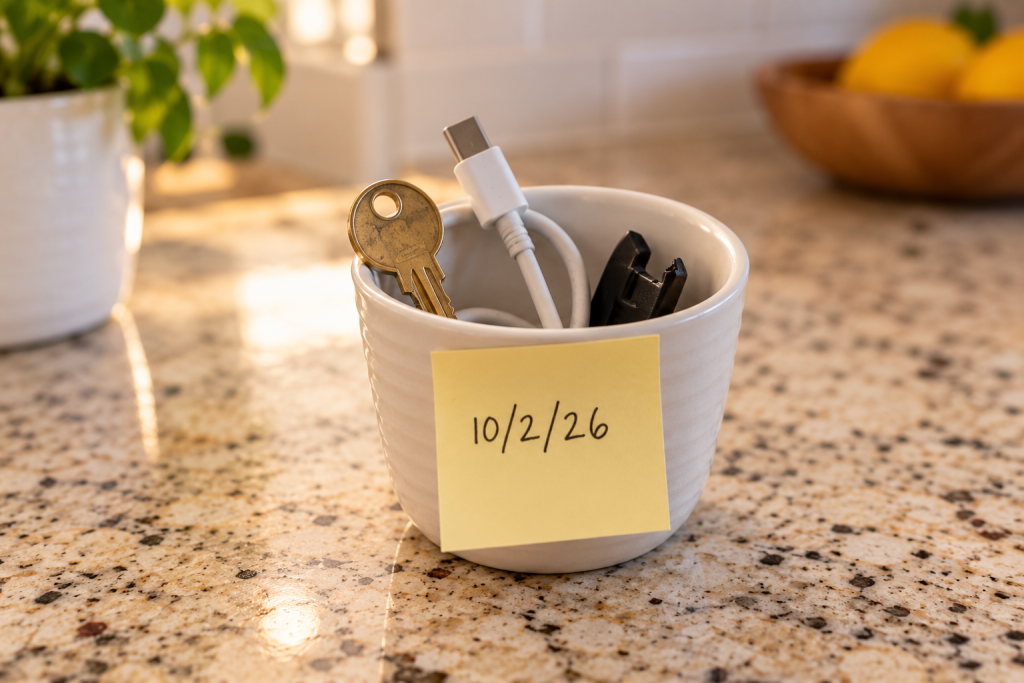
If you really can’t settle an item yet, a small temporary spot is reasonable. However, it needs an exit condition: a date, an event or an answer that tells you when the object leaves. Without one, “temporary” has a way of becoming permanent.
Shouldn’t Be Here
Some objects aren’t a problem because they’re messy. They’re a problem because the drawer is the wrong place for them altogether.
That deserves its own section.
At a Glance: Object → Decision → What Happens Next
| Decision | What it means | What happens next |
|---|---|---|
| Belongs Here | You use it, and this drawer is where you’d naturally look for it | It stays |
| Needs a Home | Useful, but its place is elsewhere | It goes to that place |
| Needs a Decision | Waiting to be returned, repaired, recycled, identified, sold or discarded | It gets an answer, or a temporary spot with an exit condition |
| Shouldn’t Be Here | The drawer is the wrong or unsafe place for it | It leaves now |
Some Things Don’t Need a Better Compartment
Organization asks where something fits. Safe storage asks whether it belongs there at all.
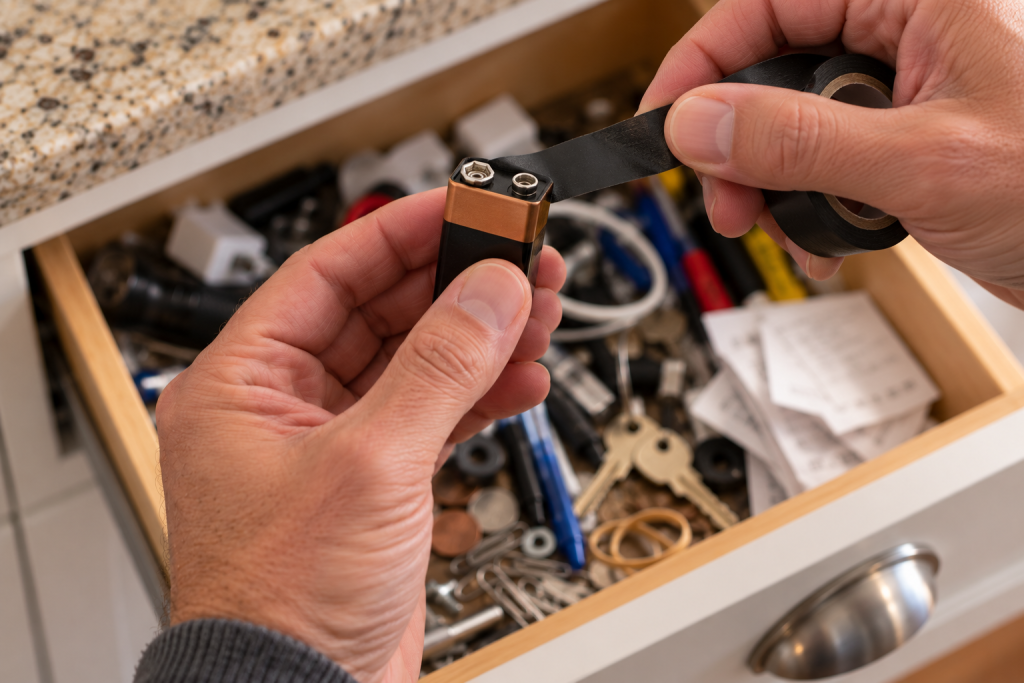
Loose batteries are the clearest example. A loose 9-volt, for instance, shouldn’t simply get its own little section in the tray.
The National Fire Protection Association is unusually direct about 9-volts: “9-volt batteries should not be stored loose in a drawer.” The reason is the drawer itself. “If a metal object touches the two posts of a 9-volt battery, it can cause a short circuit,” NFPA explains. “This can make enough heat to start a fire” (NFPA). Now think about what else may be in that drawer: keys, coins, paper clips, screws.
Button and coin batteries carry a different risk. According to the U.S. Consumer Product Safety Commission, a swallowed button battery “can burn through a child’s throat or esophagus in as little as two hours” (CPSC).
Loose batteries matter here, too. In one large analysis of battery-ingestion cases reported to a national hotline, published in Pediatrics in 2010, nearly 3 in 10 batteries swallowed by children under 6 were loose or sitting out — not inside a device (Litovitz, Whitaker & Clark, 2010).
That figure comes from cases between 1990 and 2008, so it isn’t a current rate, and it doesn’t say where those loose batteries were found. Even so, it shows why a small loose battery shouldn’t be treated as ordinary drawer clutter.
Poison Control’s advice is worth reading closely: “Store spare batteries, and batteries to be recycled, out of sight and reach of young children” (Poison Control).
Batteries to be recycled. That’s the dead battery you tossed in the drawer to deal with later. In other words, it’s a Needs a Decision item with real stakes attached.
What happens next depends on the battery. For a used 9-volt, NFPA recommends covering both posts with tape before getting rid of it. NFPA also says 9-volts should not be thrown away with trash, identifies household hazardous-waste collection as an option, and says to check locally for the appropriate disposal method. A discharged button or coin battery is different: CPSC recommends covering the terminals — or the entire battery — with non-conductive tape and taking it to a battery-collection center. EPA likewise advises handling and disposal based on battery chemistry rather than treating every household battery the same way (EPA).
Spares need what Poison Control already asks for: a place out of sight and out of reach of young children. A drawer a small child can open and dig through doesn’t meet that standard.
Batteries aren’t the only objects that can fail this test. They’re simply the clearest reminder that “does it fit?” and “should it be here?” are different questions.
At a Glance: Battery → Why the Drawer Is the Wrong Place → What to Do Instead
| Battery | Why the drawer is the wrong place | What to do instead |
|---|---|---|
| 9-volt | Metal touching both posts can short-circuit it and create enough heat to start a fire (NFPA) | Don’t store it loose; cover the posts with tape. For a used one, don’t throw it away with trash; household hazardous-waste collection is an option, and check locally for the appropriate disposal method (NFPA) |
| Button/coin | A swallowed one can burn through a child’s throat or esophagus in as little as two hours (CPSC); loose batteries matter, not only those inside devices (Litovitz); a drawer a small child can open isn’t out of reach | Keep spares and batteries waiting to be recycled out of sight and reach of young children (Poison Control). For a discharged one, tape the terminals or the whole battery and take it to a battery-collection center (CPSC) |
If a button or coin battery is swallowed, seek medical attention immediately. Call the National Battery Ingestion Hotline at 1-800-498-8666 or Poison Help at 1-800-222-1222 for treatment guidance (CPSC; Poison Control).
Now Look at What’s Left
By this point, the pile on your counter has changed. The objects that belong elsewhere are gone. Anything still waiting on an answer either has one now or sits in a small spot with a deadline. And the batteries are out.
What remains is the drawer’s real inventory. That’s the only inventory worth planning for.
Don’t organize the inventory you started with. Organize the inventory that survives the decisions.
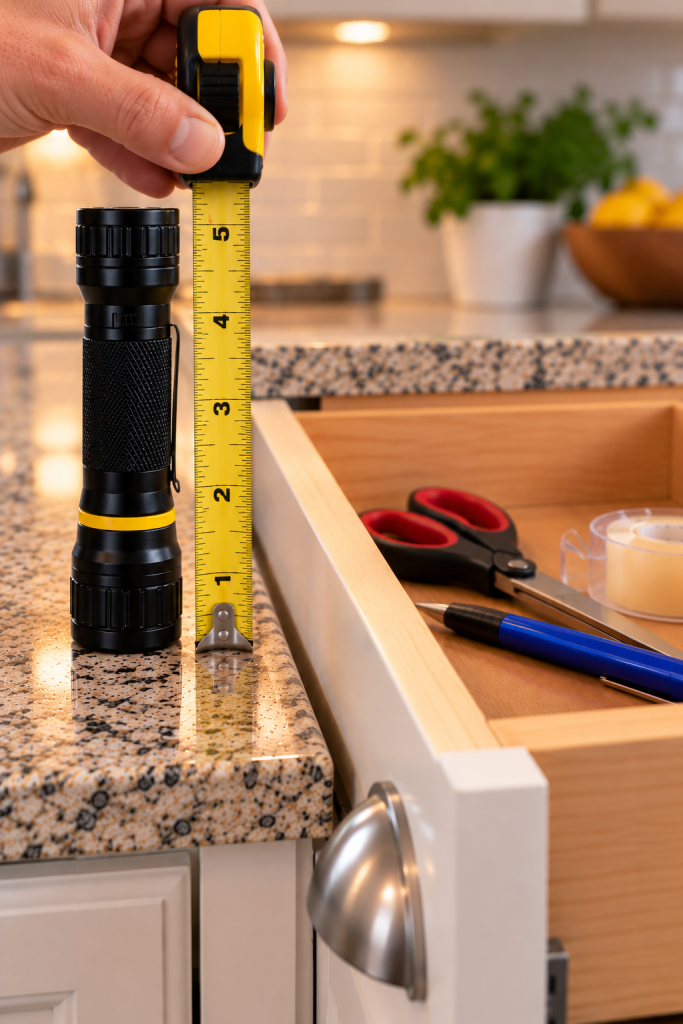
Now the practical questions are easier. Does anything here need to be separated, or would it be fine loose? Which items need a spot of their own? And how big are they, really?
Measure the objects, not just the drawer. The tallest item still has to let the drawer close, and long tools need space to lie flat. Small parts, meanwhile, need something that keeps them from drifting to the back.
It’s the same principle that matters when you match larger storage to sports equipment: capacity numbers become useful only when they correspond to what you actually need to store.
Only then does the organizer question make sense. Fixed compartments can work well when the same small objects always live there. By contrast, adjustable dividers or modular bins may make more sense when sizes or categories change. And sometimes the answer is no organizer at all.
After all, the organizer isn’t supposed to justify everything you pulled out of the drawer. It’s supposed to serve what legitimately remains.
None of this is an argument against buying one. Rather, it’s an argument about order.
Don’t choose the organizer until you know what you’re organizing.
What Happens to the Next Random Thing?
Imagine the drawer is finished. Everything inside has a reason to be there.
Then, tomorrow, a tiny screw turns up on the kitchen floor. Nobody knows what it came from, and throwing it away feels risky. So someone opens the drawer and thinks, I’ll just put it here for now.
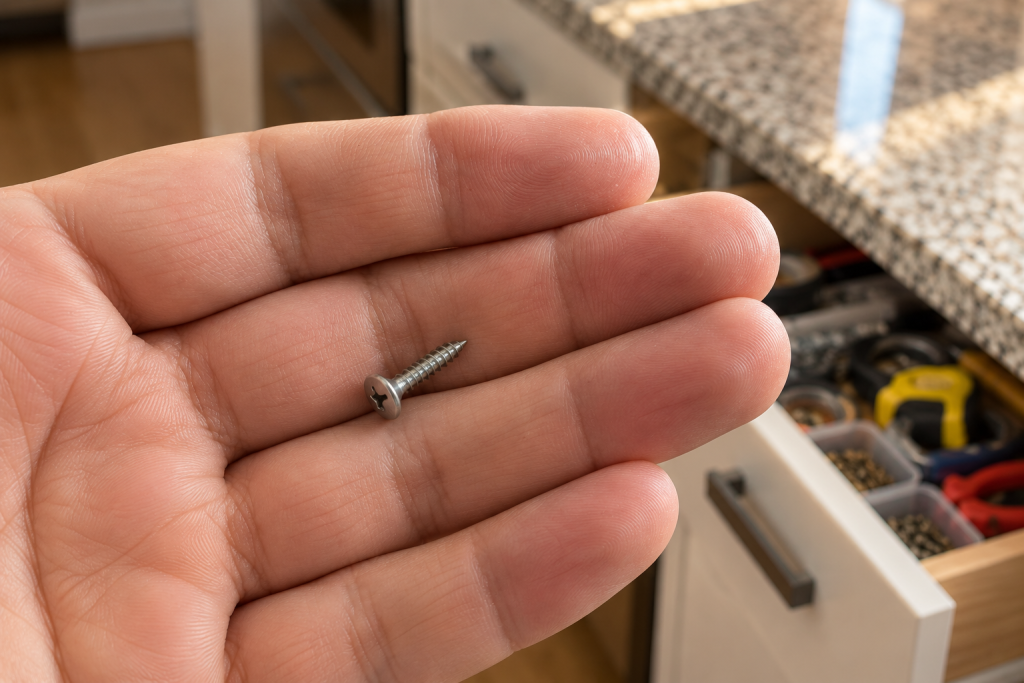
That’s the moment the cycle restarts. This is the part a one-time cleanout can’t solve, because the screw arrived after you finished.
Fortunately, there’s useful research on planning ahead for moments like this one. Across 94 tests, research on if-then planning found that deciding in advance what you’ll do when a specific situation comes up made people more likely to reach their goals (Gollwitzer & Sheeran, 2006).
That research didn’t study junk drawers. The household application here is an editorial one: if a new object shows up, then it has to pass a few questions before the drawer automatically becomes its home.
Ask:
- Do I know what this is?
- Do I expect to use it?
- Would I naturally look for it here the next time I need it?
- Is this an appropriate and safe place for it?
If the answer to all four is yes, this drawer makes sense as its home.
Otherwise, you already have somewhere to send it. It goes to its real home if it Needs a Home, to the small temporary spot if it Needs a Decision, or out of the drawer for good if it Shouldn’t Be Here. Either way, the drawer doesn’t become its waiting room by default.
There is another reason the location itself matters. Habit research shows that repeated behaviors can become associated with recurring contexts (Wood, Quinn & Kashy, 2002; Wood & Rünger, 2016). Applying that principle to storage is an editorial inference — not something these studies tested directly.
Think about the scissors. If they always live in the same spot, reaching for them eventually takes almost no thought. Keep them in the kitchen today, the office tomorrow and the garage on Saturday, though, and every use starts with a search.
The goal isn’t to create rigid rules for every small object in your house. It’s to make the drawer predictable enough that putting something there means something.
The Drawer You Can Still Explain
Go back to the key from the beginning — or the cable, the screw, the battery. That object doesn’t need a beautiful compartment. What it needs is an answer: it stays, it moves, it gets a deadline or it leaves.
Above all, it shouldn’t still be there merely because the drawer was available.
A successful junk drawer isn’t the one that looks perfect when you finish organizing it. It’s the one you can open months later and still explain why everything inside is there.
Sources
- Ferrari, J. R., & Roster, C. A. (2018; online 2017). Delaying disposing: Examining the relationship between procrastination and clutter across generations. Current Psychology, 37(2), 426–431. Link.
- Patel, D. A., Graupmann, V., & Ferrari, J. R. (2023). Reactance, decisional procrastination, and hesitation: A latent class analysis of clutter behavior. International Journal of Environmental Research and Public Health, 20(3), 2061. Link.
- OnePoll for ClosetMaid (2021). Survey of 2,000 U.S. adults on household organization, including junk drawers. As reported by South Florida Reporter, March 6, 2021. Link.
- Saeedi, P., Cade, W., Jabin, N., Oh, T., Watson, S., & Williams, E. (2026). How do stated knowledge and attitudes influence end-of-current-use disposition of electronics? Sustainability, 18, 5239. Link.
- National Fire Protection Association (NFPA). 9-Volt Battery Safety Tip Sheet. Link.
- U.S. Consumer Product Safety Commission (CPSC). Button Cell and Coin Battery Information Center. Link.
- Litovitz, T., Whitaker, N., & Clark, L. (2010). Preventing battery ingestions: An analysis of 8648 cases. Pediatrics, 125(6), 1178–1185. Link.
- Poison Control (National Capital Poison Center). Button battery prevention tips and battery ingestion guidance. Prevention tips; If a battery is swallowed.
- U.S. Environmental Protection Agency (EPA). Used Household Batteries. Link.
- Gollwitzer, P. M., & Sheeran, P. (2006). Implementation intentions and goal achievement: A meta-analysis of effects and processes. Advances in Experimental Social Psychology, 38, 69–119. Link.
- Wood, W., Quinn, J. M., & Kashy, D. A. (2002). Habits in everyday life: Thought, emotion, and action. Journal of Personality and Social Psychology, 83(6), 1281–1297. Link.
- Wood, W., & Rünger, D. (2016). Psychology of habit. Annual Review of Psychology, 67, 289–314. Link.
