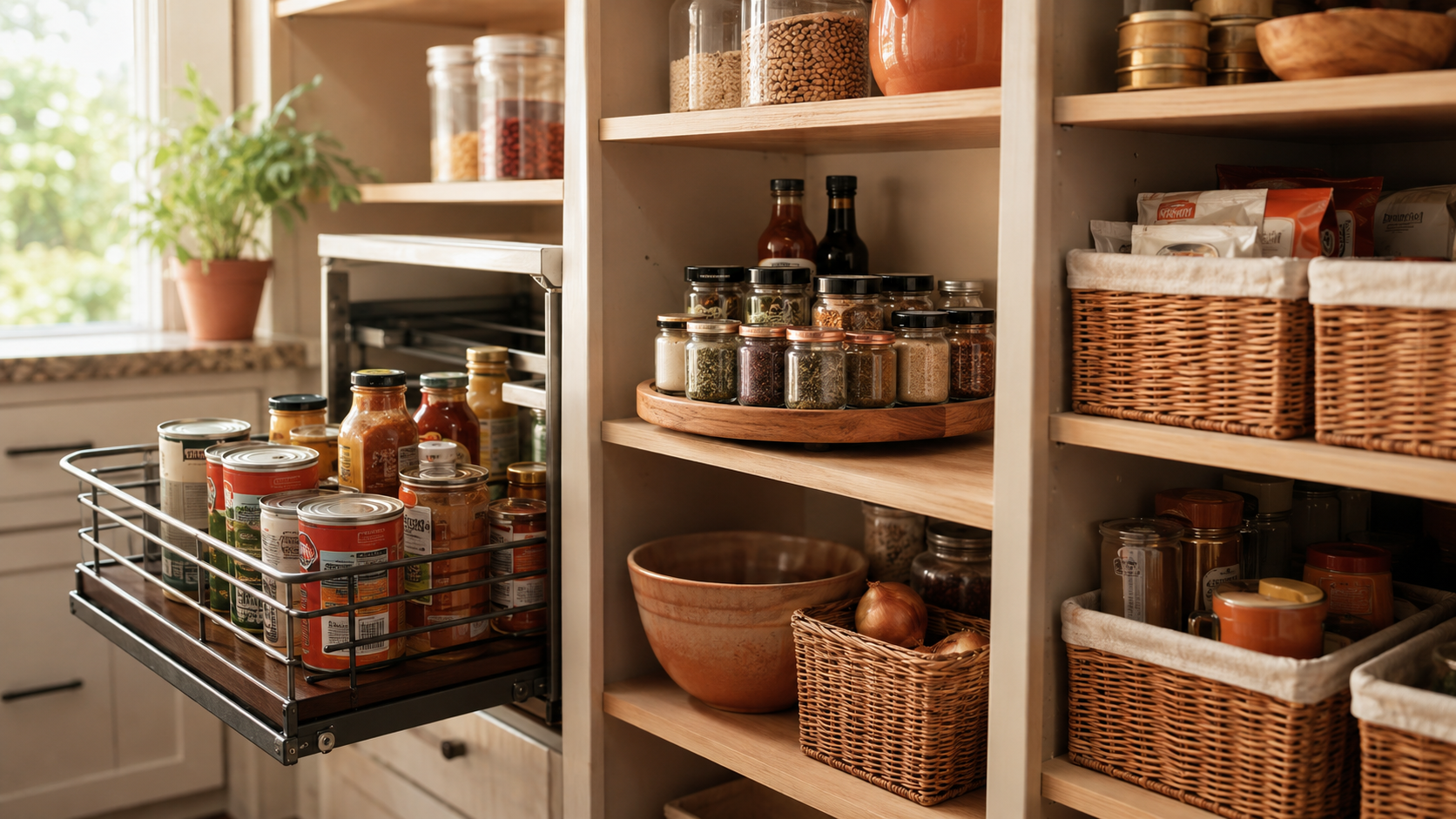
Deep pantry shelves look generous on paper. More depth should mean more storage.
But once boxes, cans, jars, and backstock start filling that depth, something else happens: the shelf can hold plenty of food while making some of it harder to see, reach, and retrieve. That distinction matters. The goal of a pantry isn’t to fit the largest possible number of items onto a shelf — it’s to make the food you store usable.
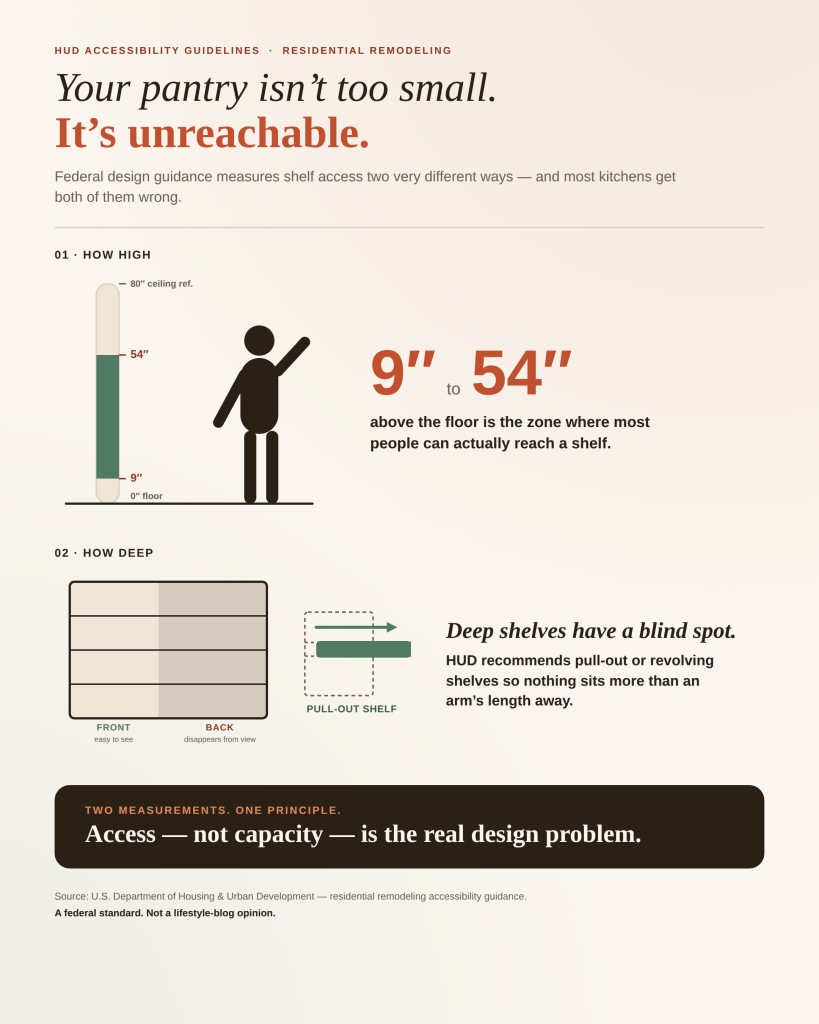
HUD’s residential remodeling guidance addresses this directly in two ways. First, on vertical reach: “Most people can reach shelves mounted between 9 inches and 54 inches above the floor.” Second, and separately, on depth specifically: HUD recommends considering “pull-out or revolving shelves to make it easier to reach items stored at the back” of deep, narrow pantry shelving. Those are two different measurements — how high a shelf sits, and how far back into it something can hide — and both point in the same direction: access, not raw capacity, is the design problem. That’s a federal guideline, not a lifestyle-blog opinion.
So instead of asking which pantry organizer is best, start with: what is this shelf’s depth actually preventing me from doing? If you can’t remember what’s in the back, that’s an organization problem. If you can see an item but can’t comfortably reach it, that’s an access problem. If getting one product means unloading everything in front of it, that’s retrieval. And if the shelf already works, you may not need an organizer at all.
1. How Deep Should Your Pantry Shelves Actually Be?
Two independent sources land in a similar range — real convergence, not one blogger’s opinion — though they don’t agree on an exact number, and that disagreement is itself useful information:
| Source | Standard shelf | Upper/high shelf |
|---|---|---|
| Dimensions.com | 14–16 in | 10–12 in |
| The Kitchn (interview with Scott Davis, VP Product Development, Closetmaid) | 16–20 in | ~12 in |
Closetmaid’s own advice, direct quote: if items “consistently disappear toward the rear,” go shallower still. There’s no universal cutoff where a pantry suddenly becomes “too deep” — the two sources genuinely differ, and inventing a single magic number (12, 15, 16, 20 inches) would overstate what the evidence supports. The functional test matters more than any number: does the depth make items difficult to see, reach, or retrieve? If not, depth may not be a problem at all, whatever the shelf measures. If it does, that’s the moment to change how the shelf works — which is exactly the gap HUD’s pull-out/revolving-shelf recommendation is aimed at.
Measure the opening, not just the shelf.
A container that looks perfect online can fail because of a door frame, hinge, shelf lip, or an opening narrower than the interior shelf. For a removable bin, measure usable width, usable depth, vertical clearance, and the narrowest point the bin has to pass through. For an installed rollout, add cabinet opening width, door/hinge clearance, slide dimensions, required mounting space, extension distance, and the manufacturer’s load rating. The dimensions printed for the pantry itself are not the dimensions available to the organizer.
2. Three Tools, Three Different Jobs
“Pull-out,” “turntable,” and “zone storage” are treated as competing ideas. That comparison is useful but incomplete — they solve different parts of the access problem:
Pull-outbrings a group of items — or the entire storage surface — toward you.The turntablerotates individual items from back to front.Zone storagecontrols where categories and inventory live on the existing shelf.
That means the right answer may not be one of the three. It may be a combination — and sometimes it costs nothing.
| Feature | Pull-Out Bin / Mounted Rollout | Turntable | Zone Storage |
|---|---|---|---|
| Primary job | Bring a category or the storage surface forward | Rotate individual items toward the front | Give inventory a predictable location |
| Useful when | Depth creates obstruction or difficult retrieval | Several smaller items benefit from individual access | Location and inventory awareness are the main failures |
| Weight | Removable bins move with their contents; mounted systems depend on the hardware’s rated load | Follow the specific turntable’s rated load and stability | Constrained by the shelf itself, not the zoning strategy |
| Installation | None for removable bins; required for mounted rollouts | Usually none for standalone models | None, using existing storage |
| Main tradeoff | Weight (bins) or cost/clearance/hardware (mounted) | Footprint, diameter, and stability | Doesn’t mechanically solve a reach problem |
| Cost direction | $ (bin) → $$$ (installed rollout) | Usually $–$$ | Potentially $0 |
There’s no universal winner in that table because these aren’t three versions of the same tool.
3. Pull-Out Bins and Drawers for Deep Pantry Shelves
There’s an important distinction hidden inside “pull-out”: a removable bin and a permanently mounted rollout are not the same product.
Removable bins turn a deep shelf into something resembling a manual drawer — instead of reaching behind six packages, you pull the whole category forward. Good for snack packets, baking ingredients, breakfast items, small boxes. No slides, no cabinet modification, cheap to test before committing to hardware. But the weight moves with the bin: a bin full of lightweight packets behaves very differently from one packed with canned goods, so a “pull-out bin” shouldn’t automatically mean “best for heavy food.”
Mounted rollouts change the mechanics — the storage surface itself travels on slides. Family Handyman’s practical installation guide reports a real distinction between the two common slide types, worth checking before buying based on the tray alone:
| Slide type | Extension | Weight rating (per Family Handyman) | Relative cost | Limitation |
|---|---|---|---|---|
| Roller slides | ~¾ of shelf length | 35–100 lb | Cheapest | Back few inches stay out of reach |
| Ball-bearing slides | Full extension | 75–100 lb standard, up to 200 lb in reinforced versions | ~3× roller-slide cost, per that source | Precise installation required |
Those numbers describe what one detailed buying guide reports for these hardware categories generally—always confirm the load rating printed on the specific slide you’re buying, since that’s the number that actually governs safe use. Separately, Rev-A-Shelf’s product catalog describes its ball-bearing pull-out baskets as commonly built to a 22-inch depth and rated for 100 lb per basket—a manufacturer-wide catalog spec, not the measurement of any one SKU.
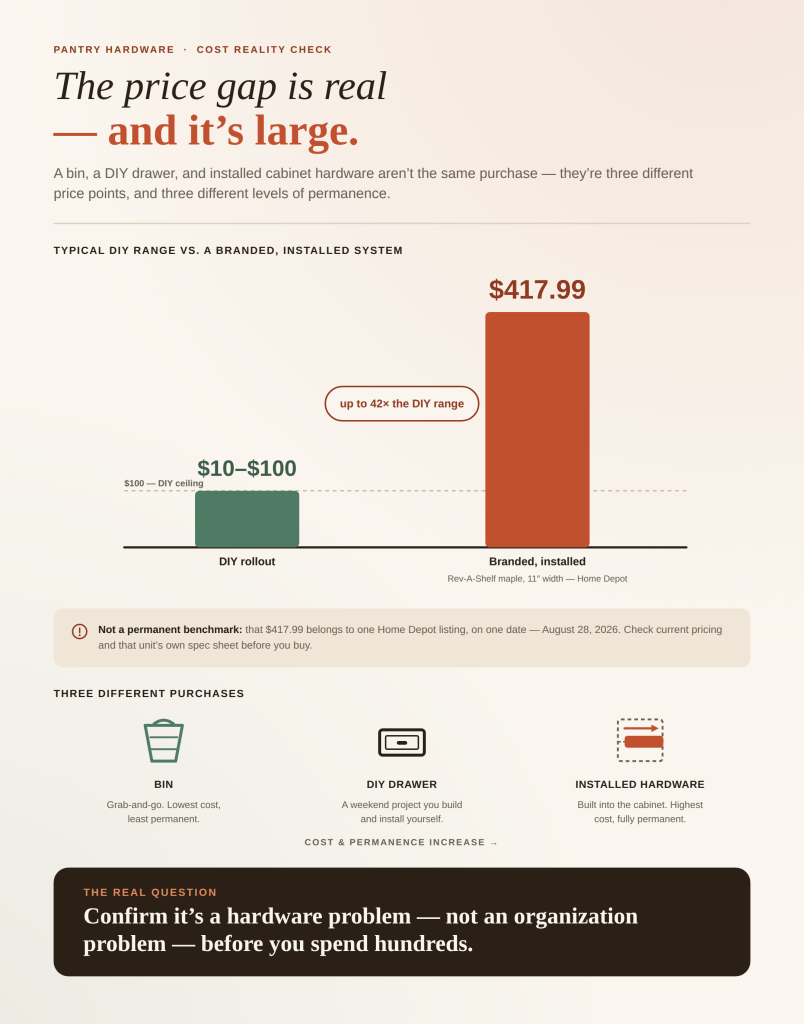
The price gap is real and large. A DIY rollout runs $10–$100. A branded, professionally built system (Rev-A-Shelf maple, 11-inch width) was listed at Home Depot for $417.99 as of August 28, 2026 — that price belongs to that specific listing on that specific date, not a permanent benchmark or a stand-in for the catalog specs above; check current listings and that unit’s own spec sheet before buying. Still, the gap illustrates something real: a bin, a DIY drawer, and installed cabinet hardware are three different purchases at three different levels of cost and permanence. Before spending hundreds of dollars, confirm the shelf has a hardware problem, not an organization problem.
4. Turntables (Lazy Susans)
A turntable solves depth differently — it doesn’t bring the shelf toward you; it brings the item toward you. That makes it particularly well suited to collections of smaller items that benefit from individual access: jars, spice bottles, condiments. It is an access device, not automatically a capacity-maximizing device — large boxes or floppy bags gain little from rotation.
Real sizes, confirmed directly from manufacturers: OXO’s “Not So Lazy Susan” line includes a 16-inch model (confirmed on oxo.com). IKEA’s KLIPPKAKTUS measures 11 inches in diameter with an 11-pound maximum load and raised edges to keep items in place during rotation ($11.99, verified on ikea.com) — a useful reminder that turntable capacity is a real, per-product number, not a category-wide constant, so check the manufacturer’s rating before loading it with heavy jars. At retail, OXO Good Grips turntables list for $16.99–$22.99 at The Container Store; other brands run $11.89–$20.99 (snapshot, August 28, 2026) — dated examples, not typical or representative prices going forward.
Does a lazy Susan waste space?
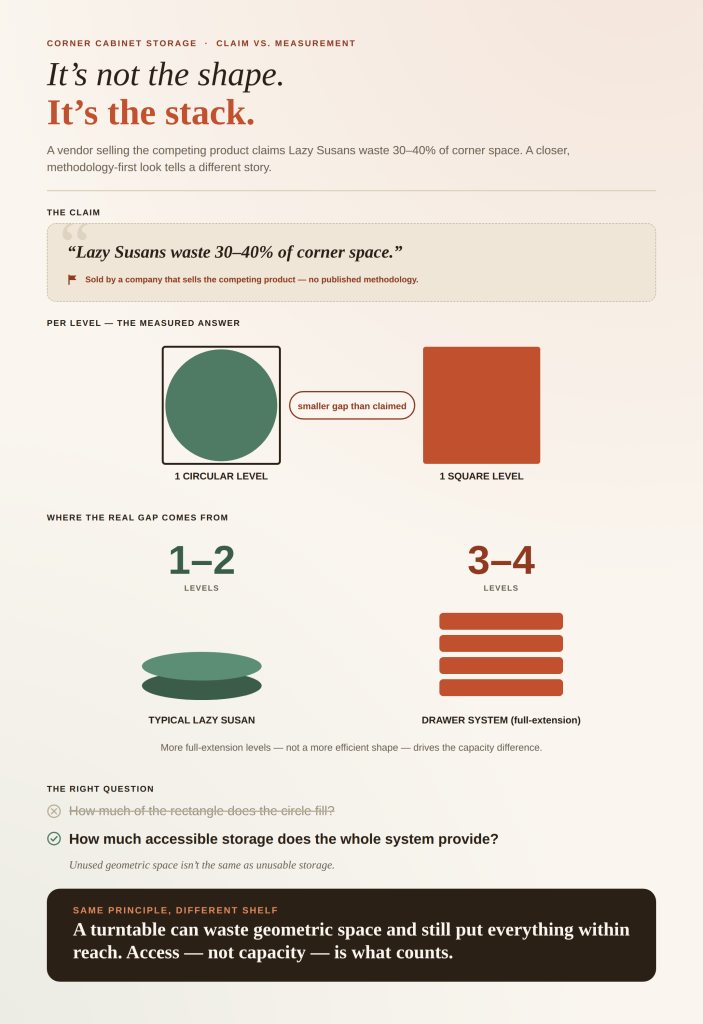
This deserves more caution than it usually gets. One vendor promoting corner-drawer alternatives claims Lazy Susans waste 30–40% of corner space — but that claim comes from a company selling the competing product, with no transparent methodology behind the number. A separate, more detailed public breakdown of corner-cabinet math reaches a more measured conclusion: comparing one circular level against one square level didn’t show the dramatic per-level penalty people might expect. In that analysis, much of the total-capacity advantage on the drawer side came from stacking additional full-extension levels (three or four, versus one or two for a typical corner lazy Susan), rather than from a large per-level efficiency gap. The useful question isn’t “how much of the rectangle does the circle fill” — it’s “how much accessible storage does the whole system provide.” A turntable can leave geometric space unused while making everything on it directly retrievable.
5. Zone Storage
Zone storage has no slides, doesn’t rotate, and may require no new product at all — it simply gives categories a predictable place to live (breakfast, baking, dinner, snacks).
Here’s the evidence distinction worth making, honestly: “zone storage” is common terminology among professional organizers and storage companies. No academic research establishes “zone storage” as a scientifically validated system, so this article won’t pretend otherwise. What is backed by real institutional guidance is the rotation principle that makes zoning actually work: Penn State Extension’s guidance on home food storage is direct — “Inventory your canned goods each year, putting older foods where they will be used first… This is called the FIFO method, ‘first in, first out.’” A zone creates the plan for that rotation; it provides zero mechanical assistance. If every new package gets shoved in front of the older one, depth gradually becomes an inventory graveyard—and the fix isn’t another organizer; it’s a rule.
6. Daily Use and Backstock Shouldn’t Compete for the Same Access
This matters especially if you buy groceries in bulk. As covered in The Costco Pantry Problem, daily-use inventory and backstock do different jobs: daily-use should prioritize access; backstock should prioritize protection and rotation. A simple pattern—opened/older/frequently used toward the front, unopened backstock toward the back—isn’t a universal law (package shape, shelf configuration, and household height all change it), but the underlying question stays useful: does the location of this product match how often you need it?
Don’t automatically move overflow to the garage.
USDA’s Food Safety and Inspection Service is specific: shelf-stable food belongs in “a cool, dry place,” with temperatures below 85°F preferred — never above or beside the stove, under the sink, in a damp garage or basement, or anywhere exposed to extreme temperature swings (above 100°F is described as actively harmful to canned goods). A larger storage area is not automatically better storage.
7. Accessibility Isn’t Just for Adults
Worth knowing, and useful for how you think about this problem, is that federal accessibility standards don’t define a single human reach range — the U.S. Access Board’s building-accessibility standards set an adult reach range (15–48 inches, unobstructed) and, separately, lower advisory ranges for building elements meant primarily for children: 20–36 inches for ages 3–4, 18–40 inches for ages 5–8, and 16–44 inches for ages 9–12 (verified independently across two sources).
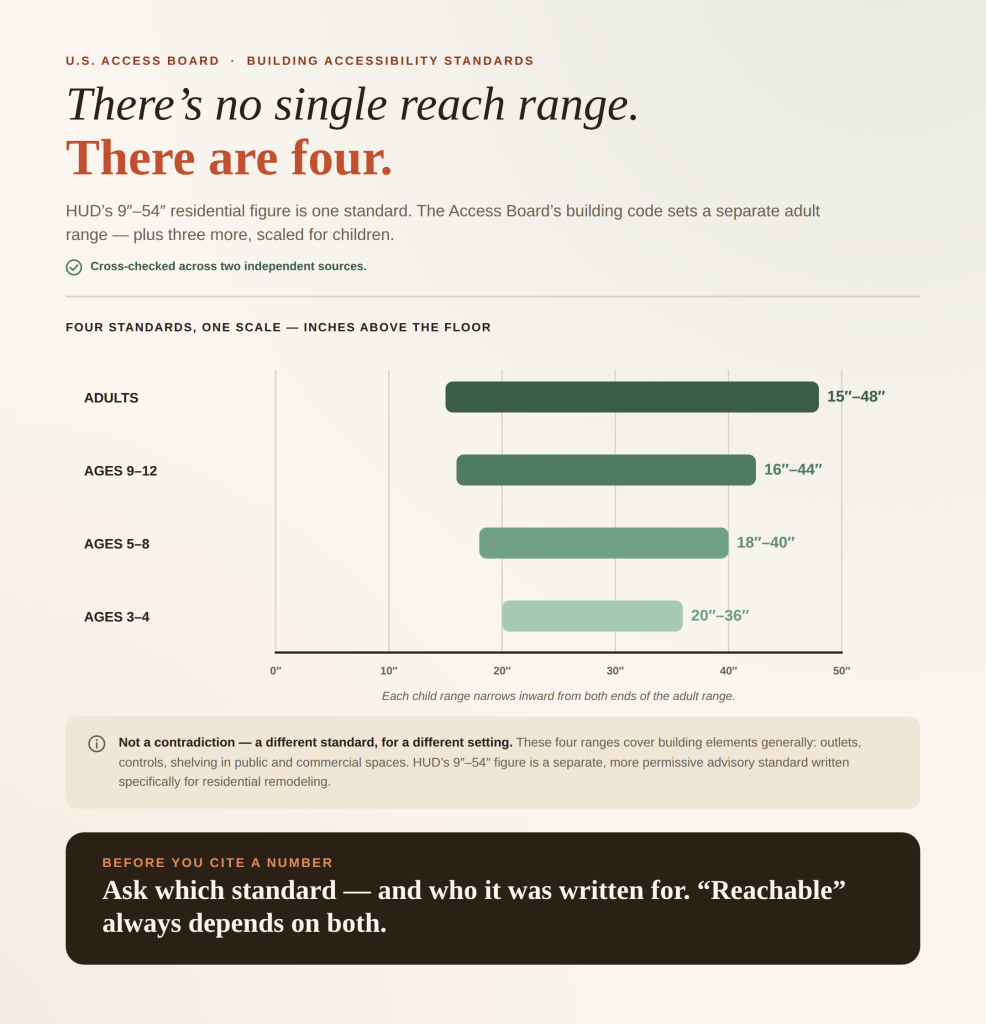
To be precise about what that is and isn’t: these are accessibility standards written for public buildings and covered facilities, not a code or recommendation for how a household should arrange its own kitchen. Nothing here says a family “must” keep a child’s snacks within a specific band of inches. What the numbers do illustrate, reliably, is the underlying principle worth carrying into any pantry decision: reach isn’t one fixed number — it changes with who’s doing the reaching. A shelf height that’s merely inconvenient for an adult can be functionally unreachable for a child, or for anyone else in the household with limited reach or mobility. That’s a reason to think about who actually uses a given shelf before organizing it, not a rule to measure against.
For deep storage specifically, that principle points to the real measure of success: capacity + visibility + reach + retrieval together, not how many items physically fit.
DECISION BOX
Use the Access Problem to Choose the Tool
- “I don’t know what’s back there.” Start with zone storage + inventory rotation — the problem is information, not hardware.
- “I have a whole category buried behind other things.” Consider a removable pull-out bin — retrieve the category, not one item at a time. Watch how heavy the bin gets.
- “I have lots of small jars or bottles and want individual access.” Consider a turntable — check the diameter against the shelf and confirm the load rating.
- “I use this shelf constantly and reaching the back is physically awkward.” Consider a mounted full-extension rollout — check opening width, hinges, slide extension, and load rating before buying.
- “My pantry is full because I keep buying duplicates.” Don’t start with more organizers — start with inventory visibility and zoning. Multiple independent pantry installers describe poor visibility as a mechanism behind forgotten, duplicated purchases; we did not find research quantifying how much household waste this causes — but if you keep finding duplicates behind other food, your own pantry has already shown you the problem.
- “Everything already fits and I can reach it.” Consider nothing. An organizer should solve a problem — filling a working shelf with product adds cost without adding function.
8. A Better Decision Order
- Inventory — what actually lives here?
- Frequency — daily, weekly, occasional, or backstock only?
- Access — can’t see it, can’t reach it, or have to move other things?
- Geometry — depth, width, opening, height, door/hinge clearance (measured, not estimated).
- Load — how heavy will the stored category get, checked against the hardware’s actual rating?
- Tool — only now: zone it, rotate it, pull the category forward, pull the shelf forward — or leave it alone.
9. Recommended Setups by Household Situation
Small kitchen / shallow pantry —the dominant question is simply whether items are actually getting lost or hard to reach, regardless of the shelf’s measured depth. Zoning alone often solves it; skip hardware until a specific item keeps disappearing.Family with kids who help themselves —the dominant variable is who’s actually reaching, not adult convenience. Items a child is meant to reach independently work best when placed within that child’s real reach, with turntables reserved for light items that kids can safely spin themselves.Large or secondary pantry/backstock space —the dominant variables are weight and rotation, not visibility alone. A mounted rollout can justify its higher cost here if retrieval frequency, load, and geometry actually call for it — and the USDA storage-condition rule (cool, dry, below 85°F) matters more than in a daily-use cabinet.
The Cheapest Fix Gets the First Test
- $0 — Rezone. Change where things live before changing the cabinet. If that fixes it, stop.
- $2–$17 — Removable bins (Container Store, snapshot Aug 28, 2026). Useful when grouping and pulling a category forward solves the access problem.
- $12–$23 — Turntable (OXO/iDesign, snapshot Aug 28, 2026). Useful when individual access to multiple smaller items is the problem.
- $10–$100 DIY, up to $418 branded — Mounted rollout (snapshot Aug 28, 2026). Useful when physical reach and frequent retrieval justify changing how the shelf operates.
These are dated examples observed on specific retail listings, not representative or typical prices — check current listings before buying. What’s more durable than any number here is the sequence: try the least expensive intervention capable of solving the actual problem. You can always add hardware later — it’s much harder to make an unnecessary purchase free again.
VERDICT BOX
THE BOTTOM LINE
Deep pantry shelves are not automatically bad design — depth gives you capacity. The problem begins when that capacity becomes difficult to see, reach, or rotate.
That’s why there’s no universal winner between pull-out bins, turntables, and zone storage. They aren’t three versions of the same solution: zoning decides where things live, bins bring groups forward, turntables rotate individual items forward, and mounted rollouts bring the storage surface itself forward.
Common mistake: buying the most expensive tool (a full mounted rollout) for a problem a simple turntable — or a free rezoning — would have solved.
10. Sources / Methodology
HUD — Residential Remodeling and Universal Design →
The Kitchn — The Ideal Measurements for Your Pantry Shelves →
Dimensions.com — Pantry Storage Depths →
U.S. Access Board — Chapter 3: Operable Parts (reach ranges) →
USDA FSIS — Shelf-Stable Food Safety →
Penn State Extension — Storage Guidelines for Home Preserved Foods →
Rev-A-Shelf — Pull-Out Pantry Systems (catalog spec) →
Home Depot — Rev-A-Shelf 448-BC-11C (price snapshot, Aug 28, 2026) →
Family Handyman — Tips for Installing Pull-Out Pantry Shelves →
OXO — 16″ Not So Lazy Susan Turntable →
IKEA — KLIPPKAKTUS Lazy Susan →
The Container Store — Lazy Susans & Turntables (price snapshot, Aug 28, 2026) →
The Container Store — Clear Bins & Baskets (price snapshot, Aug 28, 2026) →
Houzz Forum — Corner Cabinet Space Calculations →
Note on pricing: all prices reflect a snapshot observed on August 28, 2026. Check current listings before purchasing.
