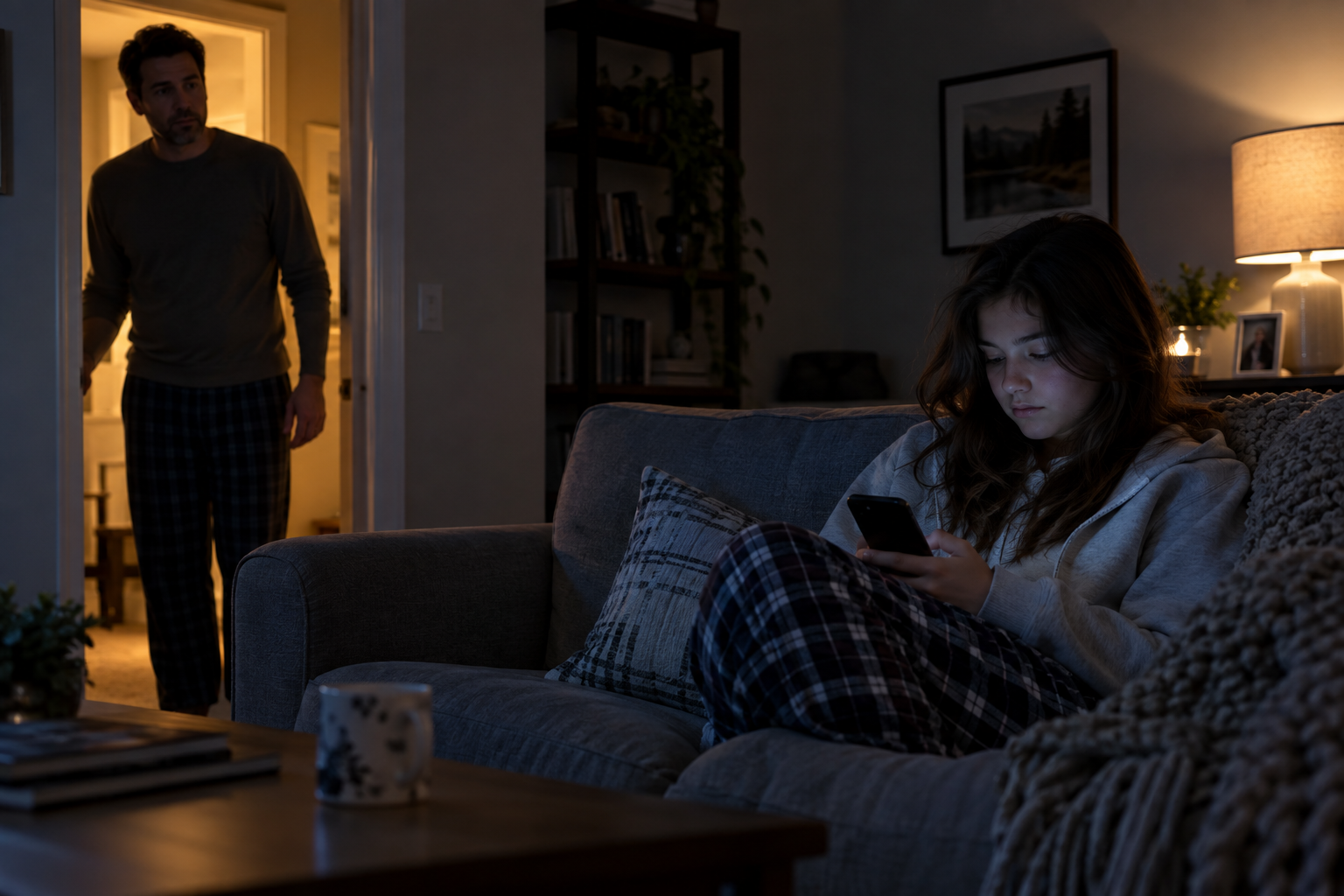
It’s a school night, a little before ten.
Your 13-year-old is sitting on the couch with a phone in hand. You walk into the room, and the screen goes dark.
Maybe it’s nothing.
But maybe you’ve noticed other changes lately, and a question you’ve been trying not to ask moves to the front of your mind:
What if something is happening online?
So you search.
Within minutes, you can find warning signs, statistics about how many teens are cyberbullied, and lists telling parents exactly what to do.
The research is less tidy.
Some things are supported by evidence. Others are recommendations from government agencies or professional organizations. And for some common recommendations, our targeted review found no studies measuring whether they improve later outcomes.
That doesn’t leave parents helpless.
It changes the first question.
Instead of starting with:
“Is my child being cyberbullied?”
Start with:
“What actually happened, what else might be happening, and what does this situation require from me?”
First, What Counts as Cyberbullying?
Federal bullying guidance describes bullying among school-aged children as involving unwanted aggressive behavior, a real or perceived power imbalance, and repetition or the potential for repetition.
That means not every cruel message or painful online interaction automatically fits the conventional definition of bullying.
Online, however, some of those boundaries become harder to apply.
Repetition is a good example.
Langos argued in 2012 that a single public online post can function repetitively because people can continue viewing it. Dooley, Pyzalski and Cross similarly discussed how persistent digital material complicates the traditional repetition criterion.
Those are conceptual arguments.
Separately, a study of 899 Italian adolescents who evaluated 2,946 incidents found that frequency shaped whether victims classified an incident as cyberbullying. The same pattern did not hold when adolescents evaluated incidents from a perpetrator’s perspective.
But those are two different kinds of repetition.
One concerns repeated actions.
The other concerns what happens after something has already been posted.
We found no empirical study establishing that every additional view or reshare automatically satisfies the traditional repetition criterion.
Nor did we find a basis for saying repetition simply stops mattering online.
For a parent, the practical point is narrower:
An uncertain label does not make a painful event trivial. It only means the label may not be the most useful question to answer first.
The Cyberbullying Number You’ve Heard May Not Measure What You Think
In 2022, Pew Research Center surveyed 1,316 U.S. teens ages 13 to 17.
Forty-six percent said they had ever experienced at least one of six online behaviors.
Those included offensive name-calling, false rumors, unsolicited explicit images, physical threats, someone other than a parent constantly asking where they were, what they were doing or who they were with, and explicit images of them being shared without consent.
That 46% is real.
But it is not a universal cyberbullying rate.
Pew’s question didn’t ask whether the behavior was repeated or involved a power imbalance.
And “ever” is very different from asking what happened during the past month or year.
Now compare that with the National Center for Education Statistics.
During the 2021-22 school year, 19.2% of students ages 12 to 18 reported being bullied during school. That figure covers all bullying at school, not cyberbullying alone.
Among those students who reported bullying, 21.6% said it happened online or by text.
Those numbers should not be multiplied together and presented as an NCES-published cyberbullying rate. That would be our calculation, not theirs.
The CDC’s 2023 Youth Risk Behavior Survey uses yet another approach. It asks U.S. high-school students whether they had been electronically bullied during the previous 12 months, including through texting, Instagram, Facebook or other social media.
Different surveys are measuring different things, in different populations, over different periods and with different sampling methods.
The available evidence does not tell us which of those differences explains the gaps between their results.
At a Glance: Three Surveys, Three Different Measures
| Survey | What It Measured | Key Figure | What It Doesn’t Tell You |
|---|---|---|---|
| Pew Research Center (2022) | Ever experienced at least one of six online behaviors — U.S. teens ages 13–17, n = 1,316 | 46% | Didn’t ask whether the behavior was repeated or involved a power imbalance |
| National Center for Education Statistics (2024) | Bullied during school, any form — ages 12–18, 2021-22 school year | 19.2% reported school bullying; 21.6% of those said it happened online or by text | The 19.2% covers all school bullying, not cyberbullying alone — the two figures shouldn’t be multiplied into a single rate |
| CDC Youth Risk Behavior Survey (2023) | Electronically bullied in the previous 12 months — U.S. high-school students | Not reported here | A different population, timeframe and question wording from the two surveys above |
So when you encounter a cyberbullying percentage, ask three questions:
- What did the survey measure?
- In whom?
- Over what period?
A percentage without those answers can create more certainty than the research deserves.
Warning Signs Aren’t a Diagnosis
Government resources do list warning signs of bullying.
StopBullying.gov, for example, describes general changes parents might notice.
Those changes can be reasons to pay attention or begin a conversation.

But we found no validation study showing how accurately common parent-observed warning signs identify cyberbullying.
That is an important distinction.
It does not mean the signs are unreliable. Rather, it means our research did not find evidence establishing how accurately they identify cyberbullying.
And there is another complication.
Parents and children may not see the same experience in the same way.
A 2025 study by Rapp, Fredrick and Nickerson examined 231 parent-child pairs from grades 4 through 12 in one suburban Northeastern U.S. school district.
Overall parent-child agreement about the child’s cybervictimization was low: κ = .18.
Secondary findings from the same study found lower agreement around social-media incidents than around text or email incidents.
Parents were not simply underreporting everything, either. In this sample, parents actually reported slightly more cybervictimization overall than their children did.
One study cannot tell us what happens in every family.
Our read: it does illustrate why observation alone has limits. You may notice that something changed; your child may still hold context you can’t observe.
The Phone May Not Be the Whole Story
Once you know something happened online, there is another question worth asking:
Is something connected to this happening offline too?
A meta-analysis by Chen, Ho and Lwin found traditional victimization to be the strongest examined correlate of cybervictimization.
Much of the pooled evidence was cross-sectional.
So it does not establish that traditional bullying causes cyberbullying.
But it does show that online and offline victimization can overlap.
That makes asking about school or other offline settings reasonable.
This is an editorial inference from the overlap evidence, not a finding about your individual child.
The phone may be where you first see the problem.
It does not necessarily tell you where the problem begins or ends.
What Mental-Health Research Actually Shows
Cybervictimization deserves to be taken seriously.
But serious evidence does not need to be exaggerated.
A longitudinal meta-analysis by Lee and colleagues examined studies published from January 2010 through June 2021.
Across the relevant studies, cybervictimization was associated with later depression symptoms at about r = .27 and anxiety symptoms at about r = .23.
Those are associations.
They do not establish that cyberbullying caused the later symptoms.
Other longitudinal research finds that the relationship can run in both directions: victimization may contribute to later difficulties, or existing difficulties may increase vulnerability to victimization. That’s not a full account of the mechanism, only a reason to say the direction isn’t settled.
Research has also reported associations between cybervictimization and serious outcomes such as self-harm and suicidal thoughts.
Again, observational association is not proof of causation.
Serious outcomes should not be minimized. They also should not be sensationalized.
If your child is talking about harming themselves, or you’re worried about their immediate safety, go straight to the safety steps near the end of this article.
The useful question for a parent is whether the child in front of them needs support or immediate protection.
At a Glance: What This Research Does and Doesn’t Establish
| Finding | What the Evidence Shows | What It Doesn’t Show |
|---|---|---|
| Depression symptoms | Associated with cybervictimization, about r = .27 | That cyberbullying caused the depression |
| Anxiety symptoms | Associated with cybervictimization, about r = .23 | Same limit — association, not causation |
| Direction of the relationship | Longitudinal research finds it can run in both directions | A full account of the mechanism — only a reason the direction isn’t settled |
| Self-harm and suicidal thoughts | Associations have been reported | Proof of causation — this is observational association |
Will Your Child Tell You?
It is tempting to think:
If something serious were happening, my child would tell me.
The evidence doesn’t let us assume that.

In the NCES School Crime Supplement for the 2021-22 school year, 44.2% of students ages 12 to 18 who reported being bullied during school said an adult at school was notified.
That statistic covers bullying generally.
It does not specifically measure cyberbullying, disclosure to parents, or disclosure to all adults.
Older cyberbullying research also found substantial nondisclosure.
In an English study using data from 2005-06, a substantial share of cyberbullied pupils told no one. Among those who disclosed, friends were reported more often than parents or teachers.
Those data predate today’s smartphone environment, so they should not be treated as a current estimate.
Qualitative research adds another piece.
Dennehy and colleagues conducted 11 focus groups with 64 young people ages 14 to 17.
One barrier to seeking support was a lack of confidence in parents’ ability to provide it.
That finding tells us such concerns exist.
It does not tell us how common they are.
What Your Reaction Can—and Can’t—Change
This is where the evidence becomes surprisingly thin.
The American Academy of Pediatrics advises parents not to threaten to take away a child’s device after learning about cyberbullying.
Its reasoning is that the child may see losing the device as punishment and become less willing to tell a parent about bullying situations in the future.
That is professional guidance.
It is not a demonstrated outcome from a study that followed children after disclosure.
We specifically looked for research following this sequence: a child discloses, a parent responds, and researchers later measure whether the child discloses again. None turned up testing that complete sequence.
So advice such as “stay calm and your child will tell you next time” may sound sensible, but it is not a demonstrated finding in this evidence record.
The broader parenting literature is more encouraging about conversation than restriction, but it is mixed and largely correlational.
Some family characteristics show small associations with cybervictimization. Monitoring itself was not significantly associated with cybervictimization in one synthesis.
A longitudinal Korean study found that parent-child communication predicted less later victimization, but that study concerned general bullying, not cyberbullying specifically.
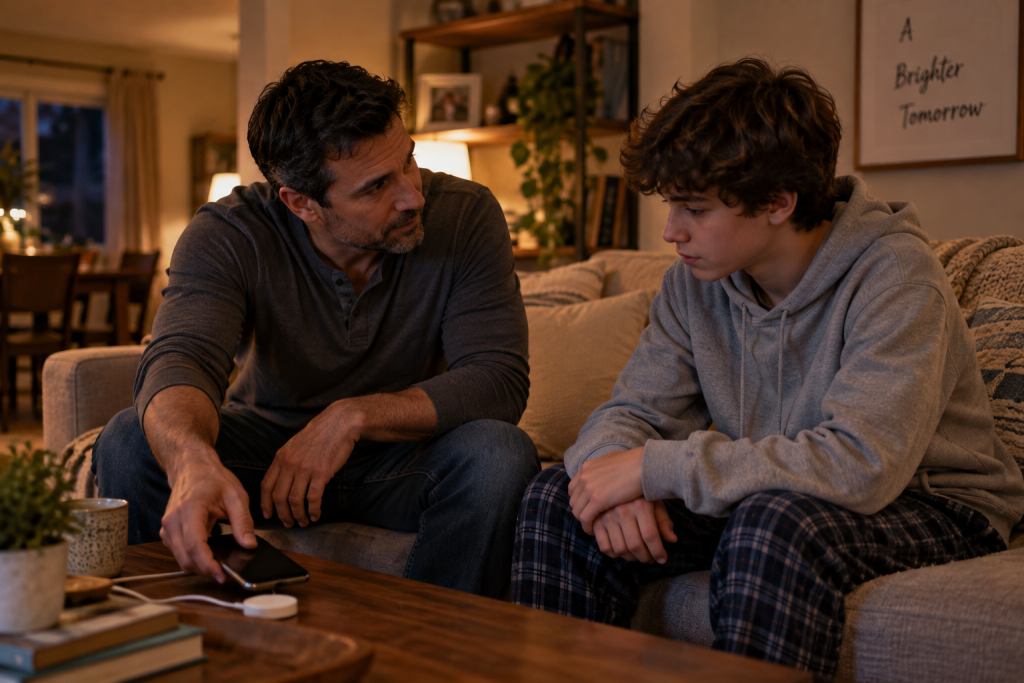
Our read: that gives some support to conversation-based approaches. It doesn’t support promising your child, or yourself, that any particular way of talking will work. Research doesn’t give parents a guaranteed script, and that’s different from saying there’s nothing a parent can do.
Before Choosing a Response, Find Out What Happened
This next step is an editorial framework, not a validated cyberbullying assessment tool.
Try to understand the situation before deciding which response fits it. Ask:

- What happened? Was it one message, repeated behavior, a public post, a rumor, exclusion, impersonation, a threat, sexual content, or something else?
- Who is involved? Someone your child knows? Several classmates? A stranger? An adult?
- Is it continuing? A past incident and an active situation may require different decisions.
- Is something connected happening offline? The online interaction may be only one part of the problem.
- Does your child feel unsafe? That can change the response quickly.
And ask what your child thinks will happen if adults become involved. That doesn’t mean a child gets veto power over necessary safety decisions. It gives you information you didn’t have before.
Screenshots, Blocking and Reporting: What These Steps Actually Do

StopBullying.gov recommends documenting harmful content, preserving evidence, blocking the person involved, and reporting behavior to the appropriate platform, school, or law enforcement when circumstances warrant it. The AAP also advises saving screenshots of online evidence.
Those are recommendations, not the same thing as demonstrated outcome effects.
Our targeted research found no cohort or experimental evidence showing that screenshotting, blocking, muting or platform reporting by itself reduces subsequent teen cybervictimization or distress. In older surveys, some teens rated blocking as helpful, but that’s a perception, not a measured outcome.
That doesn’t mean those actions are ineffective. They can still have immediate practical functions.
A screenshot can preserve material that might disappear. Blocking can close a particular route of contact. Reporting can notify a platform or institution that something is happening.
But the evidence in this review does not support promising that any one of those actions will make the problem stop. Guidance can be useful without pretending that guidance is proof of efficacy.
At a Glance: What Each Step Can and Can’t Do
| Action | What It Can Do | What the Evidence Doesn’t Show |
|---|---|---|
| Screenshot | Preserve material that might disappear | That doing this reduces later victimization or distress |
| Block | Close a particular route of contact | That blocking by itself stops the situation |
| Report | Notify a platform or institution that something is happening | That reporting guarantees a resolution |
What About the School?
The answer depends on the circumstances and where you live.
StopBullying.gov states that “there is no federal law that specifically applies to bullying.” State laws and school-district policies differ, including in how they address behavior that occurs away from school.
So neither extreme is safe: “It happened off campus, so the school can’t act,” nor “The school always has authority because students were involved.”
Whether and how a school can respond can depend on state law, district policy, the circumstances, and the connection between the behavior and school.
Harassment involving certain protected characteristics can also raise a separate federal civil-rights issue. The U.S. Department of Education’s Office for Civil Rights provides guidance on harassment based on race, color, national origin, sex and disability. Whether a school has particular legal obligations depends on the facts and applicable law. This article cannot determine what a particular school is legally required to do in an individual case.
When It Stops Being a Question of Definitions
Some situations should not wait for a debate over whether the behavior technically qualifies as cyberbullying.
Federal guidance identifies circumstances such as threats of violence, stalking, hate crimes, sexually explicit messages or images involving minors, and invasions of expected privacy as situations that may warrant escalation beyond an ordinary bullying response.
Sexual exploitation deserves its own boundary. Sextortion can involve sexual material followed by coercive demands and threats to distribute that material. That belongs to a different crime and safety framework, even if the first thing a parent sees is a message on a phone.
If your child is being sexually exploited or threatened with the release of intimate images, contact the FBI at 1-800-CALL-FBI or tips.fbi.gov, or report suspected child sexual exploitation to NCMEC at report.cybertip.org. Preserve relevant messages and account information. NCMEC also offers Take It Down to help limit the spread of intimate images taken when someone was under 18.
The same principle applies to immediate physical or mental-health danger.
If your child is in immediate danger, call 911. For suicide-related or mental-health crisis support in the United States, call or text 988, or use the chat at 988lifeline.org. The 988 Suicide & Crisis Lifeline is available 24 hours a day, seven days a week.
When immediate safety is at stake, the label is not the priority.
At a Glance: When to Escalate Beyond an Ordinary Bullying Response
| Situation | What To Do |
|---|---|
| Sexual exploitation, or threats to share intimate images | Contact the FBI (1-800-CALL-FBI or tips.fbi.gov) or NCMEC (report.cybertip.org). Preserve messages and account information. NCMEC’s Take It Down can help limit the spread of images taken when someone was under 18. |
| Immediate physical danger | Call 911. |
| Suicide-related or mental-health crisis | Call or text 988, or use the chat at 988lifeline.org. Available 24 hours a day, seven days a week. |
| Threats of violence, stalking, hate crimes, or invasion of expected privacy | Report threats of violence, stalking, suspected hate crimes or serious privacy violations to local law enforcement. If anyone is in immediate danger, call 911. Document relevant messages and account information. |
Back in the Living Room

The screen is still dark.
You still do not know what happened. No checklist can tell you from across the room, no national statistic can tell you what is happening to your child, and research cannot give you one parental response guaranteed to fix it.
But you are not starting from nothing.
You can ask what happened, find out whether the situation continues beyond the phone, and distinguish a painful interaction from a pattern that may require a larger response.
From there, you can preserve information, block or report where those actions serve a practical purpose, and involve other adults or institutions when the circumstances call for it. And you can recognize when the situation has crossed into threats, exploitation or immediate danger, where safety comes first.
None of those steps requires you to solve the definition before you begin.
Start with what happened. Then find out what else is happening, and decide what the situation requires.
The label can wait long enough for you to understand what your child actually needs.
Sources
- U.S. Department of Health and Human Services, StopBullying.gov (2021). What Is Bullying. stopbullying.gov/bullying/what-is-bullying.
- StopBullying.gov (reviewed Nov. 10, 2021). Warning Signs for Bullying. stopbullying.gov/bullying/warning-signs.
- StopBullying.gov (reviewed Dec. 11, 2024). Report Cyberbullying. stopbullying.gov/cyberbullying/how-to-report.
- StopBullying.gov (reviewed Nov. 10, 2021). Prevent Cyberbullying. stopbullying.gov/cyberbullying/prevention.
- StopBullying.gov (reviewed May 2023). Laws, Policies & Regulations. stopbullying.gov/resources/laws.
- Langos, C. (2012). Cyberbullying: The Challenge to Define. Cyberpsychology, Behavior, and Social Networking. SSRN full text.
- Dooley, J. J., Pyzalski, J., & Cross, D. (2009). Cyberbullying Versus Face-to-Face Bullying: A Theoretical and Conceptual Review. Zeitschrift für Psychologie / Journal of Psychology. Edith Cowan University repository.
- Menin, D., Guarini, A., Mameli, C., Skrzypiec, G., & Brighi, A. (2021). Was that (cyber)bullying? Investigating the operational definitions of bullying and cyberbullying from adolescents’ perspective. International Journal of Clinical and Health Psychology, 21(2), 100221. PMC full text.
- Pew Research Center (2022). Teens and Cyberbullying 2022. pewresearch.org.
- National Center for Education Statistics (2024). Student Reports of Bullying: Results From the 2022 School Crime Supplement to the National Crime Victimization Survey (NCES 2024-109). nces.ed.gov.
- Centers for Disease Control and Prevention. 2023 Youth Risk Behavior Survey Results. cdc.gov.
- Rapp, K., Fredrick, S. S., & Nickerson, A. B. (2025). Cyber victimization reports between parents and children: An examination of agreement predictors. Children and Youth Services Review. sciencedirect.com.
- Chen, L., Ho, S. S., & Lwin, M. O. (2017). A meta-analysis of factors predicting cyberbullying perpetration and victimization: From the social cognitive and media effects approach. New Media & Society. journals.sagepub.com.
- Lee, J., Choo, H., Zhang, Y., Cheung, H. S., Zhang, Q., & Ang, R. P. (2025/2026). Cyberbullying Victimization and Mental Health Symptoms Among Children and Adolescents: A Meta-Analysis of Longitudinal Studies. Trauma, Violence, & Abuse. journals.sagepub.com.
- Marciano, L., Schulz, P. J., & Camerini, A.-L. (2020). Cyberbullying Perpetration and Victimization in Youth: A Meta-Analysis of Longitudinal Studies. Journal of Computer-Mediated Communication, 25(2), 163–181. academic.oup.com (DOI 10.1093/jcmc/zmz031).
- John, A., Glendenning, A. C., Marchant, A., Montgomery, P., Stewart, A., Wood, S., Lloyd, K., & Hawton, K. (2018). Self-Harm, Suicidal Behaviours, and Cyberbullying in Children and Young People: Systematic Review. Journal of Medical Internet Research, 20(4), e129. jmir.org.
- Smith, P. K., Mahdavi, J., Carvalho, M., Fisher, S., Russell, S., & Tippett, N. (2008). Cyberbullying: Its nature and impact in secondary school pupils. Journal of Child Psychology and Psychiatry. Wiley (DOI).
- Dennehy, R., Meaney, S., Cronin, M., & Arensman, E. (2020). The psychosocial impacts of cybervictimisation and barriers to seeking social support: Young people’s perspectives. Children and Youth Services Review, 111. sciencedirect.com.
- American Academy of Pediatrics, HealthyChildren.org (last updated Jan. 28, 2022). Cyberbullying: How to Help Prevent It. healthychildren.org.
- Grama, D. I., Georgescu, R. D., Coșa, I. M., & Dobrean, A. (2024). Parental Risk and Protective Factors Associated with Bullying Victimization in Children and Adolescents: A Systematic Review and Meta-analysis. Clinical Child and Family Psychology Review, 27(3). doi.org.
- Choi, B. (2024). Parental Coping Strategies as Predictors and Outcomes of Bullying: Longitudinal Relationships Between Child Victimization, Parent-Child Communication, and Parent-Teacher Consultation. Journal of Youth and Adolescence, 53, 2378–2392. link.springer.com.
- Machackova, H., Cerna, A., Sevcikova, A., Dedkova, L., & Daneback, K. (2013). Effectiveness of coping strategies for victims of cyberbullying. Cyberpsychology: Journal of Psychosocial Research on Cyberspace, 7(3), article 5. cyberpsychology.eu.
- Perren, S., Corcoran, L., Cowie, H., Dehue, F., Garcia, D., Mc Guckin, C., Sevcikova, A., Tsatsou, P., & Völlink, T. (2012). Tackling cyberbullying: Review of empirical evidence regarding successful responses by students, parents and schools. International Journal of Conflict and Violence, 6(2), 283–293. stable archive copy (Deutsche Nationalbibliothek).
- Federal Bureau of Investigation. Electronic Tip Form. tips.fbi.gov.
- National Center for Missing & Exploited Children. CyberTipline. report.cybertip.org.
- National Center for Missing & Exploited Children. Take It Down. takeitdown.ncmec.org.
- 988 Suicide & Crisis Lifeline. 988lifeline.org.
- U.S. Department of Education, Office for Civil Rights. Civil Rights Laws. ed.gov.
