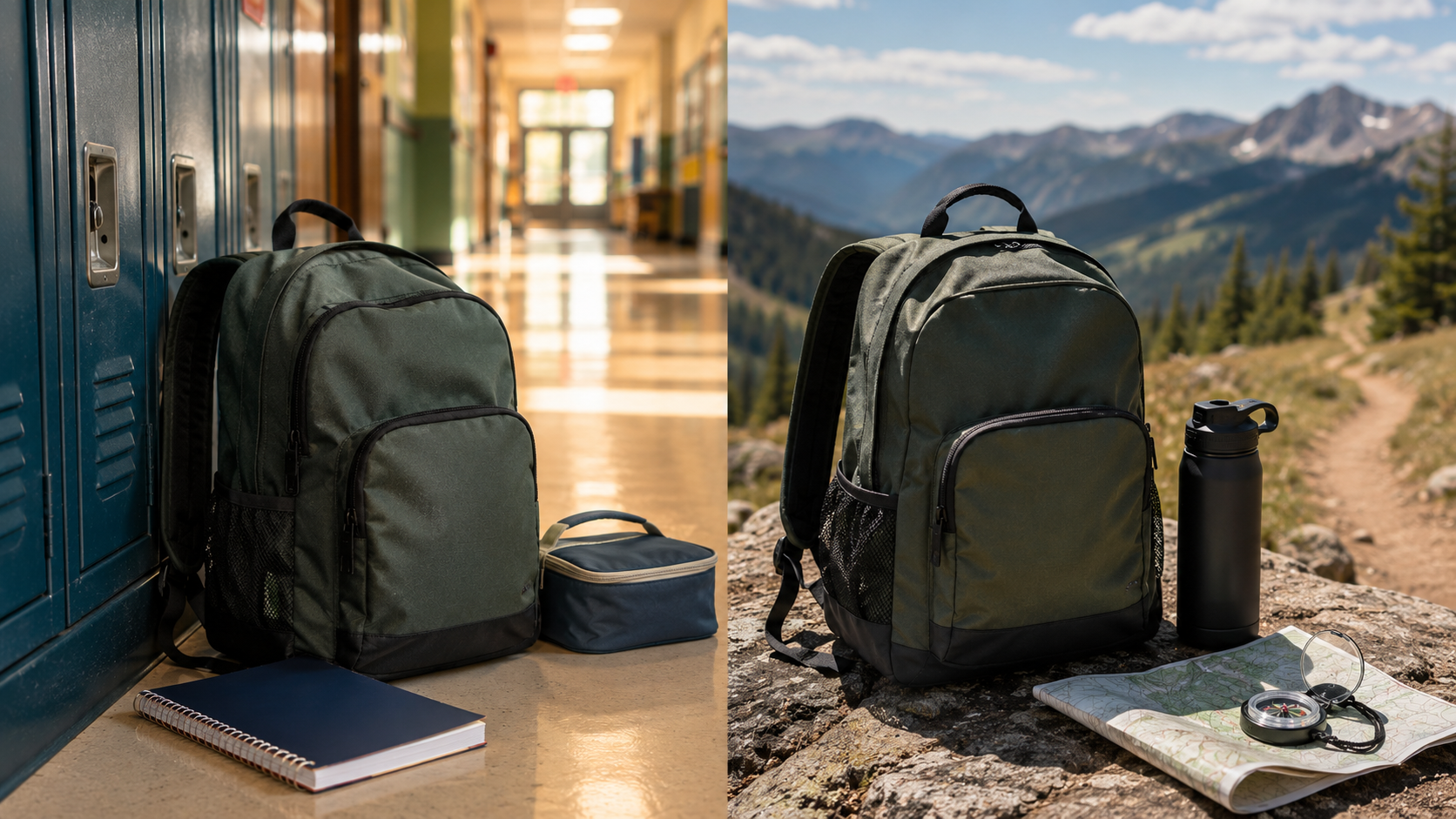
Every August, the same question shows up in parenting group chats: can we just buy one backpack that does both—carries books all week and comes camping with us on weekends?
It sounds like a reasonable ask. A backpack is a backpack.
Except it isn’t. School and hiking don’t ask the same things from a pack, and after digging through pediatric guidance, physical therapy and occupational therapy associations, orthopedic surgeons, a NOLS wilderness-medicine curriculum director, and the sizing literature from REI, Osprey, and Deuter, we couldn’t find a single medical or outdoor-industry authority that has validated “one bag for both” as its own category. That’s not a knock on dual-purpose packs — it just means the burden of proof falls on the bag itself, feature by feature, rather than on a label that says “does everything.”
The real question isn’t whether a backpack can go from classroom to trail. Almost any backpack can. The better question is: can one backpack fit the child, carry the appropriate load, organize school gear, and stay comfortable enough for hiking, without making a major compromise in either job?
For some children and some kinds of hiking, the answer is yes. For others, two specialized packs make a lot more sense. Here’s the evidence, sorted so you can tell which parts are professional guidance, which parts are things kids actually carry, and which parts are our own analysis.
The School-Backpack Rule: A Percentage of Body Weight, and Nobody Fully Agrees Which One
Ask a pediatrician’s office how heavy a school backpack should be, and you’ll get an answer measured as a share of body weight — but the exact share depends on who you ask.
The American Academy of Pediatrics, via its official HealthyChildren.org guidance, sets the ceiling at 15%: “Backpacks shouldn’t weigh more than 15% of your child’s body weight.” The American Academy of Orthopedic Surgeons uses the same number in its refreshed August 24, 2026 back-to-school guidance: “a child’s loaded backpack should weigh no more than 15% of their body weight” — while naming exactly what pushes kids over that line: “laptops, water bottles, textbooks, lunches, and activity gear all competing for space.”
Occupational therapy guidance draws the line lower. The American Occupational Therapy Association’s backpack-safety guidance sets the ceiling at roughly 10% of body weight, and the American Physical Therapy Association’s consumer arm, ChoosePT, lands in the same camp — translating that 10% into numbers a parent can use at home without doing math: a 50-pound child tops out around 5 pounds; a 70-pound child, 7 pounds; a 110-pound child, 11 pounds.
| Guideline | 60 lb child | 100 lb child |
|---|---|---|
| 10% (AOTA / APTA) | 6 lb | 10 lb |
| 15% (AAP / AAOS) | 9 lb | 15 lb |
So — 10% or 15%? The professional organizations draw the limit in different places — AOTA and APTA at the more conservative end, AAP and AAOS allowing a bit more room. We’re not collapsing this into “the science says 10%” or “the science says 15%” — the honest version is “professional guidance ranges from 10–15%, and everyone agrees more than that is a problem.” And these figures describe the loaded backpack, not just what’s inside it — the empty pack itself eats into a child’s carrying allowance before the first book goes in, which matters once you start comparing lightweight school bags against structured hiking packs with frames, hip belts, and adjustment systems.
Fit Matters as Much as Weight
Fit matters as much as weight. The AAP is specific: the pack should sit “from waist level up to about 1–2 inches below the shoulders” and never hang “more than 4 inches below the waistline.” And the stakes are real, not abstract — CPSC/AAOS data puts backpack-related injuries treated in U.S. emergency departments in 2016 at roughly 12,900, more than 6,300 of them in kids ages 5–18.
What Kids Are Actually Carrying (Which Isn’t the Same as What’s Recommended)
A widely cited study — Forjuoh, Lane, and Schuchmann, American Journal of Physical Medicine & Rehabilitation, 2003 — directly weighed backpacks against body weight for kindergarten-through-fifth-grade students at three central-Texas elementary schools. The average was 8.2% of body weight, comfortably under even the stricter 10% guideline. But the average hides a steep climb by grade: kindergartners carried just 6.2%, while fifth graders averaged 12.0%, and 26% of all students measured were already at or above the 10% threshold.
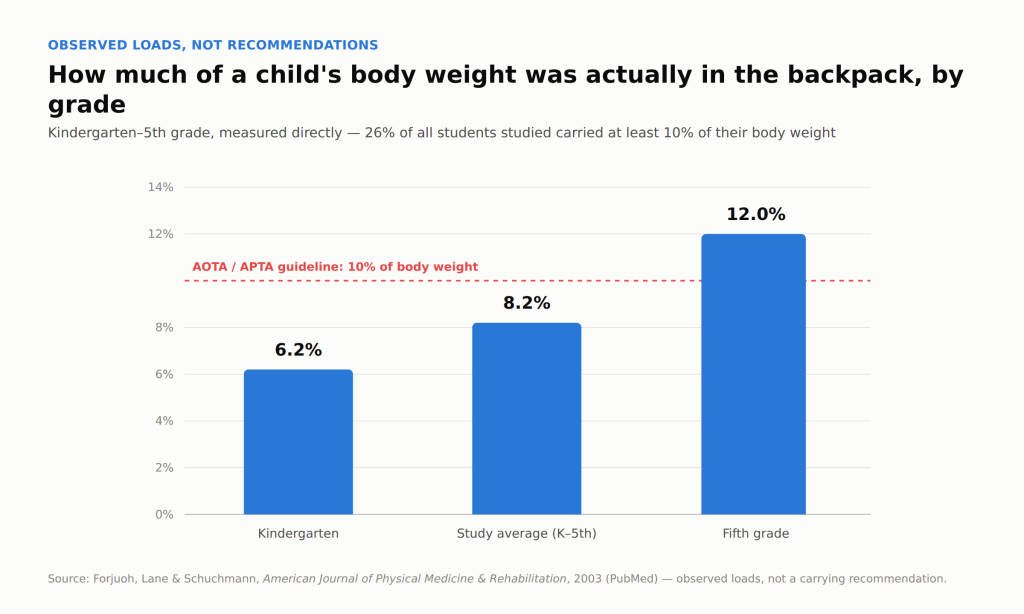
That’s observed behavior, not a recommendation — the study measured what kids were actually hauling, not what they should haul. A fifth grader in the study carrying 12% doesn’t mean fifth graders should carry 12%. What it does suggest is a pattern worth watching for as a child moves through elementary school.
Age Is a Starting Point. Torso Length Decides the Fit.
Walk into REI or look up Osprey’s kids’ lineup, and body weight isn’t the first number that comes up — torso length is. REI’s fit guide is direct about it: “Your torso length — not your height — is the key measurement,” measured from the C7 vertebra at the base of the neck down to the top of the hip bones. REI also warns that torso ranges aren’t standardized across brands, which is exactly why an age printed on the box is a starting screen, not a fitting.
Real manufacturer charts make that overlap concrete. Age on the label is a rough filter; torso length decides the actual fit:
| Pack | Age (mfr.) | Torso range |
|---|---|---|
| Osprey Daylite Jr | 4–12 | 11–15 in |
| Osprey Moki | 4–12 | 11–16 in |
| REI Tarn 18 (Kids’) | 6–12 | sized by age; 18L |
| Osprey Jet 18 | 8–14 | 13–17 in |
| Osprey Talon Jr / Tempest Jr | 8–14 | 13–18 in |
| Deuter Junior 18 | ~6–10 (110–140 cm height) | 32–44 cm (≈12.5–17.3 in) |
| Osprey Ace 38 | 5–11 | 11–14 in |
| Deuter Fox 30 | ~8–16 (110–168 cm height) | 28–42 cm (≈11–16.5 in) |
| Osprey Ace 50 | 8–14 | 14–18 in |
| REI Tarn 40 (Kids’) | 8–12 (mfr.) | 12–16 in |
| Osprey Ace 65 | 10–17 | 14–18 in |
(REI and Osprey figures confirmed directly against current REI and Osprey listings; Deuter from the manufacturer’s Fox 30 and Junior 18 pages.)
Notice how much the age ranges overlap across models with different torso specs — an 8-year-old could plausibly fit a Jet 18, a Talon Jr, or an Ace 38, depending on their actual torso, not their birthday. Age on the box gets you into the right neighborhood; torso length tells you whether the pack will actually ride correctly on this particular kid’s back.
What School Actually Requires
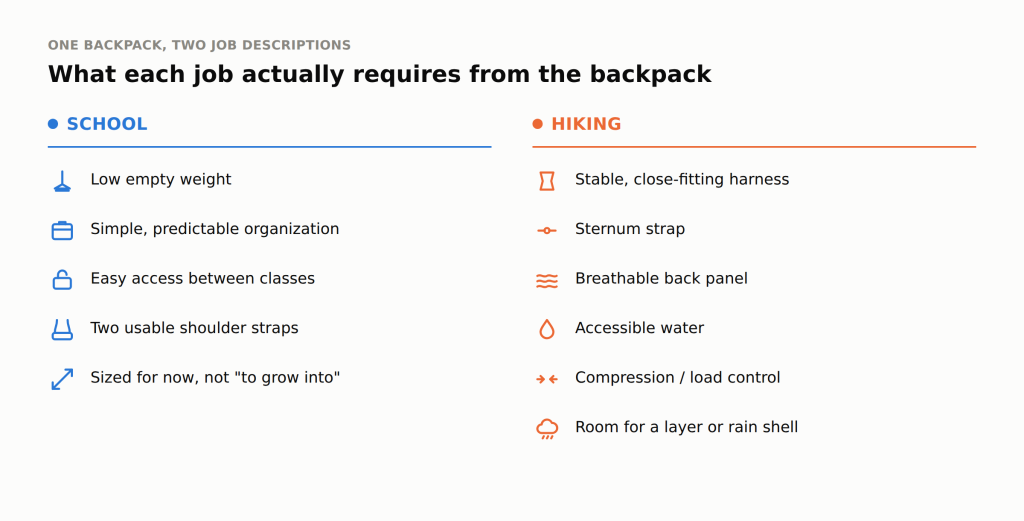
A good school backpack is used repeatedly, all day: taken off, put on, opened, closed, folders pulled out, a lunch added, a pencil found, dropped beside a desk, picked back up. For that environment, what matters is:
Low empty weight, since every pound of backpack is a pound the child carries before adding school supplies. Simple, predictable organization for books, folders, lunch, small supplies, and possibly a laptop. Easy access — a technically sophisticated hiking closure isn’t necessarily convenient between classes. Two usable shoulder straps, which pediatric and orthopedic guidance consistently favors over carrying a pack slung on one shoulder. And a size proportional to the child now, not a pack bought oversized “to grow into,” which creates poor fit in the present for a fit that may or may not arrive later.
School use isn’t really a capacity question. A 30-liter pack might hold everything a child could conceivably bring to school and still be the wrong backpack for the job.
What Hiking Changes
Take the same child onto a trail, and both the contents and the way the backpack is worn change. Instead of a short carry from a car or bus into a building, the pack may stay on continuously for an hour or more—through climbing, bending, stepping over rocks, and sweating against the back panel. That makes different features valuable: a stable harness that stays close to the body instead of swinging with each step; a sternum strap to stabilize the shoulder straps during movement; a breathable back panel; accessible water, whether bottle pockets or hydration compatibility; compression so a partially filled pack doesn’t bounce; and room for a layer or rain shell that wasn’t being worn when the hike began.
How Much Should a Child Actually Carry?
Weight becomes a live question here too, and load matters more once the pack passes a certain threshold. REI’s own daypack guidance is specific about the mechanism: “a hipbelt starts to make an appreciable difference in the quality of your experience once the pack weighs more than 15 pounds” — general daypack guidance, not written for kids specifically, but a useful marker for when a hipbelt stops being decorative.
For how much a child should be carrying on the trail in the first place, the clearest kid-specific figure we found comes from Tod Schimelpfenig, former curriculum director for NOLS Wilderness Medicine, speaking to Backpacker/Outside: he puts the ceiling at 15–20% of body weight for kids hiking in a properly fitting pack, and recommends erring toward the 15% end. Dr. Stephanie Canale, a family medicine physician quoted in the same piece, recommends roughly 5–10% of body weight for ages 4–7; the article’s own age-band summary extends that range up to 15% depending on the child. For ages 0–3, that same summary puts the range at roughly 0–5%, and for ages 8 and up, it lands at roughly 15%, with room for more in larger or more experienced hikers.
Worth being precise about what this isn’t: it’s not a joint position from an orthopedic body the way the school-backpack numbers are — it’s two named, credentialed sources (a NOLS wilderness-medicine expert and a physician) giving hiking-specific guidance, which is exactly the kind of kid-specific outdoor figure that’s been missing from this conversation. It’s also, notably, in the same range as the school-backpack ceiling — not the far more permissive 35–40% of body weight sometimes cited for healthy adult backpackers on multi-day trips, a figure that belongs to adults and shouldn’t be borrowed for a child’s day pack.
Overnight backpacking changes the calculation again — sleeping gear, more food, and more clothing push a pack toward a technical load-carrying system, which pushes the whole comparison out of day-hike territory.
The Deuter Evidence: A Manufacturer Draws Its Own Line
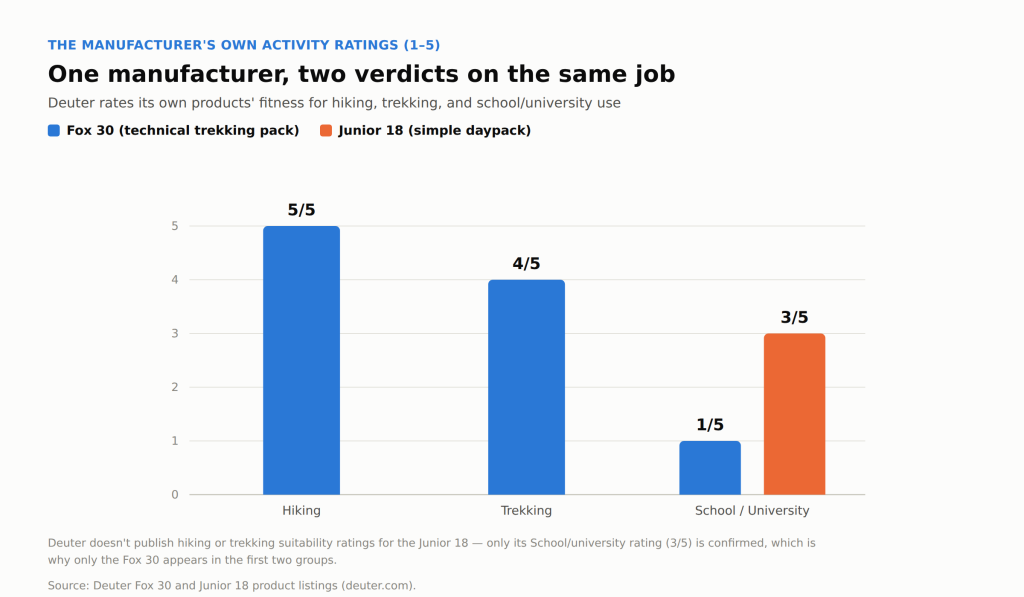
This is arguably the most useful piece of evidence in this research, and it didn’t come from a medical journal—it came from a manufacturer rating its own products. Deuter scores each backpack for suitability across activities on a 1-to-5 scale, and the contrast between two of its kids’ packs makes the school-vs-hiking divide concrete in a way percentages alone can’t.
The Fox 30 — described by Deuter as “the trekking backpack for kids and teens,” with an adjustable back system, a 3–6 kg recommended load, and a 28–42 cm torso range — rates Hiking: 5/5, Trekking: 4/5, School/university: 1/5. The manufacturer itself rates the pack poorly for school use.
The Junior 18, by contrast, is a smaller, simpler daypack, and Deuter rates it School/university: 3/5 alongside its outdoor-exploration use — the closest thing we found to an official acknowledgment that a single pack can reasonably split the difference, as long as it isn’t being asked to do serious trail work.
That’s the pattern worth remembering: the more technical a hiking pack gets — load-transfer back systems, higher recommended loads, hydration built around long trail days — the less it wants to also be a school bag. This gap isn’t about brand quality. It’s about what each design is optimized for, and here it’s the manufacturer itself drawing that line, not our inference.
No Standard Exists for “Does Both” — And That’s Useful to Know
We looked specifically for a physical therapy, orthopedic, or occupational therapy position statement addressing backpacks used for both daily school carrying and weekend hiking — the actual wear pattern a family buying “one backpack for everything” would create. We didn’t find one. APTA’s general backpack guidance mentions packs being “helpful for day trips,” but that’s a passing line inside guidance clearly built around school use, not a standard developed for combined use.
We found professional guidance for children’s backpack loads, and manufacturer guidance for hiking-pack fit — but no orthopedic, pediatric, occupational-therapy, or physical-therapy standard specifically validating one backpack for repeated full school days plus weekend hiking.
That absence isn’t a gap in the research — it’s the finding. There’s a school standard, measured in percent of body weight and back positioning, and there’s a hiking-fit standard, measured in torso length, volume, and load thresholds — and nobody has published a combined standard, because “dual-purpose backpack” isn’t really an ergonomic category. It’s a shopping category. Evaluating one means checking it against both standards separately, not assuming a bag that’s decent at one job is automatically fine at the other.
The Dual-Purpose Sweet Spot
There’s a real middle zone where one backpack makes sense — but it starts with the use case, not the product.
Picture a child who needs a backpack for normal school supplies during the week and joins the family for relatively short day hikes on weekends. In that scenario, the hiking load is water, snacks, a lightweight layer, rain protection, sunscreen, and a few personal essentials—nowhere near overnight-backpacking territory. That doesn’t require a technical trekking pack. A lightweight children’s daypack in roughly the 15–20 liter range — not an external standard, just the observed crossover territory among the plausible dual-purpose products we examined — with good shoulder straps, a sternum strap, bottle storage, and enough internal organization can reasonably cross between both environments.
Current products illustrate the idea without requiring us to crown a single “best” one: the Deuter Junior 18 ($70, School/university 3/5) sits directly in that observed crossover range, while smaller packs such as the 9-liter Osprey Daylite Jr ($50, in Osprey’s Everyday line rather than its technical backpacking range) may still work for younger children or lighter school-and-trail loads. As hiking demands increase from there, product design visibly shifts away from everyday use and toward specialization—which is exactly what the price and category segmentation below shows.
Where One Backpack Starts to Fail
The dual-purpose idea gets less convincing as either activity moves toward an extreme.
Too school-specific: a traditional book bag can carry folders and lunch perfectly well and still be uncomfortable on a longer hike if it lacks stability, ventilation, or accessible water. That’s not a flaw — it means it was built for a different job.
Too hiking-specific: the reverse is just as real. A technical children’s backpacking pack — adjustable torso, real hipbelt, load-control straps, enough volume for overnight gear — is genuinely better on a trail and can become bulk, unnecessary straps, and awkward organization in a classroom. REI’s own weight numbers show the progression: the 18-liter Tarn is about 1 pound empty; the 40-liter Tarn is about 2 lb 7 oz before anything goes inside. For a smaller child working within a conservative load target, that empty-pack weight difference is not trivial. A technical pack can be objectively better at carrying hiking loads while simultaneously being a worse choice for daily school use — there’s no contradiction; the two bags are solving different problems.
Is One Backpack Actually Cheaper? A Price Snapshot
Prices below were checked directly against retailer and manufacturer listings on August 29, 2026 — a snapshot, not a permanent price, and may have changed since.
| Backpack | Category | Capacity | Price |
|---|---|---|---|
| L.L.Bean Junior Original Book Pack | School | 17L | $39.95 |
| L.L.Bean Original Book Pack | School | 24L | $44.95 |
| L.L.Bean Deluxe Book Pack | School | 37L | $54.95 |
| Osprey Daylite Jr | Everyday / crossover | 9L | $50 |
| Deuter Junior 18 | Crossover | 18L | $70 |
| REI Tarn 18 (Kids’) | Hiking | 18L | $59.95 |
| Osprey Jet 18 | Hiking | 18L | $80 |
| Osprey Talon Jr / Tempest Jr | Multi-Sport | — | $100 |
| Deuter Fox 30 | Technical trekking | 30L | $130 |
| REI Tarn 40 (Kids’) | Technical trekking | 40L | $129 |
| Osprey Ace 38 | Backpacking | 38L | $175 |
| Osprey Ace 50 | Backpacking | — | $210 |
| Osprey Ace 65 | Backpacking | — | $225 |
Grouped by job, the same data reads as an economic decision, not just a spec sheet:
| Backpack job | Price area | What you’re paying for |
|---|---|---|
| School-first | ~$40–$60 | organization and access |
| Crossover / day-hike | ~$50–$100 | everyday usability plus trail-oriented fit |
| Technical youth backpacking | ~$129–$225 | adjustable fit, load transfer, larger loads |
Two things fall out of this. First, it isn’t simply “school is cheap, hiking is expensive” — there’s a $50–$100 band of genuinely hiking-capable day packs sitting right next to premium school bags in price. Second, a $44.95 school book bag and a $175 technical Ace 38 aren’t two options for the same purchase decision — comparing them head-to-head as “which backpack should I buy” is comparing two different product categories, and that comparison should stay out of any buying guide built from this research. A dual-purpose backpack isn’t automatically a money-saving compromise, either: a $60–$70 crossover pack that genuinely handles both jobs can be excellent value, but buying a $175 technical backpacking pack for a child who mostly carries homework and takes three-mile family hikes doesn’t become economical just because it can technically do both.
The School + Hiking Decision Test
Before buying one backpack for both jobs, run it through seven questions.
1. Fit — Does it fit the child now, using actual torso measurement where the manufacturer provides one, not just the age printed on the tag?
2. Load — What will it weigh on the child’s heaviest normal school day, including the backpack itself, books, device, lunch, and water? Compare it with the professional load guidance above and decide which threshold your family will use.
3. School — Does it actually organize what the child carries day-to-day? A hydration sleeve doesn’t make a good laptop compartment, and a huge main cavity built for a jacket and trail gear can be frustrating for folders and pencils.
4. Trail — What does “hiking” mean for your family specifically? A two-hour nature walk and an overnight backpacking trip aren’t the same requirement, and the more technical the hiking gets, the harder it is for a school-first bag to keep up.
5. Comfort — Does it fit well loaded, not just empty? A pack that feels great on the store rack tells you surprisingly little about how it behaves after water and gear go in.
6. Weight — How much of the child’s carrying allowance does the empty pack itself consume, especially for a smaller child close to the lower end of a size range?
7. Price — Does the crossover pack genuinely replace two purchases, or will you still need a second, more technical pack for overnight trips — in which case the “one bag” solution quietly becomes a third bag instead?
So, Can One Backpack Really Do Both?
Based on everything above, the honest answer is conditional.
One bag makes sense when the school load is manageable within the conservative end of pediatric guidance, the child’s actual fit — torso length, not age label — is correct, the family’s hiking stays at day-hike level, the pack is lightweight, and it has enough organization for school plus enough stabilization and hydration access for the trail. Deuter’s own activity rating provides direct crossover evidence for the Junior 18; Osprey’s Everyday classification makes the Daylite Jr a different, smaller crossover candidate depending on load.
Two bags make more sense once either side gets demanding: heavy or complex school carrying, or hiking that moves toward technical, overnight, or serious-mileage territory. That’s exactly where the two standards pull apart — a pack built to move 3–6 kg across a trail via a load-transfer back system is carrying design compromises (weight, structure, ventilation channels) that make it a worse school bag, not a better one, and a book bag optimized for low empty weight and laptop protection has none of the hip-support or hydration infrastructure a real trail day needs.
A bag that clears both bars isn’t a compromise — it’s just correctly sized for a family whose hiking hasn’t outgrown day-pack territory yet. A bag that only clears one is a sign it’s time to own two backpacks instead of one.
Evidence Notes
The percentage recommendations in this piece aren’t presented as a single medical consensus: AAP/AAOS guidance allows up to roughly 15% of body weight, while occupational and physical therapy guidance commonly uses a more conservative 10%. The kindergarten-to-fifth-grade percentages are observed loads from a published study, not recommended carrying limits, and the grade-by-grade increase is described here as a pattern worth watching for, not a proven causal trend the study itself established. The 15–20% kids’-hiking figure is attributed specifically to a named NOLS wilderness-medicine expert and a family medicine physician speaking to an outdoor publication — kid-specific, but not a joint position from a medical or orthopedic association the way the school-backpack numbers are.
Adult backpacking percentages (35–40% of body weight, cited by some outdoor organizations for healthy adults on multi-day trips) should not be extrapolated to children. The 15lb hipbelt threshold comes from REI’s general daypack guidance, not a kids-specific source. The 15–20 liter “crossover” range is our own read of the plausible dual-purpose products examined, not an external sizing standard. Manufacturer age, capacity, torso, and load figures throughout are manufacturer guidance, not independent medical standards.
The approximately 10% guidance attributed to AOTA comes from CommunOT, an AOTA-affiliated community platform; AOTA’s main institutional Backpack Awareness page discusses proper backpack use but does not cite a specific percentage.
Prices were checked on August 29, 2026, and are a snapshot — retail pricing, promotions, colorways, and specifications change.
Public Sources
- American Academy of Pediatrics / HealthyChildren — Backpack Safety
- American Academy of Orthopaedic Surgeons — Heavy backpacks can strain growing bones and joints (Aug. 24, 2026)
- OrthoInfo (AAOS) — Backpack Safety, injury statistics
- ChoosePT (APTA) — 3 Tips for Backpack Safety
- American Occupational Therapy Association — backpack safety guidance, via CommunOT
- Forjuoh SN, Lane BL, Schuchmann JA. “Percentage of Body Weight Carried by Students in Their School Backpacks.” American Journal of Physical Medicine & Rehabilitation, 2003 — PubMed
- REI — Backpacks: Fit & Torso Size Guide
- REI — Daypacks: How to Choose
- REI Co-op Tarn 18 Pack, Kids’
- REI Co-op Tarn 40 Pack, Kids’
- Osprey — Backpack Size Chart & Sizing Guide
- Osprey — Shop Kids Packs (by activity)
- Deuter — Fox 30 product listing
- Deuter — Junior 18 product listing
- Appalachian Mountain Club — How to Choose the Right Backpacking Pack
- L.L.Bean — Kids’ School Backpacks
- Backpacker/Outside — “How Far Can Kids Hike, and How Much Can They Carry?” (Tod Schimelpfenig, NOLS; Dr. Stephanie Canale)
