
The power goes out. You bought a power station rated at 1,000 watt-hours specifically for this. You do the math you assume the box wants you to do — 1,000Wh divided by the wattage of whatever you’re running — and the number you land on is not the number you get. The station dies early. Or it doesn’t, and you’re pleasantly surprised. Either way, something about that headline number didn’t behave the way a “capacity” should.
It’s tempting to conclude the spec was inflated. Mostly, it wasn’t. The real problem is smaller and more interesting than a lie: the Wh number on the box and the energy that actually reaches your device are two different measurements, and the headline capacity figure usually doesn’t tell you how much AC energy you’ll actually receive.
Two Numbers, One Label
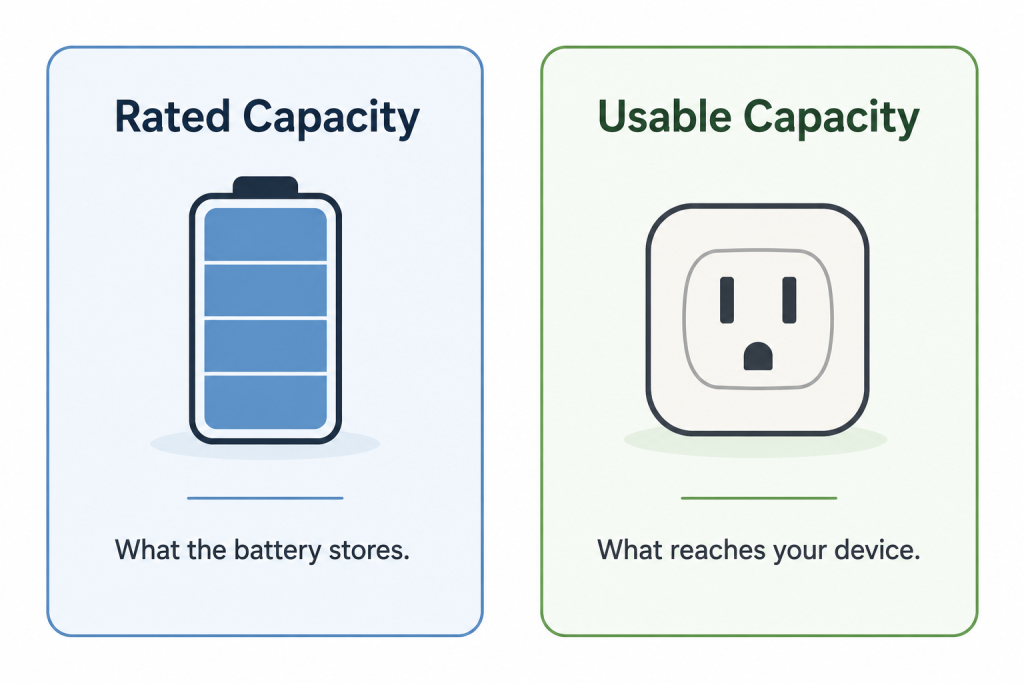
“Rated capacity” describes what the battery pack can store. “Usable capacity” describes what comes out the other end, through a specific outlet, into a specific device, under specific conditions. Manufacturers publish the first number prominently because it’s a clean, comparable spec. Manufacturers generally don’t advertise one universal usable-capacity figure alongside it — and there’s a good reason: it isn’t one fixed number. It depends on the unit, the output you use, the load, and the conditions, which is exactly what the rest of this article shows.
Even Manufacturers Don’t Use One Magic Percentage
You can see manufacturers half-admit the gap in their own math. Jackery’s current support documentation estimates runtime as Battery Capacity (Wh) × 0.8 ÷ Device Watts. Other Jackery materials from the same period use × 0.85 instead. EcoFlow’s own runtime-planning guide also uses × 0.85 as a “quick formula,” while separately warning customers not to just divide rated Wh by device watts and expect an accurate answer. BLUETTI goes a step further and publishes a formula with more moving parts: Capacity × Depth of Discharge × Inverter Efficiency ÷ (Device Load + Self-Consumption).
Three manufacturers, three different levels of detail, and not even one consistent constant between two documents from the same brand. If 0.85 were a universal constant, manufacturers wouldn’t need different assumptions and more detailed formulas to describe the same thing.
Run the numbers and the gap stops being abstract. A 1,000Wh power station powering a steady 100W load gives you, in the ideal world, 1,000Wh ÷ 100W = 10 hours. Apply Jackery’s own 0.85 factor, and that becomes 1,000Wh × 0.85 ÷ 100W = 8.5 hours. Apply their 0.8 factor instead, and it’s 1,000Wh × 0.80 ÷ 100W = 8 hours. Those are still estimates, not guarantees — but they’re a far more realistic starting point than the label’s raw number.
Where the Energy Goes
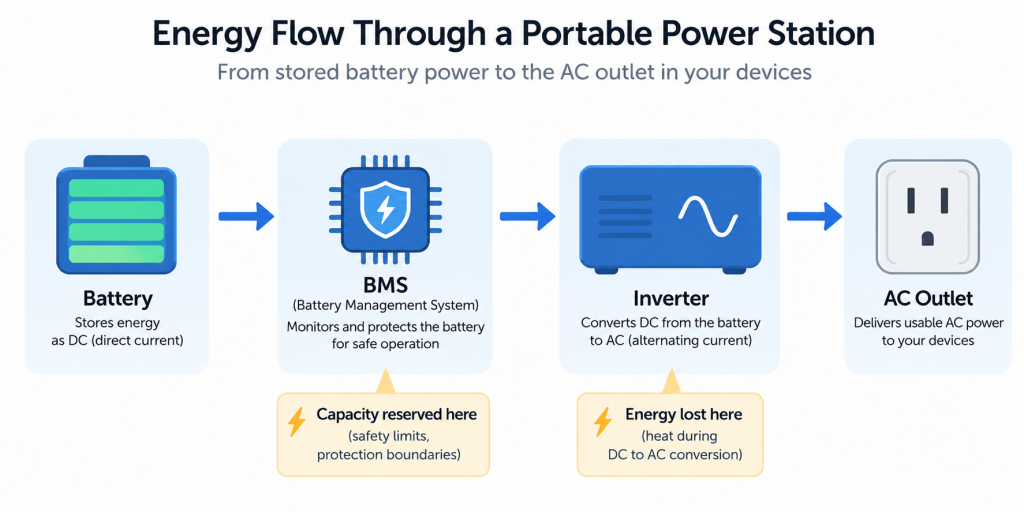
Two real, documented things happen between “energy stored” and “energy delivered.”
The inverter has its own appetite. Converting stored DC battery power into the AC power your wall outlets expect isn’t free. Victron’s published technical data for its inverters shows zero-load power draw — the power the inverter burns just by being switched on, before it delivers a single watt to you — of 6W, 7W, and 10W on its 500VA, 800VA, and 1200VA models, with peak efficiency of 90%, 92%, and 93%, respectively. Independently, the German automobile association ADAC bench-tested eight consumer power stations in 2025 and found that simply activating the built-in inverter could cost “up to 30 watts” on its own — which is why their testers recommend switching the AC outlets off when you’re not using them.
The battery management system sets the operating boundaries. Lithium battery management systems (BMS) enforce voltage, current, and temperature limits to protect the cells and the pack — that protection is real and manufacturer-documented in general terms. What we could not verify is the common online claim that every power station hides some standard percentage of its advertised capacity as a fixed “BMS reserve.” There is no defensible universal number to subtract. The boundary is real; no manufacturer or cell maker publishes a specific number consistently.
The Twist: Usable Capacity Changes With the Load
Here’s what makes this more than a “subtract some percentage” story. Outdoor Life ran the same power stations through two very different loads — roughly 34 watts and roughly 380 watts — and the usable-capacity percentage changed dramatically depending on which one they used.
An EcoFlow Delta 2, rated at 1,024Wh, delivered 67% of that capacity at the low load and 88% at the high load. The EcoFlow Delta 3, same rated capacity, went from 52% to 88%. The Bluetti AC180 went from 54% to 85%. All from the same battery, the same inverter, the same unit — just a different appliance plugged in.
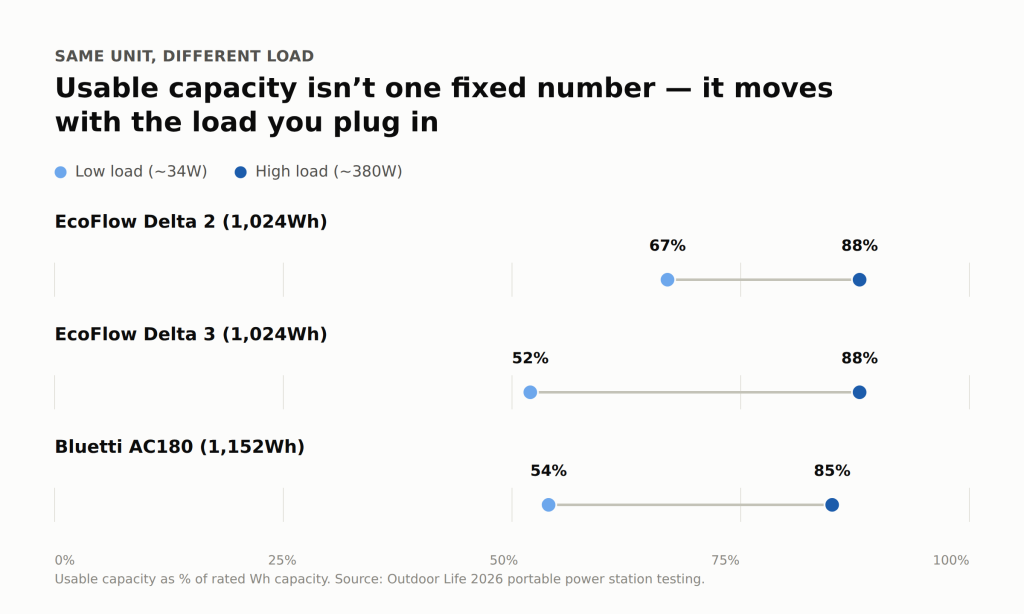
Each row is a different power station — the EcoFlow Delta 2, the EcoFlow Delta 3, and the Bluetti AC180. The axis along the bottom, from 0% to 100%, shows what percentage of the advertised Wh capacity was actually usable in testing.
Each row has two dots connected by a line. The light dot is the result under a low load — something small, around 34W, like a router or a phone charger. The dark dot is the result under a high load — something bigger, around 380W, like a small space heater.
Take the top row, the EcoFlow Delta 2: the light dot sits at 67% and the dark dot sits at 88%. That means when it was powering something small, it only delivered 67% of its advertised 1,024Wh. When it was powering something large, it delivered 88%. Same battery, same power station — but depending on what you plug into it, the result changes dramatically. That’s the whole point of this chart: there’s no single “usable capacity percentage.” It depends on the load.
The line between the two dots isn’t a trend or an average — it’s just there so your eye can connect the two points as belonging to the same product.
Outdoor Life also reported two different high-load results for the same Oupes Mega 1 — 76% initially and 92% in a later “after storage” test. That result reinforces one point without telling us the cause: a measured usable-capacity percentage belongs to a particular test, not to the product as an immutable specification.
Separately, GearLab’s bench testing — which loads each unit to roughly 80% of its rated max wattage and measures actual AC output — found usable capacity ranging from 75% to 93% across fourteen current models, with none reaching 100%. ADAC’s own 2025 test corroborates the same phenomenon from an independent lab: usable net capacity across the units it tested averaged roughly 10% to 15% below the manufacturer-stated gross capacity. Both are aggregate averages from a specific testing protocol, not a number you should expect to get under whatever conditions you happen to use your unit in — which is exactly what the load-dependent numbers above already show.
Why Small AC Loads Can Be Especially Costly
The mechanism is straightforward once you line the numbers up: the inverter’s overhead is close to fixed, regardless of load. If a power station’s electronics burn 10–16 watts just staying on (as Outdoor Life measured directly on the units above) or “up to 30 watts” (as ADAC measured), that overhead barely registers against a 380W space heater — a rounding error of a few percent. Against a 34W CPAP machine or a phone charger, that same fixed overhead can eat a genuinely large slice of what you’re actually drawing.
Victron’s spec sheet shows the same principle from the inverter-design side: a fixed zero-load draw exists no matter what you plug in, so the smaller the load, the larger a share of the battery that fixed draw consumes. Small loads don’t get a smaller cut of inefficiency; they get a bigger one.
Wh and W Answer Different Questions
There’s a second, related confusion worth clearing up because it compounds the first. Watt-hours (Wh) describe how much energy is available. Watts (W) describe how fast it can be delivered — the instantaneous load the unit can handle. A power station can have a large Wh rating and still be unable to start an appliance if its inverter can’t handle that appliance’s surge.
Refrigerators and Startup Power
This is where simple division falls apart fastest. Say a refrigerator draws 150W while running. Apply the same 0.80 planning factor from above: 1,000Wh × 0.80 ÷ 150W ≈ 5.3 hours. That number looks just as precise as the others — and for a refrigerator, it probably isn’t. A refrigerator doesn’t draw a steady wattage — its compressor cycles on and off, and starting that compressor typically demands a bigger surge than running it. Jackery’s own documentation explicitly warns that its simple runtime formula isn’t appropriate for devices with variable consumption or high startup power, specifically naming refrigerators and freezers among the examples.
Jackery’s documentation also distinguishes “continuous power” (what the AC output is rated to sustain) from “startup” or “peak” power, and — as manufacturer guidance for sizing, not a physical constant — suggests planning for roughly 4 to 7 times an inductive appliance’s running wattage in some scenarios (their example: a fridge drawing 50W running might need something in the 350W-class to reliably start).
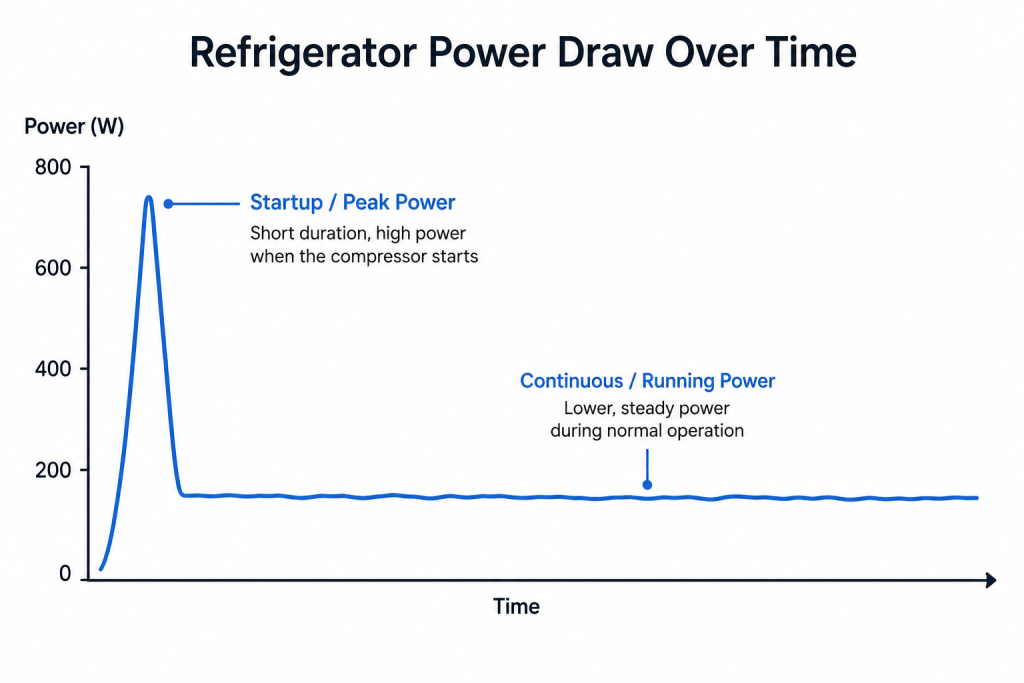
That leaves two separate questions to answer before you trust a power station with your refrigerator, and a single Wh number answers neither on its own: can it start the appliance at all, and does it hold enough usable energy to keep it running as long as you need?
AC vs. DC/USB-C
Your battery stores DC energy. Plug something into the AC outlet, and the inverter has to convert it — with the overhead described above. Many of the things people power with these units — phones, many laptops, some routers and camping gear — can often run on DC or USB-C instead. EcoFlow specifically recommends using DC or USB-C when appropriate because it can avoid the AC inverter and its associated conversion and idle overhead — not because DC or USB-C paths are loss-free. For a phone charged once, the difference may not matter much. For a low-power device that needs to run all night, or through a multi-day outage, it can matter considerably more.
What to Do Before You Buy or Depend on One
Treat the Wh rating as a starting specification, not a runtime promise, and check the things a watt-hour figure can’t tell you on its own:
- The rated battery capacity (Wh) — your starting point, not your answer.
- Your device’s actual consumption — its real running wattage, not a generic estimate from its category.
- The appliance’s startup or surge wattage if it has a motor or compressor, against the power station’s rated continuous AC output and surge capability.
- Whether the device can run directly from DC or USB-C instead of AC.
- Independent usable-capacity testing for that specific model, where it exists — not just the number on the product page.
And then do the one thing that beats every formula in this article: test your actual setup. EcoFlow’s own guidance recommends exactly this — start from a known state of charge, connect the real load, log the average wattage, note the starting and ending charge percentage, and time it. For a refrigerator, run it long enough to capture normal compressor cycling. For anything you’d need overnight, test it overnight. If the scenario genuinely matters — a real outage, a medical device — don’t make the outage your first experiment.
Verdict: Not Fake Capacity — Different Measurements
The portable power station capacity myth isn’t that a 1,000Wh rating is fake. It’s believing that 1,000Wh of nominal battery capacity means 1,000Wh will reach whatever you plug into the AC outlet. Independent testing consistently finds less usable AC energy than nominal battery capacity, and manufacturers’ own runtime formulas quietly account for that. But there’s no single percentage to subtract and call it solved — the device you’re powering, the output you use, the inverter’s own consumption, and the load all move the answer, sometimes by a lot, sometimes even between two tests of the same unit.
We also looked for a specific regulatory requirement compelling manufacturers to disclose usable AC watt-hours alongside nominal battery capacity, and didn’t find one — a limited research finding, not proof that no such requirement exists anywhere. What it does confirm is the practical problem for shoppers: the headline Wh figure alone was never going to give you the complete runtime picture.
The battery isn’t lying to you. The label just never claimed to answer the question you’re actually asking.
Sources
- Jackery — How can I estimate the runtime of my portable power station?
- Jackery — Can Jackery Power Laptop and Mobile Devices?
- Jackery Community — Startup Power and Continuous Power
- EcoFlow — Test Your Power Station’s Runtime Before an Emergency
- BLUETTI — How Long Will a 3kWh Power Station Last?
- Outdoor Life — Best Portable Power Stations of 2026, Tested and Reviewed
- OutdoorGearLab — The Best Power Stations, Lab Tested & Ranked
- ADAC — Mobile Powerstations im ADAC Test 2025
- Victron Energy — MultiPlus 12V 500–1200VA Technical Data
