
Your child asks for social media, and suddenly 13 feels less like an answer than a starting point.
Maybe they are already 13. Maybe they are getting close. Either way, the birthday itself probably isn’t what you’re really thinking about.
You’re thinking about the child in front of you.
Can they follow rules when you’re not watching? Do they think before they act? What happens when a friend leaves them out, someone says something cruel, or everyone else seems to be doing something you’ve told them not to do?
That is why “maturity matters more than age” sounds so sensible. It moves the decision away from a number on the calendar and toward the person who will actually be using the account.
And it leads to what seems like the right question:
Is my child mature enough for social media?
Before trying to answer that, though, there is a simpler place to start.
Why does 13 keep showing up in the first place?
13 Doesn’t Answer It
Thirteen has acquired a strange kind of authority in conversations about social media. Many major platforms use it as a minimum account age, so it is easy to assume that the number marks some developmental transition: before 13, not ready; after 13, potentially ready.
But that is not what the number was designed to tell you.
The American Academy of Pediatrics has pointed out that the familiar age-13 threshold is strongly connected to the Children’s Online Privacy Protection Act, or COPPA, which places special requirements on online services collecting personal information from children under 13. The AAP notes that the threshold “does not seem to be based on any specific sign of developmental readiness.”
That distinction matters. A regulatory boundary can tell a company when particular privacy obligations apply. It cannot tell you what changed inside your child on their thirteenth birthday.
Development does matter, of course. But replacing 13 with a supposedly better developmental age does not solve the problem either.
In a large 2022 study published in Nature Communications, Amy Orben and colleagues found periods during adolescence when the relationship between social-media use and later life satisfaction appeared to vary by age and sex. The effects were small, and the researchers themselves cautioned against turning population-level patterns into predictions about individual children.
So there is no scientifically established birthday that flips readiness from no to yes.
That seems to leave a more thoughtful alternative:
Forget the birthday. Look at maturity.
The problem is that “mature enough” has problems of its own.
“Maturity” Doesn’t Answer It Either
Search for advice about social-media readiness and you will encounter a familiar set of questions.
Does your child follow rules? Are they responsible? Can they handle criticism? Do they have enough self-control? Will they accept supervision? Do they still have offline interests?
None of those questions is ridiculous. Some point toward characteristics researchers genuinely study.
But put them together and something subtle happens: a collection of very different kinds of evidence begins to look like a test.
Take self-control. Research has found meaningful associations between self-control and problematic social-media use. But one longitudinal and daily-diary study in our evidence base found between-person associations without evidence of prospective within-person associations. That is very different from showing that a parent can observe good self-control today and infer that their child is ready for social media tomorrow.
“Responsibility” sits on different evidence again. A Delphi study involving panels of experts identified responsibility as an important competency. That tells us experts consider it relevant. It does not establish responsibility as a validated predictor of what will happen when a particular child begins using social media.
Then there is perhaps the most intuitive sign of all: following rules.
A prospective study of 315 adolescents and their parents found no overall main effect of internet-specific rules on later at-risk or problematic social-media use. But age changed the relationship. Below about 12.31 years, stricter rules were associated with lower later risk. Above about 15.70 years, they were associated with higher later risk. Between those ages, the study found no significant effect in either direction.
In other words, the relationship did not simply get weaker with age. It reversed direction.
That does not mean stricter rules caused problems in older teenagers, or that parents should abandon rules at a particular birthday. Reverse causation is one possible explanation: parents may change restrictions in response to problems that are already emerging. But it does show why “my child follows rules” cannot function as a simple, universal readiness signal.
Other familiar signs are weaker still. Being able to handle criticism is plausible, but a predictive bridge to social-media readiness has not been established. Having offline hobbies may sound reassuring, yet neglecting hobbies is better established as something that can appear after problematic use than as a pre-access readiness test.
And accepting parental supervision belongs at least partly on the parent-and-family side of the decision. A child’s willingness to accept supervision may make a support plan easier to carry out; it is not evidence that the child has reached some developmental state called “ready.”
The conclusion is not that maturity is irrelevant.
It is that “mature enough” compresses several different things, supported in different ways, into one label—and then asks that label to deliver a yes-or-no answer.
Maybe the problem is not that parents need a better maturity checklist.
Maybe “social media” itself needs a closer look.
Social Media Isn’t One Environment
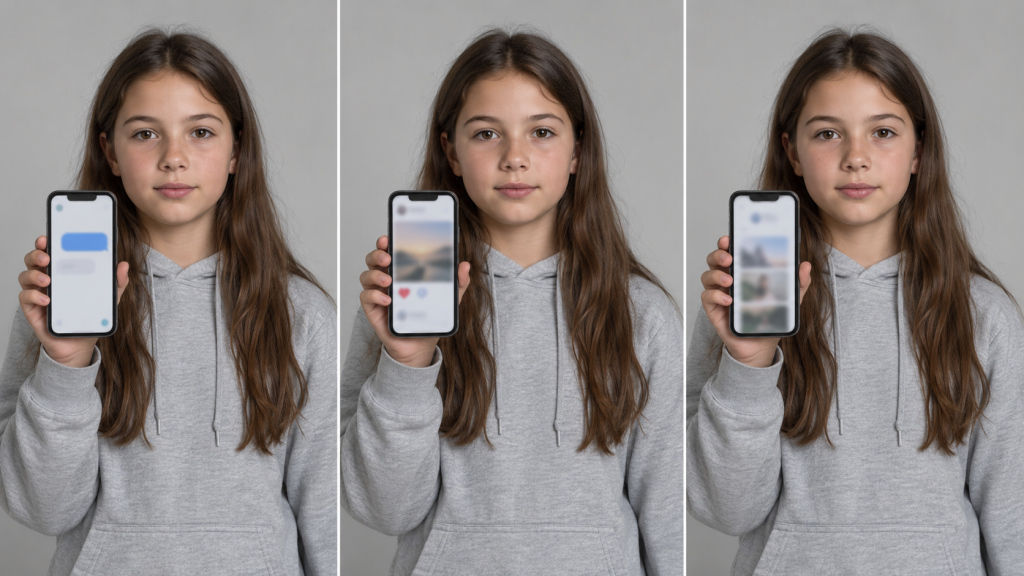
Same age. Same temperament. Same family. Same history.
Now change what the child is entering.
An account can be public or private. Contact can be narrowly restricted or extend beyond people the child knows. Feedback can be private or converted into visible counts. Content can come primarily from accounts a user chooses to follow, or it can be continuously recommended by a system deciding what to show next.
Those differences are not merely cosmetic.
A 2026 Nature Mental Health study by Bear, Soneson, Geulayov, and Fazel examined more than 32,000 young people ages 11 to 18 in England and distinguished between different routes of exposure to self-harm content. Exposure that appeared passively or algorithmically, mixed exposure, and active searching were associated differently with anxiety and depression.
The study was cross-sectional, so it cannot tell us that an algorithm caused those mental-health outcomes. It tells us something narrower and more useful here: the route and mode of exposure matter enough that treating all social-media exposure as one homogeneous thing can hide meaningful differences.
That changes the parent question.
“Can my child handle social media?” is not yet very specific.
What kind of account? Who can reach them? What is public? Which parts of the experience are quantified? How does content reach them?
But even specifying the environment does not finish the job.
Because now we have to put the child back into the picture.
The Same Feature Can Meet Different Children Differently
Consider one feature rather than an entire platform: visible social feedback.
In a 2020 Child Development study, researchers created an Instagram-like environment and experimentally manipulated how many likes adolescents received.
Among 613 ninth-graders in the first study, receiving few likes rather than many produced a large difference in feelings of rejection: d = .84. A replication with 579 adolescents produced a similarly large effect, d = .87.
But the more important result for a readiness decision was not simply that likes mattered.
The response differed depending on something the child brought into the environment.
A history of peer victimization moderated the rejection response in the first study (b = 0.99, p = .002). In other words, the same quantified-feedback environment did not meet every adolescent in the same way.
At a Glance: One Feature, Different Responses
| What Was Tested | Result |
|---|---|
| Study 1 (613 ninth-graders): few likes vs. many likes | Large increase in feelings of rejection, d = .84 |
| Study 3 replication (579 adolescents) | Replication within the same paper, d = .87 |
| Moderation by peer-victimization history | Adolescents with a history of being targeted by peers reacted significantly more strongly (b = .99, p = .002) |
That particular moderator should not be turned into a rule for individual families. A direct replication attempt did not confirm that specific peer-victimization interaction. But the broader principle—that media effects can vary substantially between individuals—is supported across independent studies, methods, and a larger research tradition on differential susceptibility and person-specific media effects.
That distinction is crucial.
The previous section showed that different social-media environments can ask different things of the same child.
This one shows something else:
The same feature can meet different children differently.
Now the original question begins to change shape.
A child isn’t simply “ready for social media.” The real decision is more specific: this child, entering this social-media environment, under these conditions.
That sounds like progress.
It also creates an obvious next thought:
If the child and the environment both matter, perhaps a parent simply needs to evaluate the match between them.
There is a problem with that too.
The Part Parents Can’t Reliably Know
Parents know things about their children that no questionnaire, researcher, or article ever will.
They know what happens after a difficult day at school. They know which friendships are fragile, which rules require repeated reminders, what their child talks about freely, and what tends to disappear behind “I’m fine.”
But knowing your child extremely well is not the same thing as possessing every piece of information needed to predict how that child will respond inside a particular social environment.
Sometimes even behaviors that already exist are difficult for parents to observe accurately.
In a 2023 study comparing adolescents’ own reports of problematic social-media use with reports from their mothers and fathers, agreement was low. Classification agreement was low (κ = 0.10–0.22), and 62.5% of adolescents who reported problematic social-media use were not identified that way by their mothers.
Another study examining parent-child agreement about cybervictimization found similarly weak agreement overall, with social-media-specific incidents showing the weakest agreement among the channels measured.
At a Glance: What Parents Notice — and What They Miss
| What Was Compared | Parent-Child Agreement |
|---|---|
| Whether an adolescent showed signs of problematic social-media use (self-report vs. mother-report) | κ = 0.10–0.22 (minimal); 62.5% of adolescents who reported it weren’t identified by their mothers |
| Cybervictimization incidents, across different channels | Weak agreement overall — weakest specifically for incidents that happened on social media |
This does not mean parents know nothing.
It means we need to separate several ideas that are easy to collapse:
A characteristic can exist before access without being easily observable by a parent.
A characteristic can be associated with later outcomes without becoming a validated individual prediction tool.
And some responses cannot be observed before the relevant situation exists at all.
That last category matters.
How will this particular child respond to quantified public feedback when it is attached to their own post? And once a recommendation system learns what keeps their attention, how difficult will disengaging feel? What happens when digital-literacy knowledge has to operate under actual social pressure rather than in a calm conversation at home?
Some of that information may not exist yet in a form a parent can reliably inspect.
So the answer cannot be to replace a generic maturity checklist with a more sophisticated CHILD checklist.
The useful move is in the other direction.
Start with what can actually be specified.
Make the Decision More Specific
Instead of beginning with:
Is my child ready for social media?
begin with:
What exactly am I considering allowing?

That sounds like a small change. It is not.
A platform name alone may still be too broad. The actual environment includes things a parent can inspect before making a decision:
- Is the account public or private?
- Who can contact the account?
- Are public or quantified feedback metrics part of the experience?
- How is content delivered—primarily through chosen connections, recommendations, or some combination?
- What controls and defaults actually apply to an account at this age?
These questions specify the exposure. They do not score it.
There’s no version of this where four “yes” answers add up to a green light. That would simply turn the same old readiness checklist into a more sophisticated-looking one.
A private account is not one “good point.” Restricted messaging is not another. There is no total that converts these facts into a safe child or a ready child.
Their purpose is simpler: they tell you what decision you are actually making.
Platforms themselves sometimes acknowledge this distinction indirectly through their product design. An account may be permitted at one age while particular features remain unavailable until later. That is product-policy evidence, not developmental science, but it illustrates why account eligibility and feature access are not necessarily the same thing.
Once the environment is specific, there is still a CHILD side to consider—but it should remain modest.
Ask one question:
What do I genuinely know about my child here, and what am I only assuming?
Not ten traits. Not a score.
Then name where the decision actually stands.
Maybe you know enough to decide this specific case.
Maybe the environment asks for something you cannot confidently evaluate yet.
Maybe something about the environment itself can be changed before you decide.
Maybe you simply do not have enough information to justify the decision now.
Those are not four levels of readiness. They are not labels for your child. And they do not run from “bad” to “good.”
They describe what you know about the decision in front of you right now.
And “right now” matters.
Decide With What You Know; Reassess What You Learn
A decision made today does not create a permanent scientific verdict about your child.
But there is an important order to preserve.
First comes the pre-access decision, based on the information you can actually know.
If that decision independently results in access, use creates real-world information that did not exist beforehand.
Only then can genuinely new information become part of a reassessment.
That sequence is:
DECIDE → USE, IF ACCESS OCCURS → NEW INFORMATION → REASSESS
It is not:
LET THEM TRY → WATCH WHAT HAPPENS → DECIDE WHETHER THEY WERE READY
That distinction prevents uncertainty from becoming an argument for experimentation.
Research does not currently give us outcome evidence establishing staged or trial access as a validated method for determining social-media readiness. So “we can’t know until we try” is not the answer to the limits of prediction.
Instead, reassessment means something much more ordinary.
If access has already been chosen for independent reasons and new information appears, you are allowed to update the decision.
A behavior you could only speculate about before may now be observable. Or a feature might affect your child differently than expected. Something that looked manageable may become difficult—or an anticipated problem may not appear.
The new information does not prove what should have been done before it existed.
It informs what you decide next.
The Question Isn’t Useless. It’s Unfinished.
“Is my child ready for social media?” sounds like one question.
But it asks age, maturity, the demands of a particular digital environment, what is actually knowable about an individual child, the conditions surrounding access, and responses that may not exist yet to collapse into a single verdict.
The evidence does not give parents that verdict.
That does not make the decision impossible.
It makes the decision more specific.
A child isn’t simply “ready for social media.” The real decision is more specific: this child, entering this social-media environment, under these conditions. Age and maturity can inform that decision, but neither can settle it—and some of what matters cannot be known beforehand.
The goal isn’t to certify readiness. It’s to make a specific decision from what you can actually know, then reassess if genuinely new information emerges.
Sources
- American Academy of Pediatrics (2025). Age to Introduce Social Media (Q&A Portal, Center of Excellence on Social Media and Youth Mental Health). Link.
- Orben, A., Przybylski, A. K., Blakemore, S.-J., & Kievit, R. A. (2022). Windows of developmental sensitivity to social media. Nature Communications, 13, 1649. Link.
- Pazdur, M., Tutus, D., & Haag, A.-C. (2025). Risk Factors for Problematic Social Media Use in Youth: A Systematic Review of Longitudinal Studies. Adolescent Research Review, 10(2), 237–253. Link.
- Burnell, K., Andrade, F. C., & Hoyle, R. H. (2023). Longitudinal and daily associations between adolescent self-control and digital technology use. Developmental Psychology, 59(4), 720–732. Link.
- Lahti, H., Kulmala, M., Lyyra, N., Mietola, V., & Paakkari, L. (2024). Problematic situations related to social media use and competencies to prevent them: results of a Delphi study. Scientific Reports, 14, 5275. Link.
- Geurts, S., Koning, I., Van den Eijnden, R., & Vossen, H. (2025). Parental Internet-Specific Rules and the Onset of Adolescents’ Problematic Social Media Use: Prospective Study Testing Potential Moderators. Journal of Medical Internet Research, 27, e64252. Link.
- Bear, H., Soneson, E., Geulayov, G., & Fazel, M. (2026). Algorithmically driven exposure to online self-harm content and its association with broader psychosocial risk in 32,000 adolescents. Nature Mental Health, 4(9), 1416–1425. Link.
- Lee, H. Y., Jamieson, J. P., Reis, H. T., Beevers, C. G., Josephs, R. A., Mullarkey, M. C., O’Brien, J. M., & Yeager, D. S. (2020). Getting Fewer “Likes” Than Others on Social Media Elicits Emotional Distress Among Victimized Adolescents. Child Development, 91(6), 2141–2159. Link.
- Van den Eijnden, R. J. J. M., Lemmens, J. S., & Valkenburg, P. M. (2016). The Social Media Disorder Scale. Computers in Human Behavior, 61, 478–487. Link.
- Geurts, S., Vossen, H., Van den Eijnden, R., & Koning, I. (2023). Adolescents’ Problematic Social Media Use: Agreement and Discrepancies Between Self- Versus Mother- and Father-Reports. Technology, Mind, and Behavior, 4(2). Link.
- Rapp, H., Fredrick, S., & Nickerson, A. (2025). Cyber Victimization Reports between Parents and Children: An Examination of Agreement Predictors. Children and Youth Services Review, 177, Article 108420. Link.
