You picked this costume because it was the one you could spot from across the store — bright orange, bright purple, maybe covered in something that caught the eye under fluorescent lights.
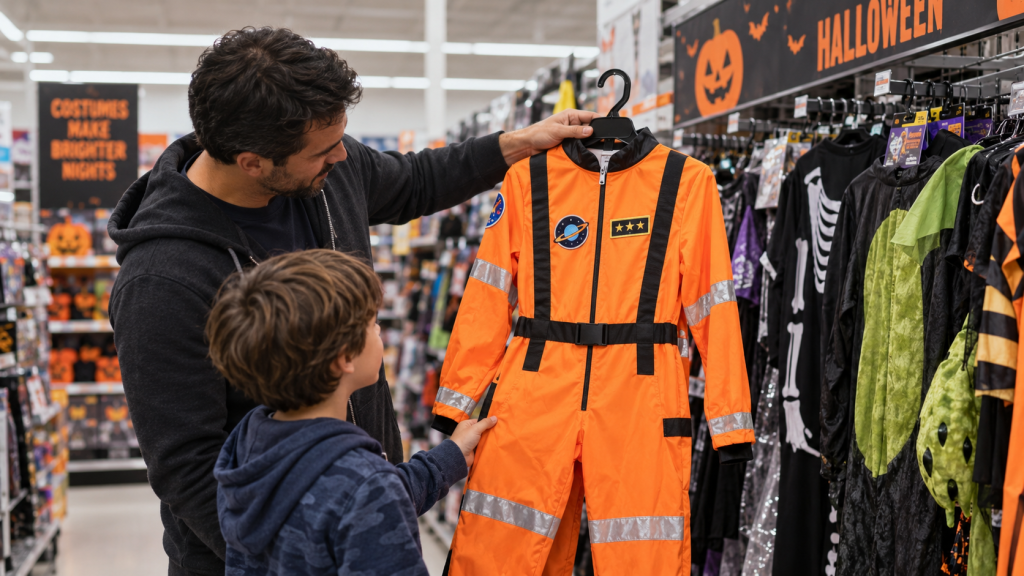
Of course they’ll see that, you thought.
And you probably weren’t wrong. Not about the store.
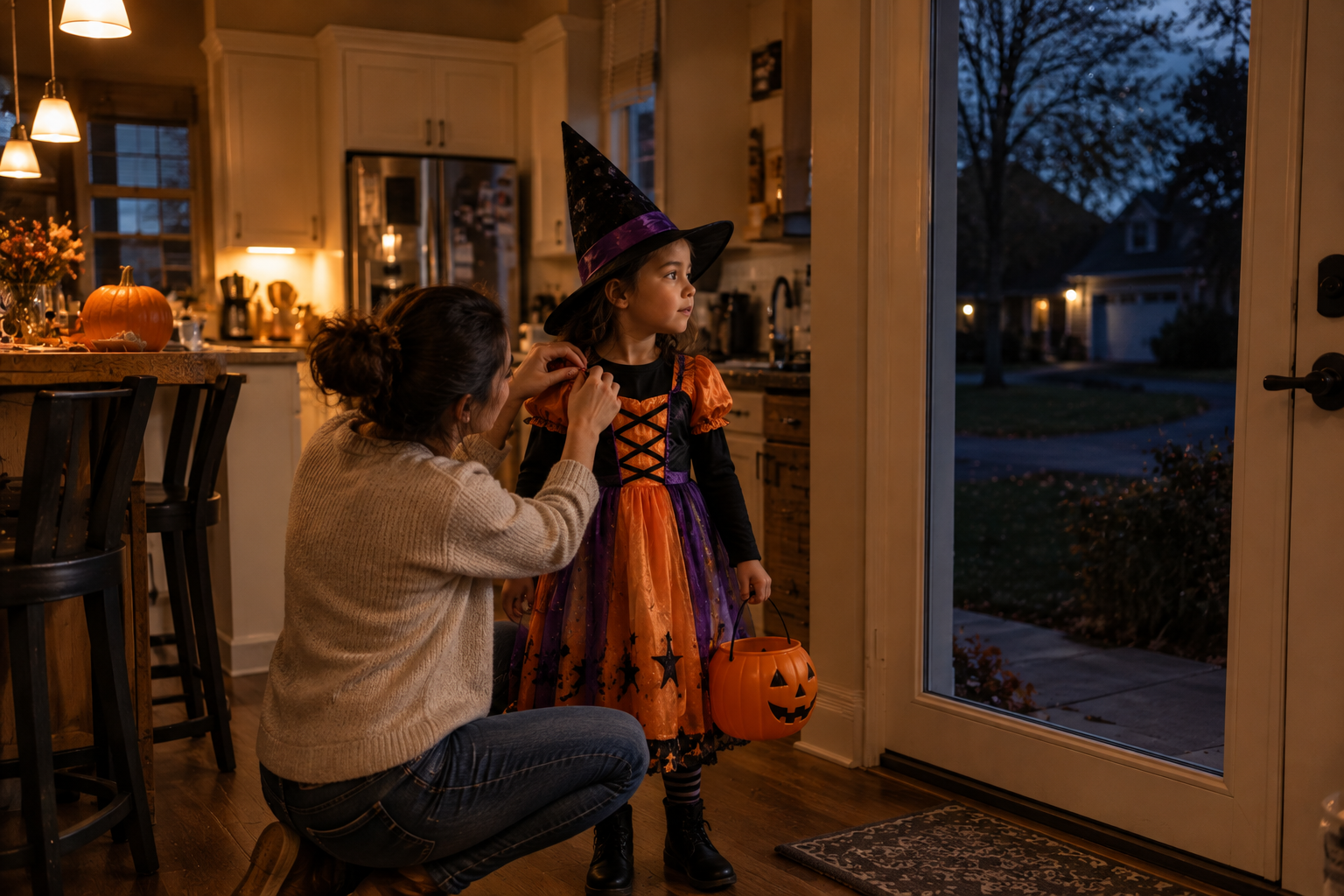
Now it’s Halloween night, and your child is standing in the kitchen, dressed and ready, doing one last check under the overhead light before you head out the door. The costume looks exactly as bright as it did the day you bought it.
That feeling isn’t wrong, exactly. It’s just answering the wrong question.
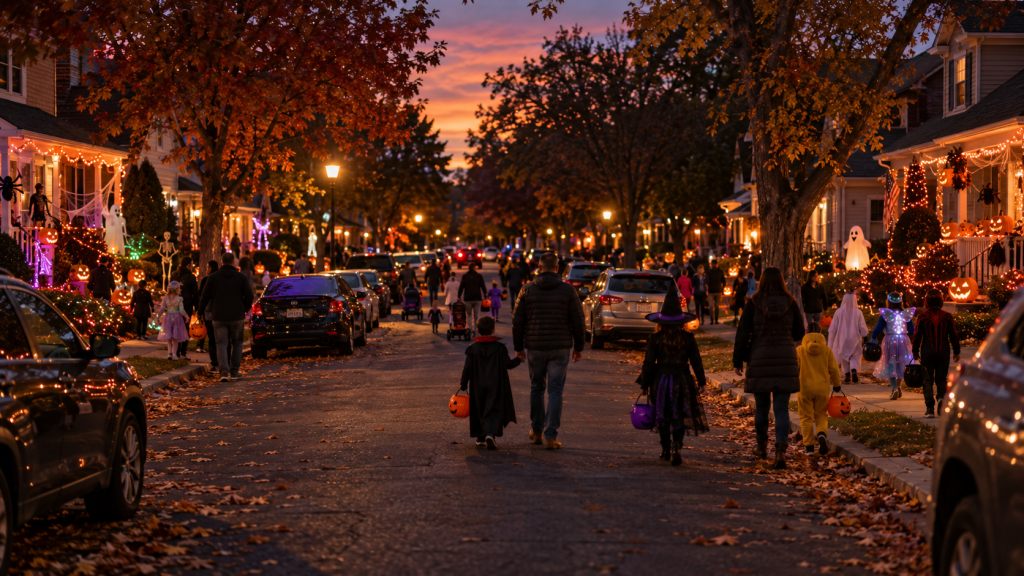
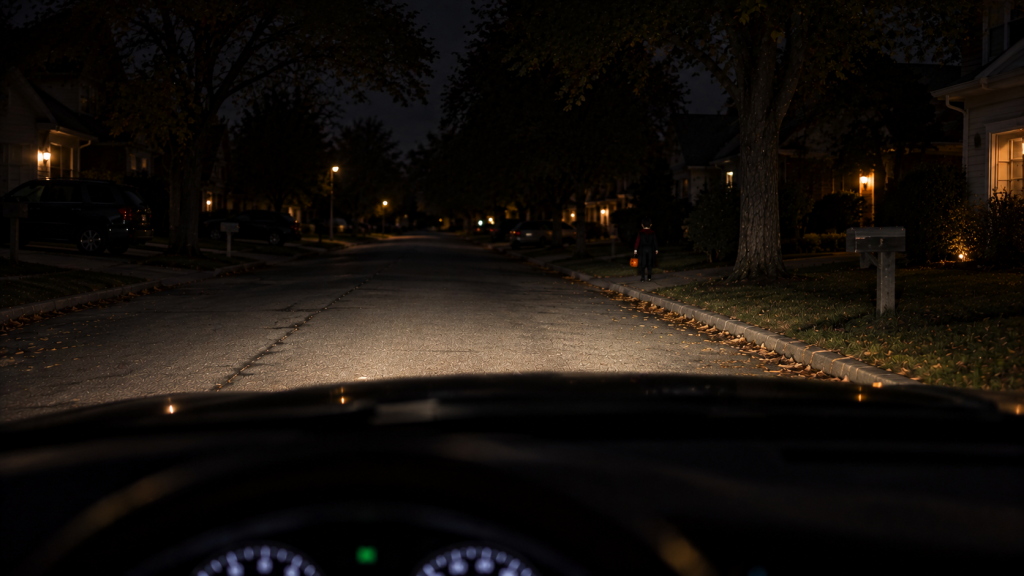
A driver won’t see your child under store lights or kitchen lights. They’ll see them — or won’t — from down a dark residential street, through a windshield, illuminated partly by their own headlights and partly by porch lights, jack-o’-lanterns, other children’s flashlights, and dozens of other things competing for attention.
And research into nighttime pedestrian visibility has been quietly building for decades around a distinction that most Halloween safety advice never really explains. A driver has to do more than notice that something is there. They have to recognize that the something is a person. And what helps with the first task isn’t necessarily identical to what helps with the second.
Why This Night Is Different
John Staples, Candace Yip, and Donald Redelmeier examined 42 years of U.S. traffic data, from 1975 through 2016. Their study, published in JAMA Pediatrics, isolated pedestrian fatalities occurring between 5 p.m. and 11:59 p.m. on Halloween and compared them with the same hours exactly one week before and one week afterward.
Across the 42 Halloween evenings studied, 608 pedestrians died, compared with 851 across the 84 control evenings. After accounting for the two-to-one difference in observation days, pedestrian fatality risk was 43% higher on Halloween — odds ratio 1.43, 95% confidence interval 1.29–1.59. Overall, the elevated Halloween risk among pedestrians peaked around 6 p.m.
The researchers also examined risk by age. Among children ages 4 to 8 specifically, the odds ratio reached 10.00 compared with the control evenings — the study’s starkest subgroup finding. That number needs to stay inside its boundaries. It does not mean an individual 4-year-old becomes “ten times more likely to be hit by a car” simply because it’s Halloween — rather, it describes pedestrian fatalities in one particular age group, across a specific historical dataset, relative to specific comparison evenings. And the study does not establish that the 4-to-8-year-old group’s risk itself peaked at 6 p.m. — the 6 p.m. peak belongs to the overall Halloween pattern. On an average Halloween, the researchers estimated about four additional pedestrian deaths compared with an ordinary comparison evening.
One other finding matters because it cuts against the instinct to treat Halloween as a crisis that’s getting progressively worse. The relative Halloween risk remained essentially stable over the 42-year period even while the absolute pedestrian death rate declined — from 4.9 deaths per 100 million Americans in the first decade studied to 2.5 in the last. Halloween wasn’t becoming progressively more dangerous in these data. It remained relatively more dangerous than the comparison evenings while pedestrian mortality overall improved.
The U.S. isn’t the only place a Halloween-evening pattern shows up, though it’s worth being precise about what the other data actually cover. A separate analysis of Great Britain’s STATS19 road-casualty database examined 73,587 child traffic casualties ages 4 to 17 between 1990 and 2017 — pedestrians, cyclists, and moped riders combined, not pedestrians alone. Between 5 and 6 p.m. on Halloween, that combined group of children had 34.2% higher odds of a fatal or serious injury than on comparison days — odds ratio 1.342, 95% confidence interval 1.065–1.692 — with casualties elevated during the 5-to-7-p.m. period.
This isn’t a clean pedestrian-to-pedestrian replication of the U.S. finding. The outcome measure is broader — serious injury or death, not fatality alone — and so is the population: child road users rather than pedestrians specifically. What it shows is a related but distinct thing: elevated road-traffic risk for children also appears during Halloween evening in the Great Britain data. Two different questions, asked in two different countries, arrived at a broadly consistent signal — Halloween evening was associated with elevated road-traffic harm involving children — without either study duplicating the other.
At a Glance: Two Datasets, Two Different Things
| Dataset | Who’s Counted | What’s Measured | Halloween-Evening Finding |
|---|---|---|---|
| U.S. (Staples, Yip & Redelmeier, 1975–2016) | Pedestrians only | Fatalities | 43% higher risk overall (OR 1.43); ages 4–8: OR 10.00 |
| Great Britain, STATS19 (1990–2017) | Pedestrians, cyclists & moped riders combined | Fatal or serious injury | 34.2% higher odds, ages 4–17 (OR 1.342) |
Which makes the conventional recommendation perfectly reasonable: make children easier to see. The interesting question is what that actually means.
“Make It Bright” Is Already the Official Advice
If you’ve ever looked up Halloween safety guidance, you’ve already encountered the standard answer.
The U.S. Consumer Product Safety Commission has recommended essentially the same approach since at least 1983 — the earliest Halloween safety guidance we could independently verify: choose costumes that motorists can see, add reflective material, and carry a flashlight. Modern CPSC guidance continues the same basic message.
The American Academy of Pediatrics similarly recommends bright, reflective costumes and suggests reflective tape, striping, or other visibility elements. Safe Kids Worldwide recommends flashlights, glow sticks, and reflective wristbands or tape. The FDA’s consumer guidance echoes the same general combination.
And the U.S. federal agency most focused on traffic safety takes a different approach. NHTSA doesn’t mention costume visibility at all in its Halloween guidance. Its recommendations focus instead on issues such as driver behavior, speed, sober driving, and pedestrian behavior.
| CPSC | Light or bright costume, reflective tape, carry a flashlight (guidance stable since at least 1983) |
| AAP | Bright, reflective costumes; reflective tape or striping; other visibility elements |
| Safe Kids Worldwide | Flashlights, glow sticks, reflective wristbands or tape |
| FDA | Bright, reflective costumes or added reflective tape |
| NHTSA | Does not address costume visibility — focuses on driver speed, sober driving, pedestrian behavior |
None of that makes the existing guidance wrong. A public-safety message has to remain simple enough to remember. But underneath that simple message, the science of how drivers see and recognize pedestrians at night has become considerably more specific than: wear something bright.
“Bright” and “Reflective” Aren’t the Same Promise
A fluorescent color — the vivid orange, yellow, or lime green that seems almost impossible to miss under store lighting — works by absorbing available light, including ultraviolet energy, and re-emitting some of that energy as visible light. That can make fluorescent material particularly conspicuous during daylight and some twilight conditions.
Retroreflective material works differently. Rather than simply appearing bright, it is designed to return incoming light toward its source. At night, one important source is a vehicle’s headlights. An active light — a flashlight, LED, or glow device — is different again because it produces its own visible signal rather than depending entirely on reflected illumination. These mechanisms can overlap on a real street with streetlights, porch lights, headlights, and other illumination. But they aren’t interchangeable.
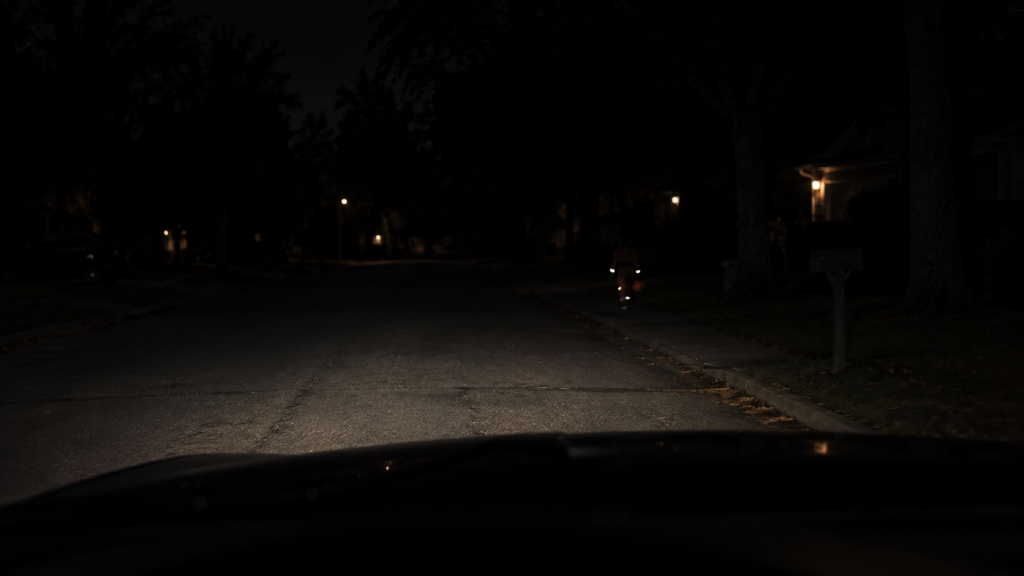
Research on how pedestrians judge their own nighttime visibility has found they dramatically overestimate it, and underestimate how much retroreflective material actually helps once it’s genuinely dark. So the costume that looks most conspicuous while you’re shopping for it is not necessarily the one that gives a driver the most useful visual information at night.
Then researchers asked another question. What happens when you change where the reflective material goes?
Where You Put Reflective Material Can Change What a Driver Sees
In 1994, D. Alfred Owens, Robyn Antonoff, and Ellie Francis tested nighttime pedestrian visibility using four different configurations. Participants watched pre-recorded driver-perspective video of a jogger at night and used a simulated brake-pedal response when they detected the pedestrian. The jogger appeared with no retroreflective material, a reflective torso configuration, reflective markings placed arbitrarily on the limbs, or reflective markings arranged around major moving joints in a pattern corresponding to human movement. That final arrangement is generally described as biological motion, or biomotion.
All of the retroreflective configurations improved performance over the dark control. But they didn’t perform equally. Limb markings performed better than torso markings. And the biomotion configuration performed better than the reflective vest and arbitrary limb placement. When participants were asked which configuration was easiest to see, 85% selected biomotion.
Why might a few moving reflective points matter? Because a driver’s visual system isn’t necessarily solving only: is there something ahead? It may also be solving: what is it, and how is it moving? Reflective elements moving with the characteristic pattern of arms and legs can provide information that a static reflective area does not: human movement.
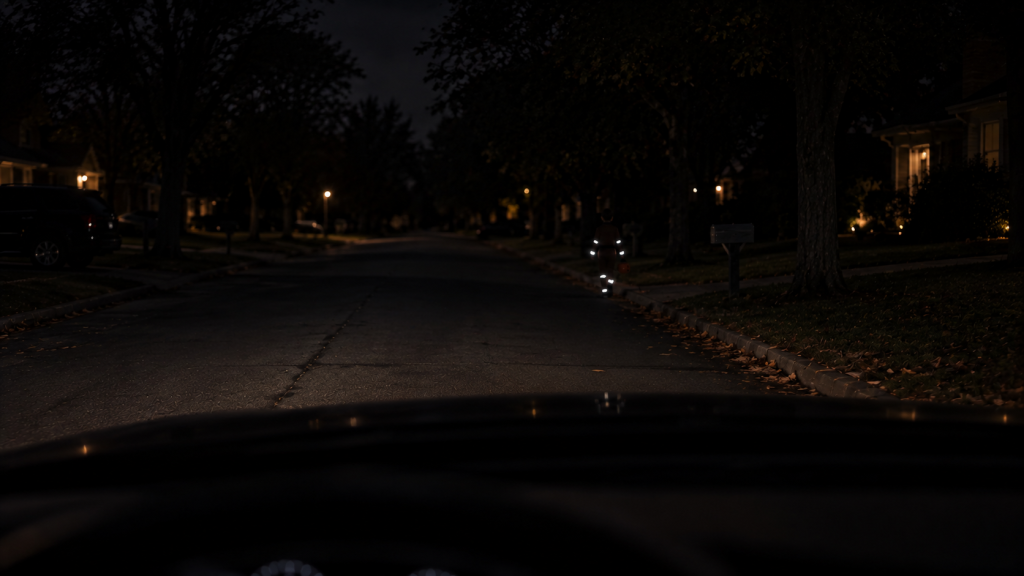
Later studies continued testing that idea under different conditions. A 2005 study reported a striking contrast: drivers recognized only 5% of pedestrians in its most challenging condition — low-beam headlights, black clothing, and glare — while drivers recognized 100% of pedestrians wearing retroreflective clothing configured to depict biological motion in a condition without glare.
That comparison is worth reading precisely. Clothing wasn’t the only thing that changed between those two numbers. Glare changed too. So the honest interpretation is narrower than “biomotion versus black clothing” alone. And it certainly does not mean biomotion made the pedestrians “20 times safer.” Detection or recognition in an experiment isn’t crash prevention.
A 2017 closed-road study went further by tracking the eye movements of 14 young licensed drivers as they drove at night. Drivers recognized pedestrians wearing biomotion markings at an average distance of approximately 319 meters, compared with 185 meters for a standard retroreflective vest. When drivers were asked to identify the pedestrian’s direction of travel, the corresponding distances were approximately 215 meters versus 96 meters. The average time to recognition was 6.4 seconds in the biomotion condition versus 13.9 seconds with the vest.
Those numbers require an important firewall. Recognition time is not reaction time. And reaction time is not braking time. The study did not establish that a particular reflective configuration gives a driver a specific number of additional feet or meters in which to stop. What it showed was that changing the reflective configuration changed when drivers recognized that they were looking at a pedestrian.
More recent work has continued to find substantial differences under other experimental conditions. A 2023 study using relatively thin, wearable retroreflective markings reported recognition distances approximately twice those of commercial sports clothing, about 2.5 times those of a fluorescent yellow top, and around four times those of black clothing under the conditions tested.
The exact multipliers vary because the studies don’t use identical designs, clothing, environments, or visual tasks. That’s why the largest number shouldn’t become the headline. The convergence is more important: across different experimental approaches, multiple studies have found that retroreflective configuration can influence pedestrian detection or recognition at night.
At a Glance: Four Studies, One Pattern
| Study | What Was Compared | What It Found |
|---|---|---|
| Owens, Antonoff & Francis (1994) | No markers / torso / arbitrary limb / biomotion limb placement | Limb beat torso; biomotion beat arbitrary placement; 85% rated biomotion easiest to see |
| 2005 study | Black clothing (low beam + glare) vs. biomotion clothing (no glare) | 5% vs. 100% recognized — but glare differed too, not a clean clothing-only comparison |
| 2017 study | Biomotion vs. standard retroreflective vest | Recognized from ~319m vs. ~185m; direction identified from ~215m vs. ~96m; recognition time 6.4s vs. 13.9s |
| 2023 study | Thin biomotion strips vs. sports clothing / fluorescent top / black clothing | Recognized ~2x farther than sports clothing, ~2.5x farther than fluorescent, ~4x farther than black clothing |
Detection and Recognition Aren’t the Same Problem
This distinction is worth naming because it explains what the biomotion research is actually adding. Detection asks: is something there? Recognition asks: what is it? A reflective area can help make something conspicuous, while a biomotion configuration can provide additional information associated with a moving human figure.
The more defensible conclusion from the research is therefore narrower than any dramatic multiplier: under several experimental conditions, biomotion configurations have helped drivers detect or recognize pedestrians earlier or from farther away than comparison clothing. That doesn’t tell us how many crashes would be prevented. It tells us something more specific about what drivers can perceive at night.
What We Don’t Know Yet
None of this works as an unconditional rule. And one of the most interesting reasons is that the research itself doesn’t give us a perfectly tidy story about visual clutter.
A 2002 study by Moberly and Langham used pre-recorded nighttime road scenes and asked participants to detect pedestrians wearing different reflective configurations. In the visually cluttered, ambiently illuminated conditions they studied, the expected biomotion advantage was not significant. A later 2009 study involving Tyrrell, Wood, and colleagues approached clutter differently. Drivers operated a vehicle on a closed road while additional points of light were deliberately introduced around the pedestrian to create visual clutter. Under those experimental conditions, pedestrians wearing biomotion markings were still recognized more often and from farther away than the comparison condition.
Those findings shouldn’t be forced into a winner and loser. The studies used different methods, different comparison conditions, and different ways of producing clutter — so the honest conclusion is that the clutter literature is not uniform. That uncertainty matters for Halloween because a decorated residential street can be visually busy — porch lights, headlights, illuminated decorations, parked vehicles, flashlights, and groups of pedestrians — without assuming that this real-world environment is equivalent to the experimental clutter used in either study.
At a Glance: Two Clutter Studies, Two Different Answers
| Study | Method | Finding |
|---|---|---|
| Moberly & Langham (2002) | Pre-recorded video, button-press detection, vest vs. biomotion | No significant biomotion advantage in cluttered, ambiently lit conditions |
| Tyrrell, Wood et al. (2009) | Real driving on closed road, deliberate clutter, black vs. black+biomotion | Biomotion pedestrians still recognized more often and farther away despite clutter |
There is another limitation. Pedestrian orientation can affect what biomotion communicates. Some research suggests that the advantage can diminish when a pedestrian is moving in profile or parallel to the roadway rather than presenting the movement patterns tested under other viewing geometries.
And then comes the most important limitation of all. The studies behind these findings used controlled pedestrian models and clothing configurations observed by licensed drivers — not young children trick-or-treating in actual Halloween costumes. We did not identify a study that directly tested a young child wearing a real Halloween costume, moving through a real trick-or-treat environment, with different reflective configurations while researchers measured driver detection or recognition. That’s not a minor disclaimer. It’s the boundary around what this evidence allows us to claim.
The underlying mechanism is well supported: retroreflective material can improve nighttime conspicuity, and its configuration can affect how drivers detect or recognize human movement. But its exact effect on a real child, in a real costume, on a real Halloween street has not been directly measured. And we’re not going to pretend otherwise.
So What Does This Change About the Costume?
It doesn’t overturn the standard guidance. A costume shouldn’t make a child unnecessarily difficult to see. Retroreflective material can return vehicle-headlight illumination, while a flashlight or another appropriate active light can provide an additional visual signal.
The research adds one consideration to that familiar advice: don’t think only about whether reflective material is present. Think about the visual information its configuration can provide when a person moves. That doesn’t produce a universal Halloween tape pattern. It simply means that placement can change what a driver detects or recognizes — something the phrase “make it reflective” doesn’t explain on its own.
Be Seen / Be Able to See
Halloween visibility runs in two directions. The driver needs to see the child — that’s where color, retroreflection, active illumination, and reflective configuration come in. But the child also needs to see the driver. A highly conspicuous costume doesn’t solve much if a rigid mask or another costume element restricts the child’s field of view. That’s why pediatric Halloween guidance cautions against masks that interfere with vision and commonly recommends alternatives such as makeup or decorative hats when appropriate.
There are therefore two different visibility questions. Be seen: can the driver detect and recognize the child? Be able to see: can the child adequately see traffic and the environment? Reflective material addresses the first problem. It cannot compensate for creating the second.
The Kitchen Test Is the Wrong Test
Go back to the kitchen. Your child is standing under the overhead light, fully dressed and ready to leave. The costume looks bright. Maybe it looks impossible to miss. And from a few feet away, while you’re looking directly at someone you already know is there, it probably is.
But that’s not the view we’re trying to understand. Mentally move to the other side of the windshield. Darkness. Headlights. Distance. Porch lights. Parked cars. Other children. Movement. Then ask two separate questions: what will help the driver notice that something is there? And then: what will help the driver recognize that the something is a person?
Those aren’t quite the same problem. Bright or fluorescent material can contribute to conspicuity under the lighting conditions where it works. Retroreflective material can return headlight illumination. And decades of nighttime pedestrian research suggest that the configuration of retroreflective material can provide additional information about human movement. But none of those studies gives parents a magic Halloween formula. No experiment we found tells us exactly how much a particular reflective configuration changes the safety of a child wearing a real costume on a real Halloween street.
So buy the reflective tape. Use the flashlight. Follow the established guidance. Just understand what you’re asking those things to accomplish. And when you look at the costume one last time under the overhead light, don’t ask only whether it looks bright. Ask what a driver will be able to recognize from the other side of a windshield.
The person who needs to recognize your child isn’t standing in the kitchen.
Sources
- Staples, J.A., Yip, C., & Redelmeier, D.A. (2018). Pedestrian Fatalities Associated With Halloween in the United States. JAMA Pediatrics. Link.
- Hsu, L.M., Wiratama, B.S., Chen, P.L., Saleh, W., Lin, H.A., & Pai, C.W. (2021). Pediatric Traffic Injuries on Halloween in the United Kingdom: Prevalence and Injury Severity. International Journal of Environmental Research and Public Health. Link.
- U.S. Consumer Product Safety Commission (1983). CPSC Issues Halloween Safety Alert — earliest independently verified costume-visibility guidance. Link.
- U.S. Consumer Product Safety Commission (2023). CPSC Offers Safety Tips to Keep Hazards from Haunting Your Halloween. Link.
- American Academy of Pediatrics / HealthyChildren.org. Halloween Fun & Safety Tips for Kids of All Ages. Link.
- Safe Kids Worldwide. Halloween Safety. Link.
- U.S. Food and Drug Administration. Halloween Safety Tips: Costumes, Candy, and Colored Contact Lenses. Link.
- National Highway Traffic Safety Administration. Halloween Safety Tips for Drivers, Pedestrians, More. Link.
- Tyrrell, R.A., Wood, J.M., & Carberry, T.P. (2004). On-Road Measures of Pedestrians’ Estimates of Their Own Nighttime Conspicuity. Journal of Safety Research. Link.
- Owens, D.A., Antonoff, R.J., & Francis, E.L. (1994). Biological Motion and Nighttime Pedestrian Conspicuity. Perceptual and Motor Skills (SAGE). Link.
- Wood, J.M., Tyrrell, R.A., & Carberry, T.P. (2005). Limitations in Drivers’ Ability to Recognize Pedestrians at Night. Human Factors. Link.
- Wood, J.M., Tyrrell, R.A., et al. (2017). Night-Time Pedestrian Conspicuity: Effects of Clothing on Drivers’ Eye Movements. Ophthalmic and Physiological Optics. Link.
- Black, A.A., Brough, D., King, M., King, N., Bentley, L.A., Fylan, F., & Wood, J.M. (2023). Making Night-Time Pedestrians Safer Using Innovative Clothing Designs. Transportation Research Part F. Link.
- Moberly, N.J., & Langham, M.P. (2002). Pedestrian Conspicuity at Night: Failure to Observe a Biological Motion Advantage in a High-Clutter Environment. Applied Cognitive Psychology. Link.
- Tyrrell, R.A., Wood, J.M., Chaparro, A., Carberry, T.P., Chu, B.S., & Marszalek, R.P. (2009). Seeing Pedestrians at Night: Visual Clutter Does Not Mask Biological Motion. Accident Analysis & Prevention. Link.

Comments
One response to “Your Kid’s Halloween Costume Looks Bright. But Can a Driver Actually See Them?”
[…] Two more choices help. Keep the outing short, and give one adult a single job—the dog—because nobody can fully watch a dog, a child, and a street crossing at once. (For crossings, see our guide to Halloween street crossings; for visibility, our guide to Halloween costume visibility.) […]