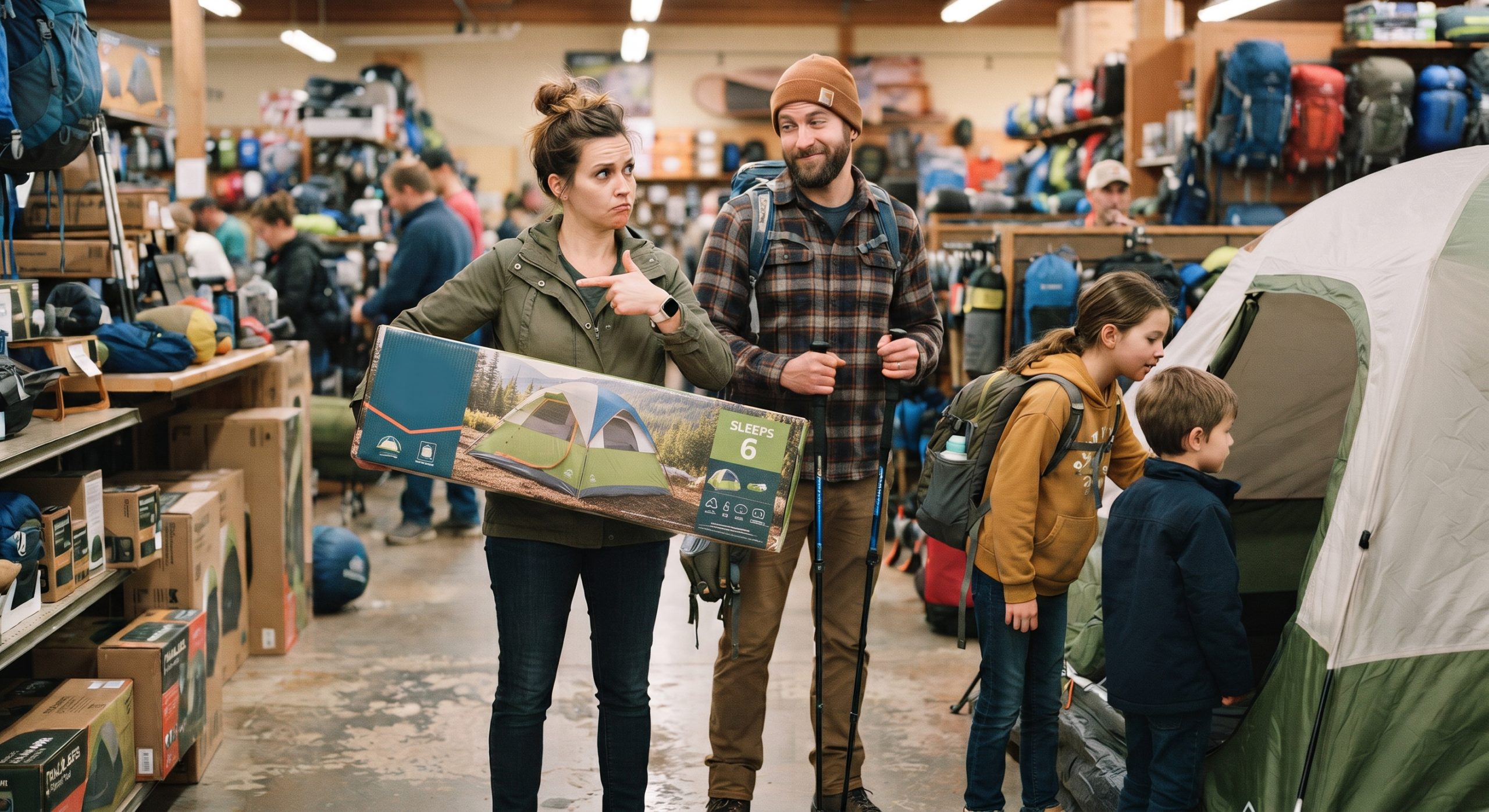
You’re standing in the aisle — or scrolling the listing — looking at a tent tagged “Sleeps 6.” There are four of you. On paper, that sounds like room to spare. So why does every camping forum have a thread full of parents asking some version of the same question: do we need the 6-person, or should we just go straight to the 8?
The number on the box isn’t wrong. It just doesn’t answer the question you’re actually asking.
The label is telling the truth about the wrong thing
“Sleeps 6” is a real, calculable number—it’s just not measuring comfort. Here’s Marmot’s own buying guide, stripped of any marketing gloss: “Capacity numbers refer to how many standard sleeping bags or sleeping pads can fit side by side. They don’t take into account gear storage.” Coleman says almost the same thing in its own tent buying guide: capacity ratings indicate how many sleeping pads can fit on the floor, and that’s “not necessarily a reflection of how comfortable the space will feel once people and gear are considered.” Coleman adds the part that matters to a family specifically — many campers size up “particularly for car camping, to allow more room for gear and movement.”
There’s an international standard behind this kind of thinking, too, for what it’s worth: ISO 5912, the standard covering camping tent requirements and test methods (most recently reconfirmed as current in 2025), calculates sleeping capacity by seeing how many times a fixed test area — for Category B tents, a 200 cm × 60 cm test area, about the footprint of one sleeping bag — fits inside the sleeping area without overlapping. That’s a real, physical, standards-based method for measuring sleeping capacity. It’s worth being precise here, though: there’s no evidence that Coleman, CORE, Ozark Trail, or other US brands calculate their advertised numbers according to that specific ISO standard. What we can say for certain is that US manufacturers independently describe capacity the same way — as a sleeping-pad math problem, not a comfort problem.
The cleanest proof of that isn’t a blog’s interpretation of a standard. It’s a manufacturer just… saying it. CORE Equipment’s own product page for its 6-Person Instant Cabin Tent lists two separate numbers, right next to each other:
Sleeps: 6 (Industry Standard) / 3 + Gear (Most Comfortable)
That’s not a third party doing math on CORE’s behalf. That’s the company that made the tent, on its own product page, telling you the “6” and a comfortable number are two different things — and that the comfortable number is half the label. Zempire, a completely different brand in a completely different price tier (premium inflatable tents, not $200 instant cabins), does the same thing on its own spec sheet: “sleeps up to 4 comfortably, with a maximum capacity of 6.” Two unrelated manufacturers, two different formats, the same admission.
So here’s the actual question worth answering before you buy anything: not “how many people does this tent sleep,” but how much space does your family actually need, where will you put it, and what format and features make that space work — in that order.
Step 1: How much tent does your family actually need?
REI’s own sizing guidance gives you real numbers to work with, not vibes:
| Scenario | Recommended floor space |
|---|---|
| 2 people, minimum | 29–33 sq ft |
| 2 active sleepers | 40–45 sq ft |
| 2 people + a child or dog | 40–60 sq ft |
| 4 people, minimum | 56–60 sq ft |
| 4 people + gear/dog | 75–88 sq ft |
| 4 people + dog + occasional guest | 110–160 sq ft |
REI is explicit that this minimum doesn’t include “additional space for playing cards, changing clothes or storing gear” — and recommends buying at least one size class larger for car camping, since weight isn’t the constraint it is for backpacking.
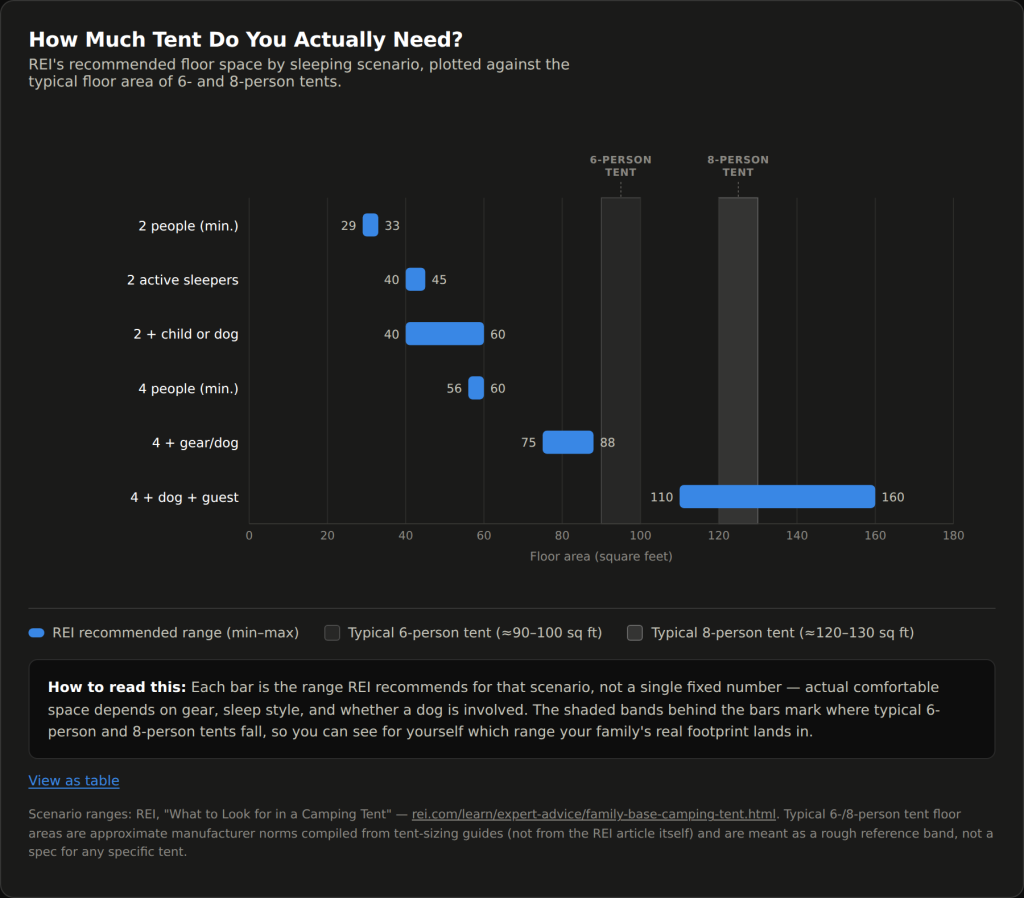
Two other major retailers land in the same neighborhood, independently. Academy Sports’ own tent guide lists a 4-person tent at 55–65 sq ft — nearly identical to REI’s bare-minimum figure. Bass Pro Shops’ buying guide goes further, citing 20–25 sq ft per person as the standard manufacturers allow, and describes what happens at that minimum in plain language: “you’ll most likely be lying right next to your tent mates with your sleeping bags touching or even overlapping.” Bass Pro’s explicit advice: if you want real room, “upsize one person.”
Before you land on a number, it helps to actually build your sleeping arrangement in your head rather than just picking a headcount:
- How many adults and children will actually sleep inside — every trip, not just the best case?
- Sleeping bags and pads, or air mattresses and cots (which take up more floor than the tent’s rating assumes)?
- Does anyone move a lot in their sleep, or need their own space?
- Is a dog sleeping inside?
- Do duffel bags, shoes, and clothing stay in the tent overnight, or live in the car?
- Do you want room to stand and change clothes, not just lie down?
- Will kids spend real daytime hours inside on a rainy afternoon?
None of that shows up in the number on the tag — which is exactly why two families both buying a “4-person tent” can end up with very different amounts of usable room.
Put the numbers together and the takeaway is concrete: a family of four at REI’s “comfortable with gear” range (75–88 sq ft) is already asking for the floor space of what’s sold as a 6-person tent. Add an air mattress, a toddler who needs the whole floor to herself at 2 a.m., or a dog who doesn’t understand personal space, and an 8-person-rated tent stops being overkill — it’s the tent that actually fits the family you have.
Step 2: Before you size up — will it fit where you’re going?
This is the part that “just buy a bigger tent” advice usually skips, and it’s worth a whole step of its own: campsites have size limits too.
Real tent pad sizes at U.S. campgrounds vary more than most people expect — from as small as 6×8 ft to as generous as 20×20 ft, with a lot of variation even within the same campground. A Grand Canyon North Rim site lists a 16×16 ft pad and requires tents to be set up on it. A Sequoia & Kings Canyon site is 8×15 ft. Yosemite’s Hodgdon Meadow lists a 14×7 ft flat tent area. KOA’s standard tent sites run around 15×15 ft, with “family” sites up to 20×20 ft.
Now compare that to what “sizing up” actually gets you: CORE’s own 12-Person Instant Cabin Tent has a floor footprint of 18 ft × 10 ft — longer than even a generous 12×12 or 15×15 pad.
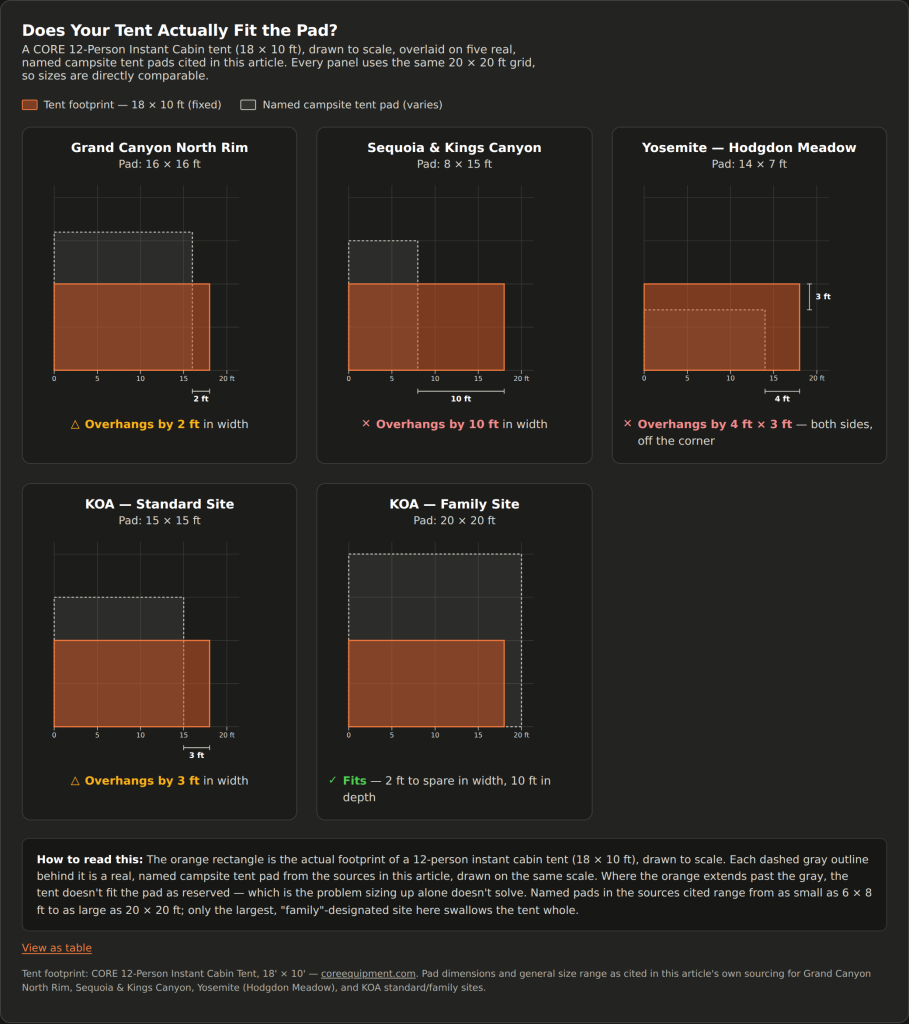
This isn’t a hypothetical. Search any national park camping forum, and you’ll find the exact question playing out in real time — campers with 13×9, 14×16, or 16×7 ft tents trying to figure out whether they’ll fit a “12×12” site limit, and more experienced campers explaining that the honest answer is “it depends on the specific site, so call ahead.” One park veteran’s practical fix, when a 14×16 ft tent met a 13×13 ft pad: stake part of it off the pad and use the flat ground around it.
The fix here isn’t complicated, just easy to forget in the excitement of solving the capacity-gap problem: before you buy the bigger tent, check the tent pad size (or maximum tent size) for the specific campground you actually camp at — not a generic “campsites are big” assumption. A tent that solves your sleeping-space problem and doesn’t fit your reserved site just trades one frustration for another.
Step 3: Once you know your size, what format actually delivers it?
With a size range in mind — and a campsite that can fit it — the next decision is format. Three formats deserve serious consideration for family car camping, and they’re not equally matched.
Instant cabin tents — the major, mature default
Brands like CORE Equipment, Ozark Trail, and Coleman have built entire product lines around near-vertical-walled “cabin” tents with pre-attached, hinged pole systems that pop into shape in roughly a minute. This is a big, well-established, actively competitive category — CORE alone sells instant cabin tents in 6P, 9P, 10P, and 12P sizes, with BlockOut (blackout), full-rainfly, and lighted variants, priced from about $200 to $400+. It’s fair to call this a major, commercially mature family-tent format — it would be overstating it to call it “the dominant” one, since that’s a claim about market share that search interest alone doesn’t establish.
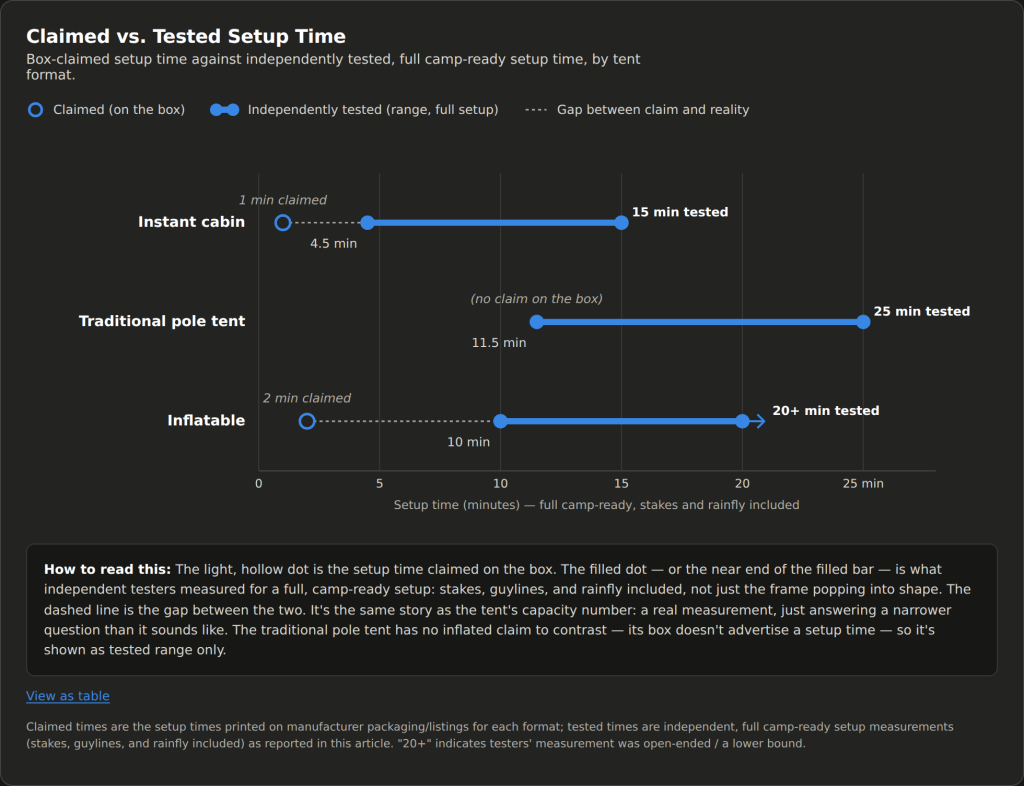
Here’s the honest nuance worth knowing before you buy: “1-minute setup” almost always refers to the frame popping into shape, not a fully camp-ready tent. Independent testers who time the whole process — frame, stakes, guylines, rainfly — consistently land in the 4.5-to-15-minute range depending on tent size, not 60 seconds. That’s still faster than a traditional pole tent (11.5 to 25 minutes in the same kind of full-setup tests), just not quite as instant as the name suggests.
The trade-off for that speed shows up in wind. Because instant cabins rely on hinged, pre-shaped joints rather than continuous flexible poles, several independent field tests found them structurally softer in gusty conditions — one reviewer’s field test of a 9-person instant cabin held up fine at 15 mph but saw the wide side collapse aggressively at 30 mph gusts, concluding it’s “not a storm shelter.” That’s not a knock on the whole category so much as a reason to treat wind exposure, not just capacity, as a real variable in your site choice.
Traditional cabin/dome — the structural alternative
Dome-shaped tents trade some usable floor space (their sloped walls eat into headroom and elbow room compared to a cabin’s near-vertical walls) for better wind shedding, and cabin-style pole tents (as opposed to instant cabins) trade setup speed for a more rigid, continuous pole structure. But “traditional beats instant in bad weather” isn’t automatically true — it depends heavily on build quality. A budget dome tent tested by independent reviewers scored poorly specifically because of water leaking through exposed mesh in side wind and cheap stakes, while a premium canvas cabin tent (Kodiak Canvas’s Flex-Bow line) held up well in gusty conditions — but only because it was staked correctly; it’s a non-freestanding design that can tip over if it isn’t.
The real lesson: format sets the ceiling, but construction quality and correct staking decide whether you actually get the wind performance you’re paying for.
Inflatable/air tents — the rising, premium alternative
Air-pole tents (Zempire, Quechua, and others) inflate instead of assembling poles, and they’re a real, if smaller, part of the market — not a fringe gimmick. The trade-off is price: a Zempire Pro TM V2 (comfortable for 4, max 6) runs about $1,700, compared to roughly $200 for a comparable CORE instant cabin — an 8-to-17x premium depending on the model. And the same “instant” honesty problem applies here too: a 2-minute inflation claim (on a sibling model) translated to 10–20 minutes in independent full-setup testing, and a different inflatable brand’s “instant air” tent took over 18 minutes for an independent tester setting it up solo for the first time. Inflatable tents are a legitimate, rising option for families who want speed and don’t mind paying for it — not yet a mainstream replacement for the $200–$400 instant-cabin category.
Step 4: Weatherproofing — one number won’t tell you the whole story
Tent waterproofing is usually sold with a single number: hydrostatic head (HH), measured in millimeters of water column the fabric can resist before leaking. As a rough general guide, ratings below about 1,000mm are water-resistant rather than truly waterproof, 1,500mm and up is commonly treated as a reasonable “waterproof” floor, and ratings climb into the thousands for tents built for sustained, heavy rain.
But treat that number as a floor, not the whole answer. A technical explainer from SlingFin — a manufacturer that actually engineers tents rather than just marketing them — makes a point worth sitting with: SlingFin notes that even 700mm of pressure would require wind well above 200 mph against a flat surface, while its own 1,200mm fly fabrics would theoretically require winds above 300 mph to generate equivalent pressure. In other words, past a certain point, a much higher HH number is less about surviving a physically realistic storm and more about compensating for how quickly a coating degrades. That distinction matters: SlingFin notes that PU-coated fabrics (common and inexpensive) can lose a significant amount of waterproofness from UV exposure in a single season, while silicone-coated fabrics generally degrade more slowly — so two tents with an identical HH rating on day one can perform very differently a year in.
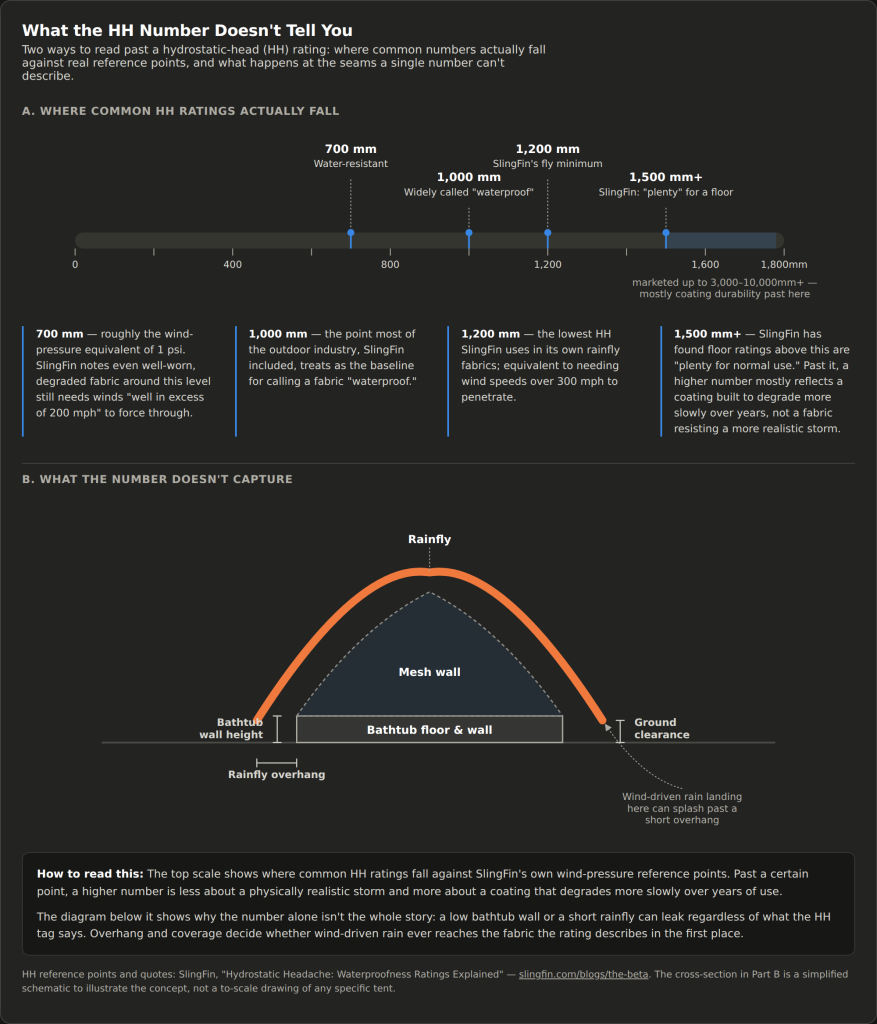
Construction details matter as much as the number. A tent’s “bathtub floor” — the waterproof floor fabric that rises a few inches up the side walls — keeps pooled water from seeping in through the floor-to-wall seams, but only up to its own height; a low bathtub wall can be overwhelmed even with a high HH rating. Coverage matters too: independent long-term field testing from Treeline Review found that a tent’s rainfly not fully extending over the tent body was a bigger practical worry than its HH number, even though years of use in a rainy climate didn’t produce leaks. Seam sealing can matter just as much: a side-by-side test of a budget tent against a premium one found the cheaper tent — with no stated HH rating and untaped seams — leaked within 30–35 minutes of heavy rain, while the pricier tent, despite a relatively modest 1,200–1,500mm HH rating, stayed dry for hours because its seams were fully taped and its floor properly built. (Treat that particular comparison as illustrative rather than conclusive on its own — it’s one test of two specific products — but it points in the same direction as the more technical sources above.)
The practical version for a buying guide: look for fully taped seams, a rainfly that extends close to the ground on all sides (not just the roof), and a bathtub floor with real height — not just the biggest HH number on the spec sheet.
Step 5: The features that actually matter for a family
Once size, site, format, and weather protection are settled, a handful of features decide how livable the tent actually is with kids.
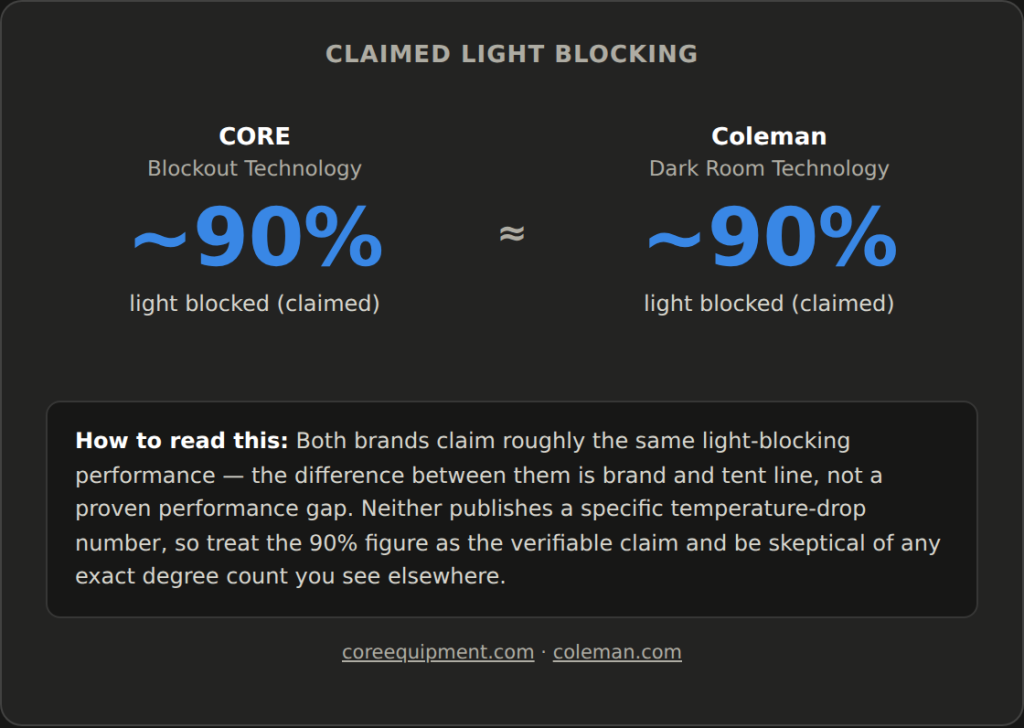
Blackout technology. Coleman’s Dark Room™ and CORE’s BlockOut™ lines both claim to block roughly 90% of incoming sunlight — useful for naps, early sunrises, and kids who don’t yet understand “sleeping in.” Both brands describe a cooling effect in general terms (“noticeably cooler,” “reduces heat buildup”) but neither publishes a specific temperature reduction — so treat “blocks 90% of light” as the verifiable claim, and be skeptical of any specific degree count you see elsewhere.
Multiple doors and room dividers. A second door means fewer 2 a.m. crawl-overs for a bathroom run, and a removable room divider can carve out a separate space for kids. Real examples: Ozark Trail’s Hazel Creek line sleeps up to 16 across 3 sewn-in rooms with 3 entrances; CORE’s 9-Person Instant Cabin includes a removable divider splitting the tent into two zones; Coleman’s Skylodge line includes a divider plus a convertible screen room. (Not every big tent has this — Kodiak Canvas’s canvas cabin tents, for instance, don’t offer an internal privacy divider; their comparable accessory encloses the exterior awning into an extra room instead, which is a different kind of space.)
Ventilation. Mesh panels in the ceiling, doors, and windows create cross-ventilation that manages condensation — REI specifically recommends opening opposing vents for airflow and seeking out larger mesh panels in hot, humid climates. In independent testing, Reviewed.com found tents with more window and mesh area noticeably better ventilated than otherwise similar family tents with fewer openings.
Match the decision to your actual trip
All five steps matter, but they don’t all matter equally to every family. A few common starting points:
If you're a family of four: don’t default to a 4-person tent. Build your real sleeping layout first (see the checklist in Step 1) — if it fills nearly the whole floor, a 6-person tent is often the more realistic starting point, and an 8-person tent earns its place once a dog, an air mattress, or real gear storage enters the picture. Just don’t skip Step 2 along the way.
If setup speed is your biggest frustration, start with the instant cabin category, choose a size that fits, and judge it by realistic full-setup time (Step 3) rather than the “1-minute” claim on the box.
If you regularly camp somewhere windy or exposed, weigh your decision toward build quality and structure over convenience — a well-staked traditional design, not just “dome” as a category, is the safer bet (Step 3).
If budget isn't the constraint and interior space is the priority, a premium inflatable tent is worth a real look, with eyes open about the price and pack-down time (Step 3).
If you're camping with young kids: once size and weather are settled, prioritize ventilation, a second door, and—if naps or 5 a.m. wake-ups are the real problem—a genuine Dark Room™ or BlockOut™ model (Step 5).
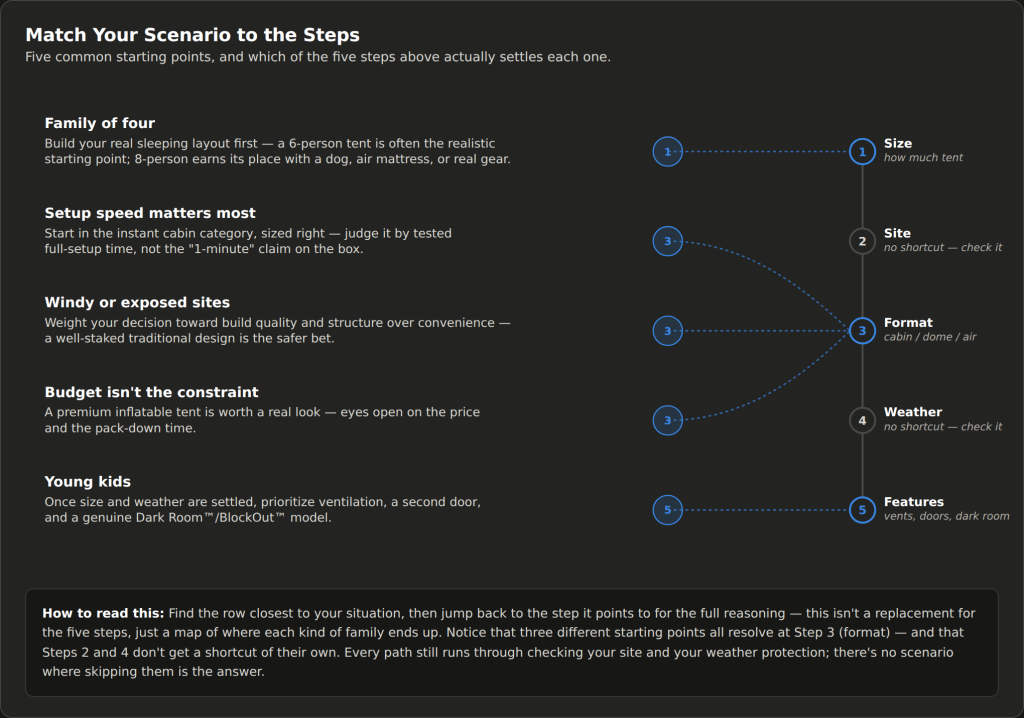
None of this is really about picking a “best” tent format — it’s about working the problem in the right sequence. Figure out your family’s real footprint first, using your actual gear and sleep setup, not the number on the tag. Check that footprint against where you actually camp, because a tent that solves the space problem and doesn’t fit the site trades one headache for another. Only then pick the format — instant cabin, traditional, or inflatable — that delivers that space the way your family wants to set up camp, and layer weather protection and family features on top.
A family of four choosing a 6-person (or even 8-person) tent isn’t falling for marketing, and it isn’t buying more tent than they need. Once you know what “6” is actually measuring, it’s very often the right call.
Sources
- Marmot, “How to Choose a Tent: Buying Guide”
- Coleman, “Tent Buying Guide”
- ISO, ISO 5912:2020 — Camping tents, requirements and test methods
- CORE Equipment, 6-Person Instant Cabin Tent
- Zempire, Pro TM V2 air tent
- REI, What to Look for in a Camping Tent
- Academy Sports, Types of Tents to Choose for Your Next Camping Trip
- Bass Pro Shops, Tent Buyer’s Guide
- Recreation.gov campsite listings: Grand Canyon North Rim #4800, Sequoia & Kings Canyon, Lodgepole #2553, Yosemite, Hodgdon Meadow #020
- KOA, Coleville Walker KOA tent sites
- CORE Equipment, 12-Person Instant Cabin Tent (18’×10′)
- CampedTooHard, CORE 9-Person Instant Cabin Tent field review
- CampingGuidance, Best Instant Tents, tested
- OutdoorGearLab, Zempire Evo TM V2 review
- Outdoors Magic, Best Family Tents, tested
- SlingFin, “Hydrostatic Headache” — waterproofness ratings explained
- SectionHiker, What Is a Bathtub Floor
- Treeline Review, The North Face Wawona 6 tent review
- CampingGuidance, Budget vs. expensive tent rain test
- Coleman, Dark Room™ Skydome 6-Person Tent
- CORE Equipment, BlockOut technology
- Walmart, Ozark Trail Hazel Creek 16-Person 3-Room Tent
- REI, How to Prevent Condensation in a Tent
- Reviewed.com, 8 Best Family Camping Tents
