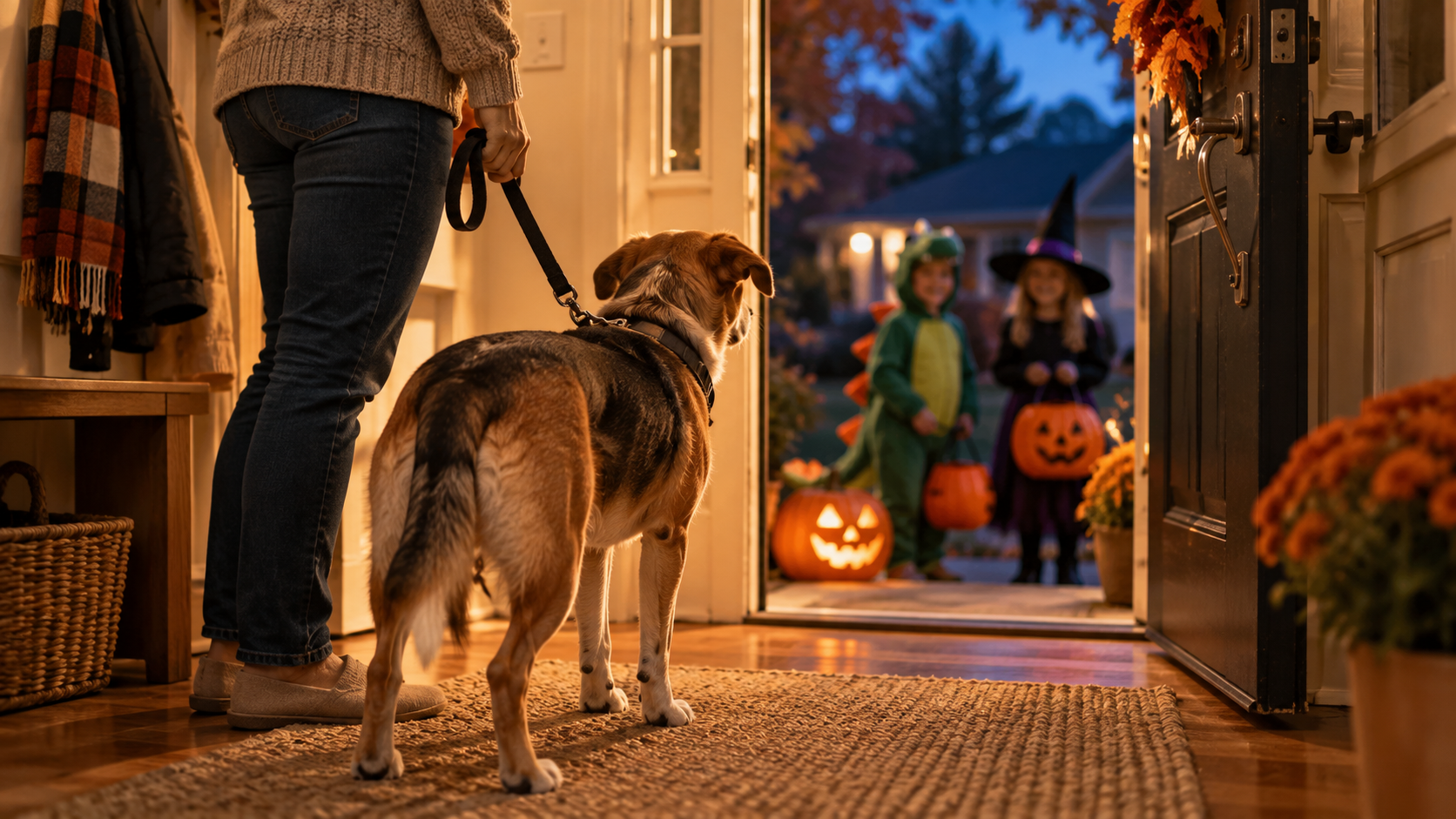
Your dog may love visitors but dislike crowded sidewalks. Meanwhile, your cat may be perfectly happy at home until the doorbell starts ringing. Before choosing a costume or planning a route, consider what Halloween will actually feel like for your pet.
The doorbell rings for the fortieth time. On the porch stand a small dinosaur, a witch, and a parent holding a flashlight.
Your dog has been at the door for every one of those rings. He isn’t barking anymore. Instead, he’s standing very still, ears pulled back, licking his lips.
Is he enjoying the party, or just getting through it? From the doorway alone, you can’t be sure—and that’s the point.
Most Halloween pet advice jumps straight to a checklist. Those steps matter, but they skip the question that comes first.
Halloween should fit your pet—not the other way around. The real decision isn’t whether your pet can take part. It’s what kind of participation, if any, suits this particular animal—and how you’ll recognize when it’s time to stop.
The Decision Starts Before Halloween
Start with the pet you already know, not the holiday.
How does your pet usually react when strangers come to the door? What about sudden loud noises, or an evening when the whole routine falls apart?
Those everyday reactions are your best preview of October 31. And for many dogs, they aren’t neutral.
In a survey covering 13,700 pet dogs in Finland, noise sensitivity was the most common anxiety-related trait: owners reported that 32% of their dogs were highly fearful of at least one noise. According to the same owners, 15% of the dogs showed fear of strangers and 11% showed fear of novel situations (Salonen et al., 2020).
These are owner reports from one country, and they don’t tell us how many dogs fear Halloween. Still, a dog who dislikes noise, strangers, or novelty isn’t unusual—and Halloween can bring all three in one night.
By the end of this guide, you’ll have three options: limited participation at home, a short supervised outing, or no Halloween participation at all.
When Halloween Comes to Your Front Door
For families handing out candy, much of Halloween happens at the front door.
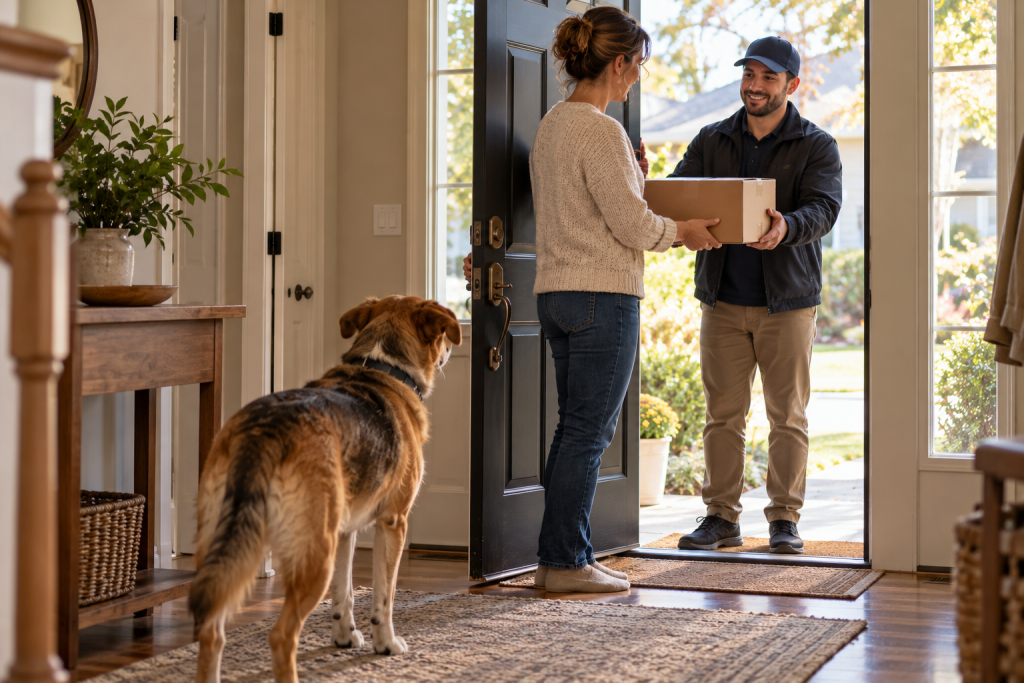
That door opens dozens of times in a few hours, bringing strangers, costumes, and excited voices. And an open door is also an exit.
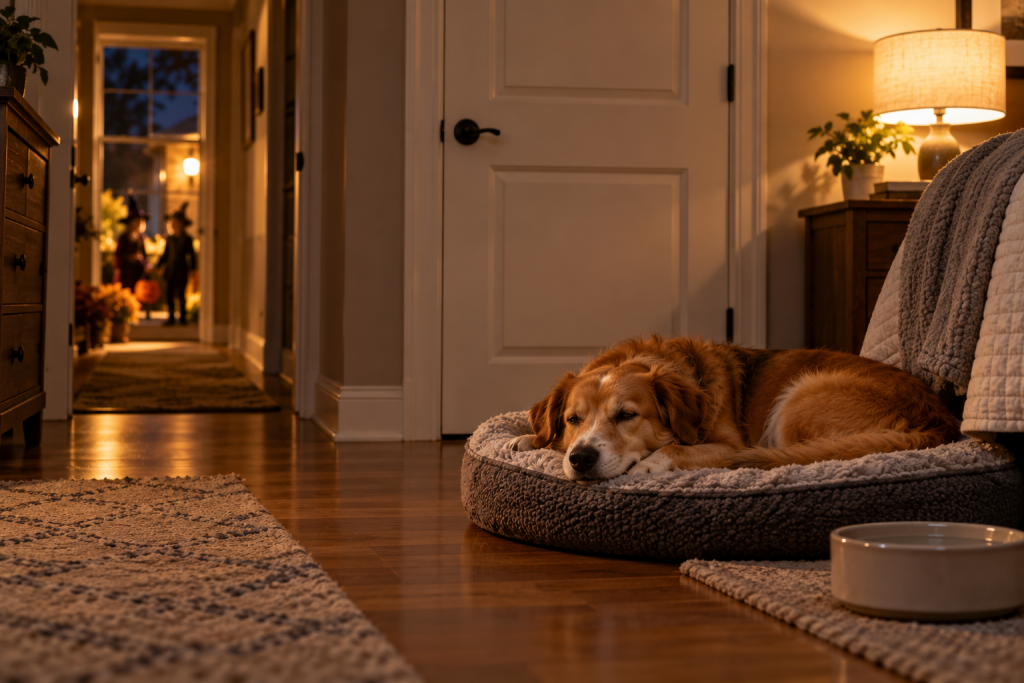
The ASPCA’s guidance is direct: “All but the most social dogs and cats should be kept in a separate, comfortable room away from the front door during peak trick-or-treating hours” (ASPCA).
Unfamiliar visitors
Keeping pets away from the front door also limits unplanned interactions with unfamiliar visitors. Related research on dog bites offers a reason to take those interactions seriously, although it doesn’t measure Halloween risk.
One study examined the records of 111 children bitten by dogs that had been referred to a university veterinary behavior clinic. Among bites to children the dog didn’t know, the most common circumstance was territory guarding, at 53% of those bites (Reisner, Shofer & Nance, 2007).
That finding needs careful handling. These were dogs already referred to a specialist for aggression, not typical family pets. The study doesn’t say where the bites happened, and it says nothing about Halloween. It doesn’t tell us how risky trick-or-treat night is. What it does suggest is that encounters between a dog and unfamiliar children are worth managing, not leaving to chance.
Managing them can be simple. Set up a closed room before the first knock, with water, a familiar bed, and—for cats—access to a litter box. Or, as veterinary behaviorist Dr. Amy Pike recommended to AAHA’s NEWStat, sit outside with a bucket of candy so trick-or-treaters don’t need to ring the doorbell at all (AAHA NEWStat).
Candy, candles, and cords
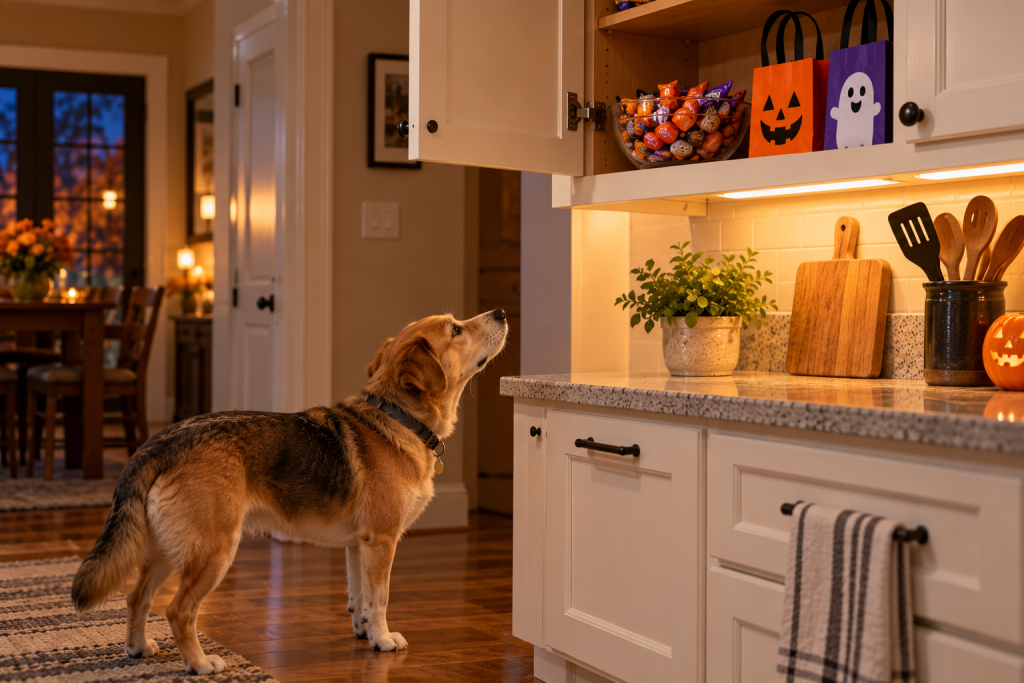
The same night that fills your doorway also fills your house with candy.
According to the ASPCA, “Chocolate in all forms — especially dark or baking chocolate — can be very dangerous for cats and dogs.” It also warns that sugar-free candies containing xylitol “can cause serious problems in pets” (ASPCA). So keep the bowl and the kids’ candy bags out of reach—including whatever candy is left lying around after the bags are emptied.
If you suspect your pet ate something harmful, don’t wait for symptoms. Call your veterinarian or the ASPCA Animal Poison Control Center at (888) 426-4435, which notes that “a consultation fee may apply” (ASPCA Poison Control).
Decorations deserve a look, too. The ASPCA warns that pets “can easily knock over a lit pumpkin and start a fire,” and advises keeping wires “out of paw’s reach” (ASPCA).
If your pet does slip out
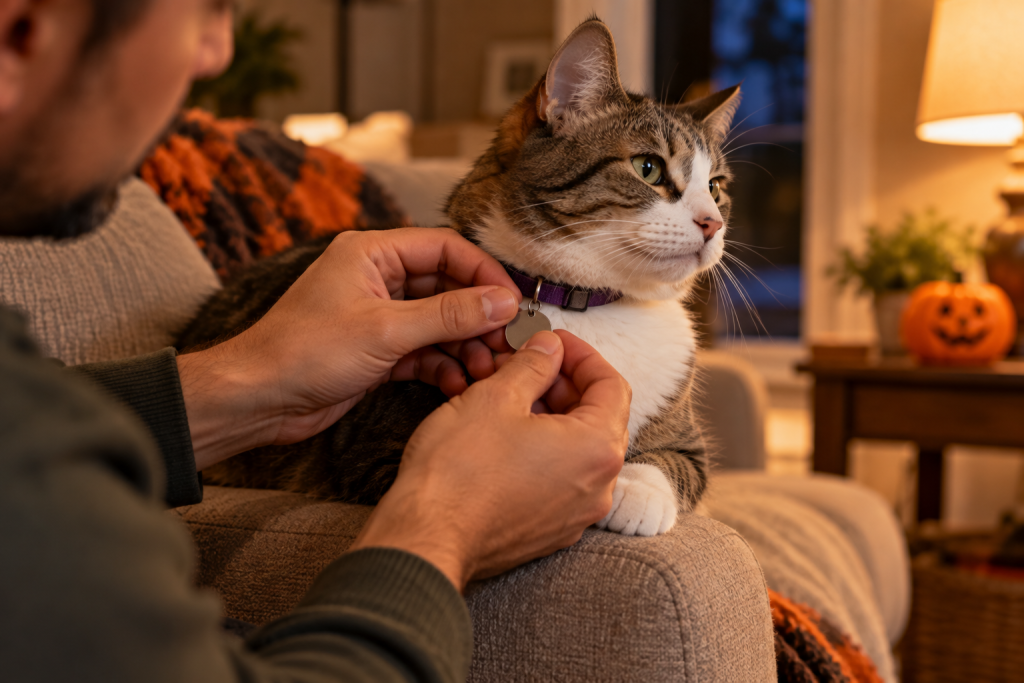
The ASPCA notes that extra pedestrians and unusual costumes can frighten pets into escaping (ASPCA). Veterinary specialists at Purdue University add a practical step: make sure your pet wears a collar with your contact information and that its microchip registration is up to date (Purdue Veterinary Medicine).
Should Your Pet Wear a Costume?
We didn’t identify a primary study measuring how Halloween costumes affect pets. So this section relies on veterinary and animal-welfare guidance, not scientific results.
That guidance starts with a high bar. The ASPCA recommends that you “don’t put your dog or cat in a costume unless you know he or she loves it,” and that your pet try it on “before the big night” (ASPCA).
From there, the focus is function. According to the AVMA, a costume should fit comfortably, shouldn’t have pieces that can be chewed off, and shouldn’t block your pet’s “sight, hearing, breathing, mouth, or movement.” It also advises never leaving a costumed pet unattended (AVMA).
Function is only half the question, though. The other half is how your pet responds while wearing it. A pet who freezes, keeps pawing at the outfit, or tries to back out of it is giving you an answer. In that case, the ASPCA suggests letting your pet wear its “birthday suit” or a festive bandana instead.
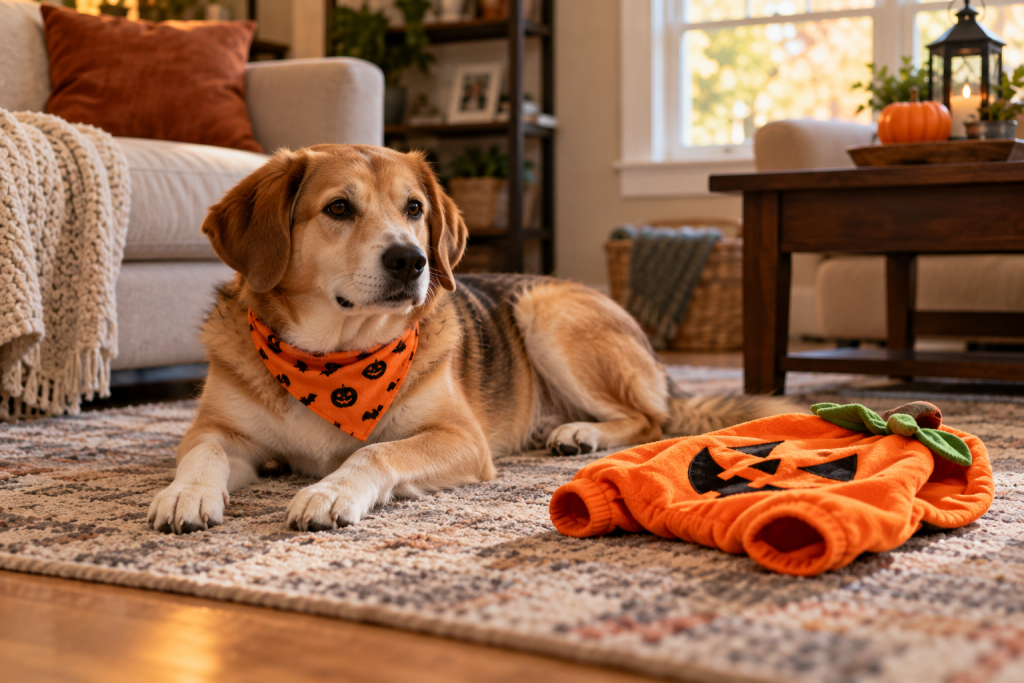
Keep in mind that a cute photo isn’t proof your pet enjoyed the moment. And if you’re hoping your dog will wear the costume trick-or-treating, that’s a separate decision—covered in the next section.
Can Your Dog Join the Kids for Trick-or-Treating?
Start with the veterinary baseline. Purdue University’s veterinary team recommends that “most pets, especially cats, should stay safely at home” during trick-or-treating (Purdue Veterinary Medicine).
Some families will still bring their dog along. This section is for them. It’s about dogs only: the research below studied dogs, and its findings shouldn’t be assumed to apply to cats.
And it’s where the most important distinction in this article lives. A dog who tolerates visitors at home won’t necessarily be comfortable on a crowded street at night. That’s our reasoning, not a research finding. Outside, there’s no quiet room to retreat to—only costumed children, strangers, noise, and traffic, all in the dark.
No study we identified has measured dogs on Halloween outings, so what follows draws on related research. It doesn’t measure Halloween risk. Instead, it supports three practical ideas.
1. Discomfort can be subtle—and depends on context
Some signs of discomfort can be subtle and easy to overlook. A dog doesn’t need to growl or bark before its behavior deserves attention.
In laboratory studies, dogs facing sudden stressors showed a very low posture alongside a rise in the stress hormone cortisol, while milder stressors brought restlessness, yawning, and mouth-related behaviors such as lip licking (Beerda et al., 1998). Similarly, when researchers compared 36 dogs on a New Year’s Eve fireworks night with the same dogs on a quiet evening, ears pulled back was the behavior most strongly associated with fireworks; the dogs also moved around and panted more (Gähwiler et al., 2020).
Stillness may be the easiest signal to miss. As Megan Maxwell writes in an article on the American Veterinary Society of Animal Behavior’s website, “Body stillness in general is a commonly overlooked characteristic of canine communication” (Maxwell, AVSAB).
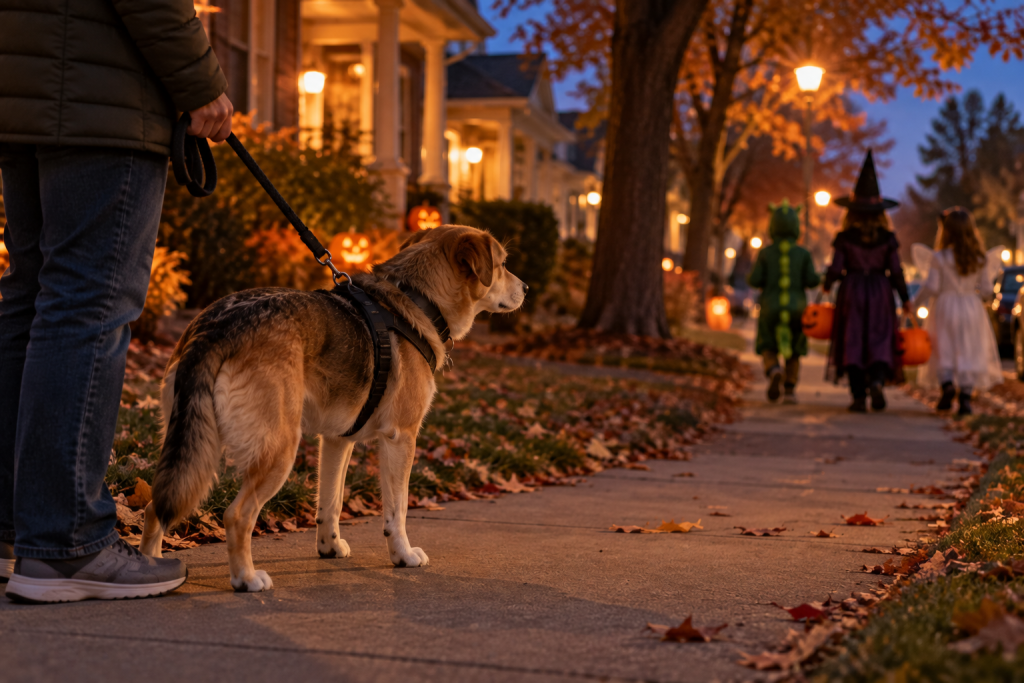
Here’s the complication: almost every one of these signals has an ordinary explanation, too. A dog may pant because of physical activity, heat, excitement, or stress. Yawning may reflect tiredness, but it can also occur in stressful contexts. In fact, a study of 116 dogs found that lip licking increased when unfamiliar people approached in direct or threatening ways—but it also appeared during friendly greetings (Firnkes et al., 2017).
So no single signal proves your dog is stressed—not even ears pulled back or a crouched posture. Instead, read signals in context: look for several together, and for a change from your dog’s normal self on a normal walk. Even then, they’re a reason to pay closer attention, not a diagnosis.
2. People can miss those signals
Recognizing those signals is harder than it sounds. In one study, more than 2,000 people watched videos of unfamiliar dogs and judged whether each was happy or fearful. Nearly everyone identified the happy dogs. Correct identification of fear, however, varied widely across groups, from about 30% among people who had never owned a dog to more than 70% among experienced dog professionals (Wan, Bolger & Champagne, 2012).
That asymmetry matters on Halloween. If a happy dog is easy to recognize and a fearful one isn’t, it’s easy to mistake a dog who is tolerating the night for one who is enjoying it. That’s our interpretation—the study didn’t measure tolerance—but it’s the trap this section is meant to help you avoid.
A survey of 1,190 Italian dog owners points in the same direction. Asked which behaviors could indicate stress, more owners picked obvious ones like trembling and whining than subtle ones like looking away, turning the head, yawning, or nose licking. The researchers suggested that “few owners are able to correctly interpret and intervene in early stages of stress” (Mariti et al., 2012).
3. An adult has to watch—and decide
Teaching kids what to look for helps. The research suggests, however, that it can’t replace an adult.
In a study using photographs of dogs’ facial expressions, 67% of the 4-year-olds misunderstood aggressive dog faces, and mistaking them for “happy” was the most common error. The adults in the study made very few such errors (Meints & Racca, 2025). Photos aren’t a real sidewalk, of course, but the gap is hard to ignore.
In another study, children aged 3 to 5 and their parents were taught to interpret dogs’ distress signals using videos. The children improved at recognizing some of the more obvious warning signals, but showed no real improvement on subtle ones. By contrast, the parents improved substantially on those subtle signals (Meints, Brelsford & De Keuster, 2018).
In other words, reading the dog is the job of the adult holding the leash, not the child holding the candy bag.
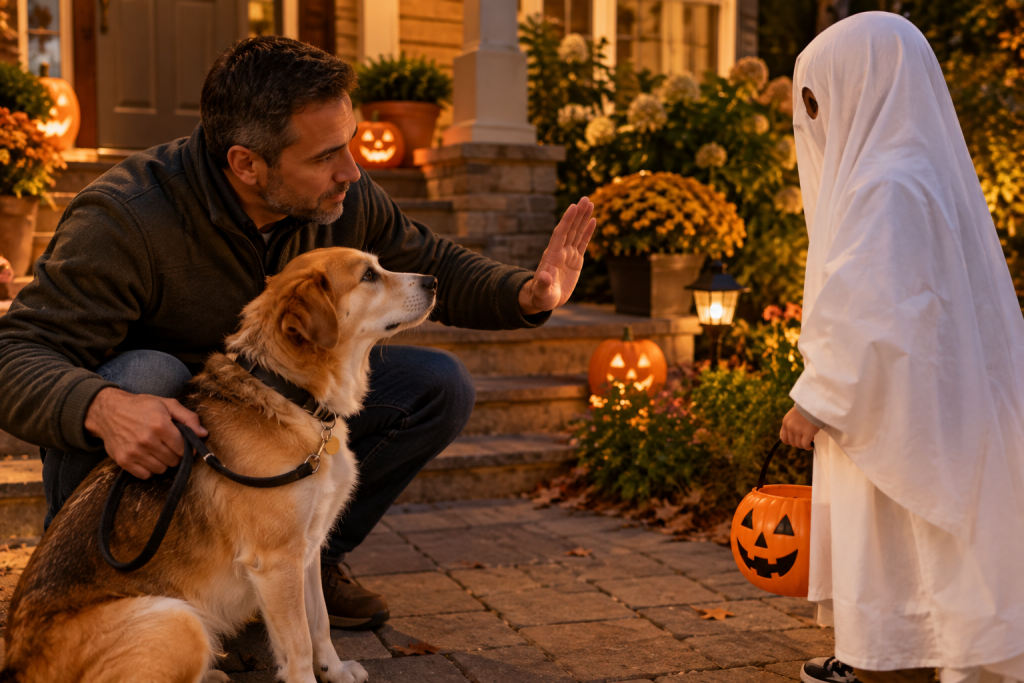
Even for adults, knowledge has limits. In a study of more than 1,400 dog owners, training improved their ratings of fear in unfamiliar dogs shown in videos. However, it didn’t change how they rated fear in their own dogs on a standard questionnaire, and the researchers called for more work to explain why (Flint et al., 2018). That doesn’t mean owners misread their own dogs. It does mean that learning the signals isn’t a guarantee—so watch with some humility, not just confidence.
At a Glance: What the Research Shows—and What It Doesn’t
| Study | What it looked at | What it found | What it can’t tell you |
|---|---|---|---|
| Beerda et al., 1998 | Dogs exposed to stressors in a laboratory | A very low posture alongside a rise in cortisol with sudden stressors; restlessness, yawning, and lip licking with milder ones | How a dog responds on a Halloween street; the signals depend on context |
| Gähwiler et al., 2020 | 36 dogs on a fireworks night vs. a quiet evening | Ears pulled back was most strongly associated with fireworks; more movement and panting | Whether trick-or-treating has the same effect |
| Firnkes et al., 2017 | 116 dogs approached by unfamiliar people | More lip licking with direct or threatening approaches | That lip licking means stress—it also appeared during friendly greetings |
| Wan, Bolger & Champagne, 2012 | More than 2,000 people judging videos of unfamiliar dogs | Nearly everyone identified happy dogs; correct identification of fear ranged from about 30% to more than 70% by experience | Whether a dog is tolerating or enjoying an activity—it didn’t measure tolerance |
| Mariti et al., 2012 | 1,190 Italian dog owners asked which behaviors could indicate stress | More owners picked obvious signs than subtle ones | What owners actually notice in their own dogs |
| Meints & Racca, 2025 | Children and adults judging photos of dogs’ faces | 67% of the 4-year-olds misunderstood aggressive faces; adults made very few such errors | How anyone reads a real dog on a real sidewalk |
| Meints, Brelsford & De Keuster, 2018 | Children aged 3 to 5 and their parents, taught with videos | Children improved on some obvious warning signals but not subtle ones; parents improved substantially on subtle ones | That children can be relied on to spot subtle signals |
| Flint et al., 2018 | More than 1,400 dog owners, with and without training | Training improved ratings of fear in unfamiliar dogs in videos | That owners misread their own dogs—training didn’t change their own-dog ratings, and the reason is unclear |
If your dog will wear a costume on the walk
Purdue’s veterinary specialists also discourage pet costumes, warning that tight ones “may restrict the pet’s movements, sight, hearing or even breathing,” and that oversized ones “can increase a pet’s risk of tripping, catching a limb or claw or falling.” Instead, they suggest simpler options like fitted holiday collars or bandanas (Purdue Veterinary Medicine).
If you still plan to take your dog trick-or-treating in a costume, treat it as two decisions. A dog comfortable in an outfit at home may respond differently among strangers, noise, and unfamiliar surroundings.
So try the costume before Halloween, including on an ordinary walk, and ask:
- Can my dog walk, sniff, turn its head, see, and breathe normally?
- Do the leash, harness, and ID tag still fit and stay visible?
- Can I still see my dog’s ears and posture?
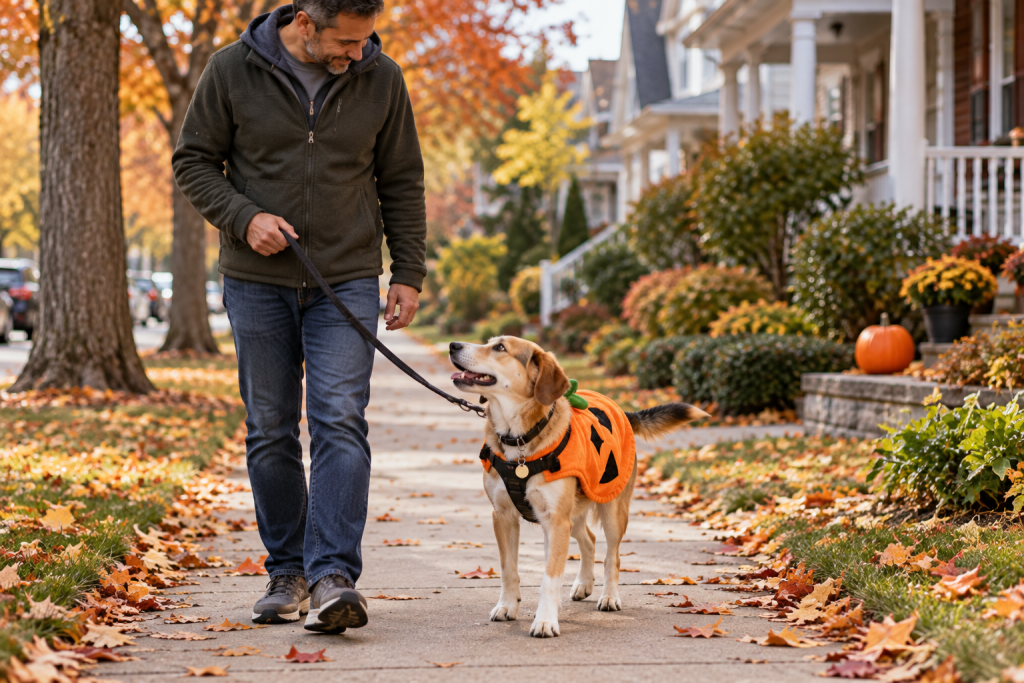
That last question matters more than it seems. Ears pulled back and a crouched posture are among the signals described above, and they’re exactly what a hood or full-body costume can cover. That’s our reasoning rather than a research finding. Even so, a costume that hides your dog’s body language also hides your best reason to turn around.
Temperature matters, too. A Texas A&M veterinarian warns that on a warm evening, a thick costume may put a dog “at higher risk of heat stroke,” which “could be exacerbated if your pet gets excited and overheated when trick-or-treating” (Texas A&M). The concern is greater for dogs already vulnerable to heat, such as flat-faced breeds, older or overweight dogs, and dogs with respiratory or heart conditions (Cornell). Still, the actual risk depends on the garment, the weather, the activity, and the individual dog.
If your dog is struggling with the costume itself, remove it in a safe place; the RSPCA lists signs such as “difficulty moving normally (including ‘freezing’)” and “struggling to remove the costume” (RSPCA). If discomfort continues without it, end the outing.
But don’t treat that as a waiting period. If your dog is generally distressed, trying to escape, or refusing to continue, end the outing rather than waiting to see whether removing the costume solves the problem.
Heavy panting together with weakness, confusion, or collapse is different again. Cornell’s veterinary college describes heatstroke as “a medical emergency”: start cooling your dog with water and get veterinary care right away (Cornell). Removing the costume and walking home isn’t enough.
This sequence is our synthesis of veterinary guidance, not a tested safety protocol. Passing every check doesn’t guarantee your dog will be comfortable.
At a Glance: Costume Trouble, General Distress, or Emergency?
| What you see | What to do | Based on |
|---|---|---|
| Your dog is struggling with the costume itself—difficulty moving normally, freezing, or trying to get it off | Remove the costume in a safe place. If discomfort continues without it, end the outing. | RSPCA guidance; the sequence is our synthesis |
| Your dog is generally distressed, trying to escape, or refusing to continue | End the outing. Don’t wait to see whether removing the costume solves the problem. | Our synthesis of veterinary guidance |
| Heavy panting together with weakness, confusion, or collapse | Start cooling your dog with water and get veterinary care right away. Removing the costume and walking home isn’t enough. | Cornell (heatstroke is a medical emergency) |
Before you go, and when to turn back
With or without a costume, the ASPCA recommends that a dog out after dark wear a reflective collar, be securely leashed, and have proper identification (ASPCA).
Two more choices help. Keep the outing short, and give one adult a single job—the dog—because nobody can fully watch a dog, a child, and a street crossing at once. (For crossings, see our guide to Halloween street crossings; for visibility, our guide to Halloween costume visibility.)
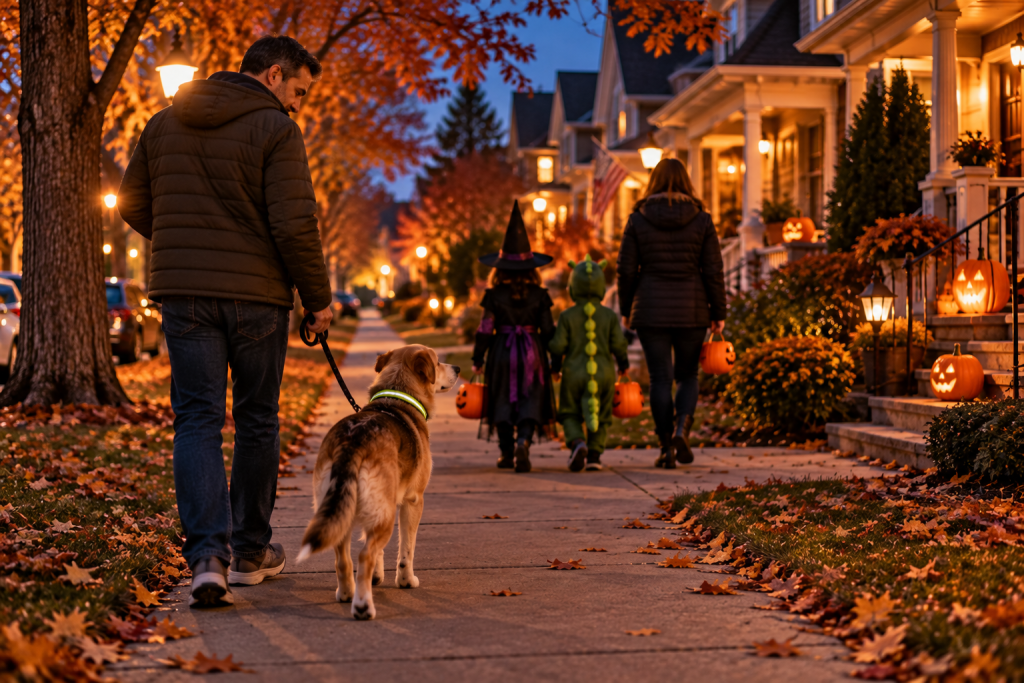
Then decide, in advance, what will end the outing.
The AVMA advises: “If your dog seems uneasy, remove them from the situation to reduce the risk of biting” (AVMA). Purdue’s list for dogs out trick-or-treating includes refusing to walk, attempting to escape, trembling, panting, drooling, growling, barking, snapping, or biting—and if any appear, “it’s best to head home right away” (Purdue Veterinary Medicine).
The question to ask on the sidewalk isn’t “Is my dog barking or growling?” It’s “Is my dog still comfortable—and how would I know if it weren’t?” If you’re unsure, that uncertainty is itself a reason to head home.
Three Ways to Celebrate Without Forcing Participation
None of this means your pet has to miss Halloween. It means choosing the version that fits. These are editorial options, not scientifically validated categories.
1. Limited participation at home. For a pet that enjoys familiar company. It can join a quiet family moment—a movie, a dinner, a photo it doesn’t resist—but stays away from the busiest visitor periods, and can leave whenever it wants.
2. A short, supervised outing. For a dog already comfortable with similar environments on ordinary days, with or without a costume it already tolerates well. Keep it brief, assign one adult to the dog, and settle the exit plan before you leave—without debating whether everyone has enough candy.
3. No Halloween participation. For a pet that finds visitors, noise, or disruption difficult. It stays in a familiar, protected space, with no expectation of joining the celebration. This isn’t a punishment; it’s the choice that respects what this animal needs.
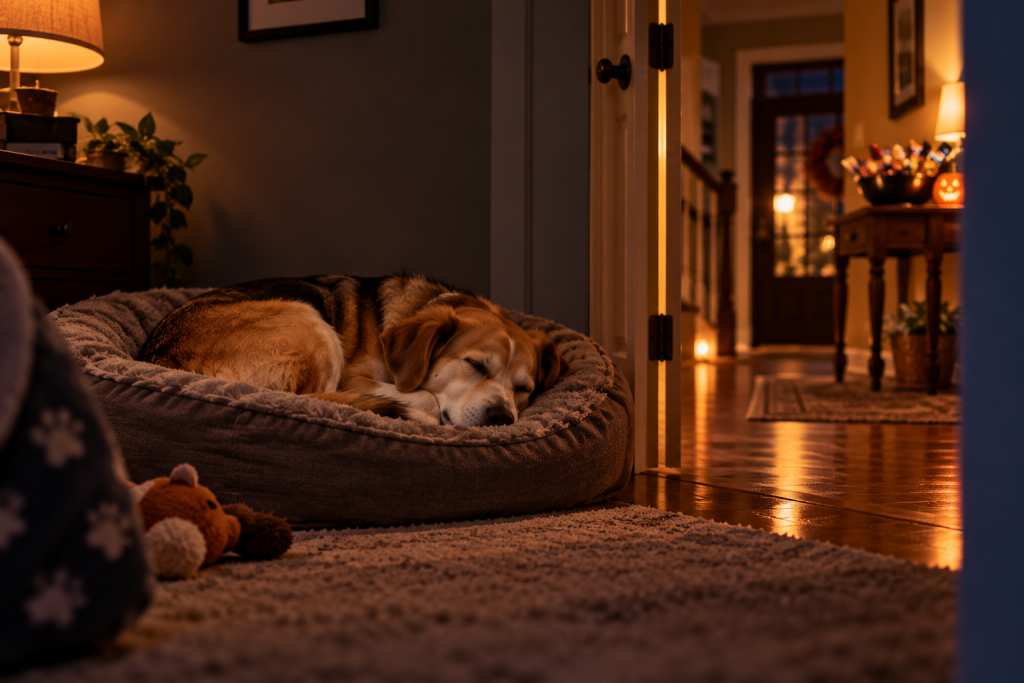
As Dr. Pike noted in that NEWStat article, safety and comfort are highly individual (AAHA NEWStat).
So think back to the dog at the door, ears back and very still. You may not know yet whether he’s enjoying the night or enduring it. But you now know what to watch for—and that the best Halloween for him might be the one he sleeps through.
Sources
- ASPCA. Halloween Safety Tips. ASPCA. Link.
- ASPCA. Your Guide to a Pet-Safe Halloween. ASPCA. Link.
- ASPCA. ASPCA Animal Poison Control Center. ASPCA. Link.
- American Veterinary Medical Association. Halloween pet safety. AVMA. Link.
- American Veterinary Medical Association. Preventing dog bites. AVMA. Link.
- Purdue University College of Veterinary Medicine (2025). Trick-or-Treat without the stress: Tips to keep your pets safe this Halloween. Purdue Veterinary Medicine News. Link.
- AAHA NEWStat (2024). Behavioral cues signal whether your pet is spooked by Halloween fun (interview with Amy L. Pike, DVM, DACVB). American Animal Hospital Association. Link.
- Texas A&M College of Veterinary Medicine & Biomedical Sciences (2021). Finding the Purr-fect Pet Halloween Costume (Dr. Lori Teller). Pet Talk. Link.
- RSPCA Australia (2024). What are the animal welfare issues with pets wearing costumes? RSPCA Knowledgebase. Link.
- Cornell University College of Veterinary Medicine. Heatstroke: A medical emergency. Riney Canine Health Center. Link.
- Salonen, M., et al. (2020). Prevalence, comorbidity, and breed differences in canine anxiety in 13,700 Finnish pet dogs. Scientific Reports. Link.
- Reisner, I. R., Shofer, F. S., & Nance, M. L. (2007). Behavioral assessment of child-directed canine aggression. Injury Prevention, 13(5), 348. Link.
- Beerda, B., et al. (1998). Behavioural, saliva cortisol and heart rate responses to different types of stimuli in dogs. Applied Animal Behaviour Science, 58(3–4), 365–381. Link.
- Gähwiler, S., Bremhorst, A., Tóth, K., & Riemer, S. (2020). Fear expressions of dogs during New Year fireworks: a video analysis. Scientific Reports, 10, 16035. Link.
- Firnkes, A., Bartels, A., Bidoli, E., & Erhard, M. (2017). Appeasement signals used by dogs during dog–human communication. Journal of Veterinary Behavior, 19, 35–44. Link.
- Maxwell, M. (2017). Understanding Canine Facial Expressions and Body Postures. Article on the American Veterinary Society of Animal Behavior website. Link.
- Wan, M., Bolger, N., & Champagne, F. A. (2012). Human perception of fear in dogs varies according to experience with dogs. PLOS ONE. Link.
- Mariti, C., et al. (2012). Perception of dogs’ stress by their owners. Journal of Veterinary Behavior, 7(4), 213–219. Link.
- Meints, K., & Racca, A. (2025). Look, He’s Smiling! Children’s Misinterpretation of Dogs’ Facial Expressions. Anthrozoös. Link.
- Meints, K., Brelsford, V., & De Keuster, T. (2018). Teaching Children and Parents to Understand Dog Signaling. Frontiers in Veterinary Science, 5, 257. Link.
- Flint, H. E., Coe, J. B., Pearl, D. L., Serpell, J. A., & Niel, L. (2018). Effect of training for dog fear identification on dog owner ratings of fear in familiar and unfamiliar dogs. Applied Animal Behaviour Science, 208, 66–74. Link.
